Before a road trip, fix six things: how many hours you'll drive each day, where you sleep on the nights that could sell out, what the car needs, whose turn it is at the wheel, what paperwork rides in the car, and what you'll do about fuel, tolls and a breakdown. Leave the rest open.
This is for a driving trip of a few days or more, alone or with others. It doesn't plan a route or pick places to see. It's written for U.S. drivers. If you cross into Canada or Mexico, read the border section below, and check the other country's own entry rules.
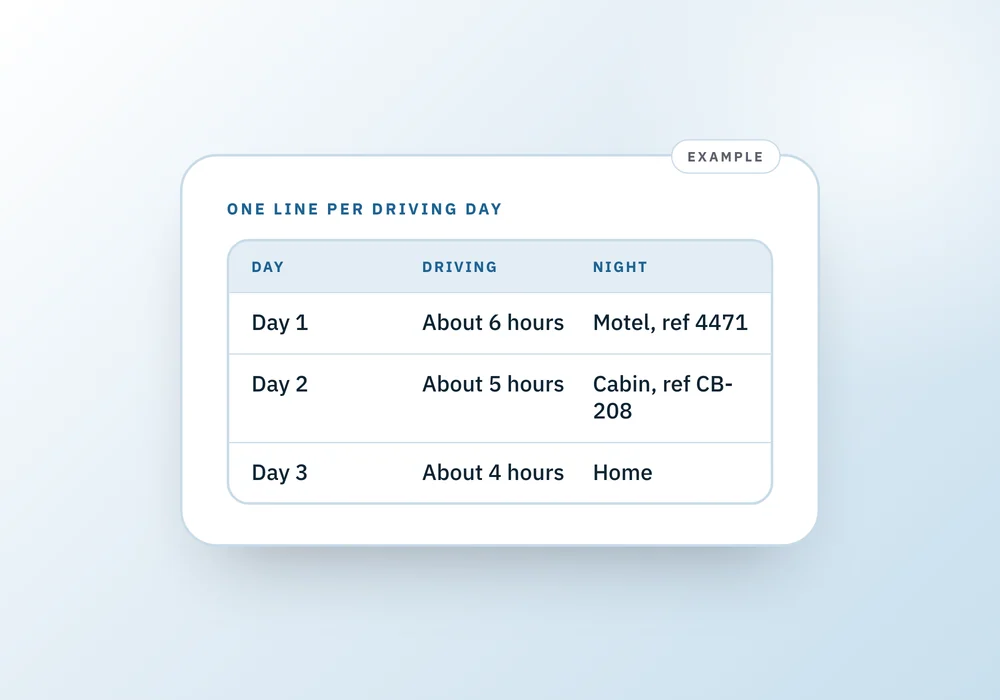
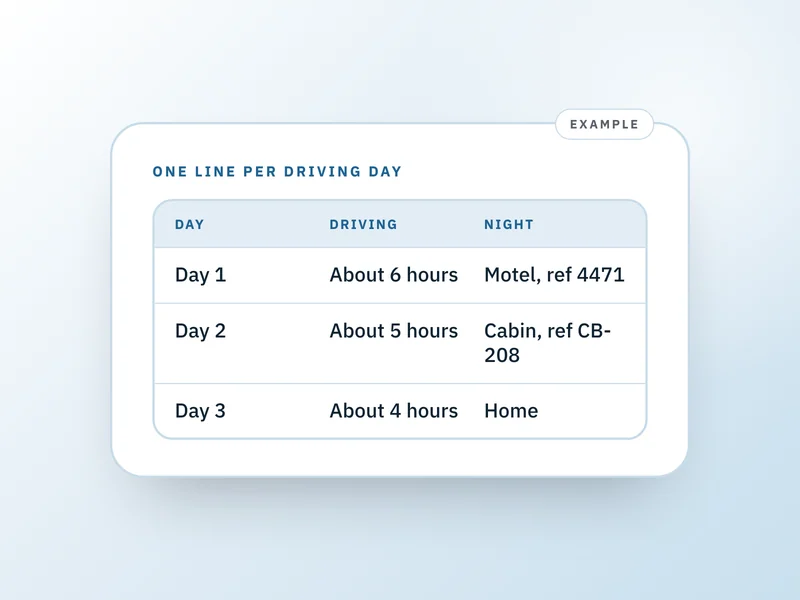
Example: three driving days on one page
An illustration with invented stays. The point is the shape: a cap on hours, stops written down before you leave, and a reference beside every night.
Day 1
- Driving
- About 6 hours
- Stops
- Fuel at 2 hours. Lunch at 4 hours.
- Night
- Motel near the highway
- Reference
- Ref 4471, check-in until 22:00
Day 2
- Driving
- About 5 hours
- Stops
- Fuel and stretch at 2 hours. Trail stop at 3.5.
- Night
- Cabin
- Reference
- Ref CB-208, check-in from 15:00, key box code in the email
Day 3
- Driving
- About 4 hours
- Stops
- Fuel before the last stretch.
- Night
- Home
- Reference
- None
| Day | Driving | Stops | Night | Reference |
|---|---|---|---|---|
| Day 1 | About 6 hours | Fuel at 2 hours. Lunch at 4 hours. | Motel near the highway | Ref 4471, check-in until 22:00 |
| Day 2 | About 5 hours | Fuel and stretch at 2 hours. Trail stop at 3.5. | Cabin | Ref CB-208, check-in from 15:00, key box code in the email |
| Day 3 | About 4 hours | Fuel before the last stretch. | Home | None |
The steps, in order
- Set a daily cap in hours, not miles, and set it lower than you think you can do. Traffic, meals and bathroom stops eat the hours you didn't count. We'd plan around the least rested driver, not the most.
- Write who drives when. Name the driver for each block, not just the day. If only one person is insured or comfortable to drive, that changes your daily cap.
- Decide which nights you can't leave open: a holiday weekend, a small town with one motel, a national park gate. Book those, and write the check-in time and the confirmation reference beside each one. Leave the other nights loose.
- Ask what each booking depends on. A cabin that needs a 22:00 arrival is built on the day's drive. If the first day runs long, the rest of the chain moves, and how to work out what else in your trip is affected shows how to check that.
- Check the car. Tires first: the recommended pressure is on the placard in the driver's door jamb, not the number molded into the tire, and NHTSA says to check tires cold and to check the spare too. Then look at what your owner's manual says is due by miles or months. What is due on my car right now shows how to work that out, and what to keep in your glove box covers the paper.
- Put paperwork in one place you can reach: driver's license, insurance card, registration, and the rental agreement if you're renting. Read the rental terms for mileage limits, additional drivers, and driving out of state, and ask the company anything you can't find.
- Write down the fuel range you have and the longest empty stretch on your route. In a remote area, we'd fill up when the tank is half full rather than wait for the light.
- Look up tolls and parking. If you're renting, ask what the company charges to use its toll device. Find out whether your auto insurer or an auto club includes roadside assistance, and write the number where you'll see it.
- Load the car so tonight's bag is reachable. Pack a small bag for the night so you don't unload everything at every stop.
What to keep within reach
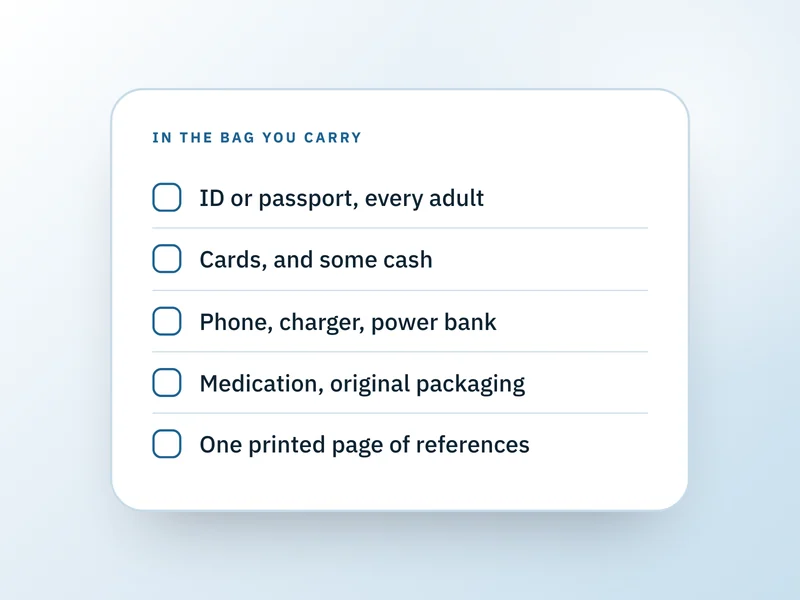
On top of each person's own bag.
6 things to do
Ticks are for this visit only. Nothing here is saved anywhere.
If you're crossing a border
CBP says a U.S. citizen entering by land can present a passport, a passport card, an Enhanced Driver's License or a trusted traveler card (NEXUS, SENTRI or FAST). For a child under 16, a birth certificate or other proof of citizenship is enough. That covers coming back into the U.S. What the other country asks of you on the way in is a separate question, and the State Department's country page and the destination's own entry information answer it. Ask your auto insurer whether your policy covers driving across the border. Don't assume it does.
What goes wrong on a road trip
- The day is longer than the map says, and the 22:00 check-in becomes 01:00, or the room is given away.
- Every night is left open, and the only room left in town is expensive or an hour off the route.
- One person does all the driving because no one wrote down a schedule, and the last afternoon is the dangerous one.
- The tire is soft on the first day, and the spare is flat too.
- The stay's address is only in an email, and there's no signal at the turn.
Where Travel Companion fits
Travel Companion has a starting packing list for a road trip: one item for each traveler and eight shared ones, added only when you press the button, and you can change any of it. It also records the bookings on your route, including a rental car, a hotel or a campsite, with the times and references you type in. If one booking depends on another, you can record that, and when you save a new time it shows what rests on the old one. The itinerary PDF then lists them day by day, with dates such as 8 Oct and 24-hour times. It has no maps, directions or route planning, and it holds one trip at a time. See the Travel Companion page.
The evening before you drive
Run the night-before list once, and print the one page worth having on paper. If kids are coming, packing and planning for a trip with kids or a baby covers how to plan a day around them.
Questions people ask
How many hours should you drive per day on a road trip?
There's no official figure for private drivers, so choose one for your own group. Plan around the driver who tires first, count meals and stops as part of the day, and set the cap lower than you think you can do. Long days also put your check-in at risk, so write the latest arrival time next to each stay.
What should you check on your car before a road trip?
Start with the tires: pressure from the door-jamb placard, checked cold, plus the spare. Then read what your owner's manual says is due by miles or months and look at the date of the last service. If something is due before you get home, do it before you leave.
How often should you stop on a long drive?
Many drivers stop about every two hours, but there's no fixed rule for private drivers. What you're after is alertness, so stop when the driver is getting tired, swap drivers if you can, and pull over safely if you can't keep your eyes open. Plan the first stop before you leave.
Do you need a passport to drive to Canada or Mexico?
Coming back into the U.S. by land, CBP accepts a passport, a passport card, an Enhanced Driver's License or a trusted traveler card, and children under 16 can use a birth certificate. The other country sets its own entry rules, so read its official information and the State Department's page for it before you go.
Should you book every night of a road trip?
Not necessarily. Book the nights that could sell out or leave you stranded, such as holiday weekends and small towns with few rooms, and leave the others open. Write each booking's check-in time and reference beside it, and keep the cancellation terms so a change of plan costs little.
Sources and how we checked
- CBP: Western Hemisphere Travel Initiative: Documents a U.S. citizen can present entering by land, and the under-16 birth certificate rule.Checked 26 September 2026.
- NHTSA: Tires and tire safety: Door-jamb placard, checking tires cold, checking the spare. The page returned 403 to the fetch tool; this comes from search excerpts, so verify before publishing.Checked 26 September 2026.
- U.S. Department of State: International Travel Checklist: Pointer for the destination country's own entry rules. 403 to fetch; from search excerpts.Checked 26 September 2026.
Where to go next
 If this is where you areNight before a trip checklist: the fifteen-minute versionBefore you set off, this short evening list covers the documents, phone and house checks the route does not.
- Packing list for a week away, by person
For the pack itself, this shows how to build a list by person with shared items marked.
- How to plan a group trip (without being the organizer)
Sharing the drive with others? This covers who books what, who is on each booking and where answers live.
- How to write a one-page trip itinerary
Turn the stops and stays into a single page in time order with a reference beside each booking.