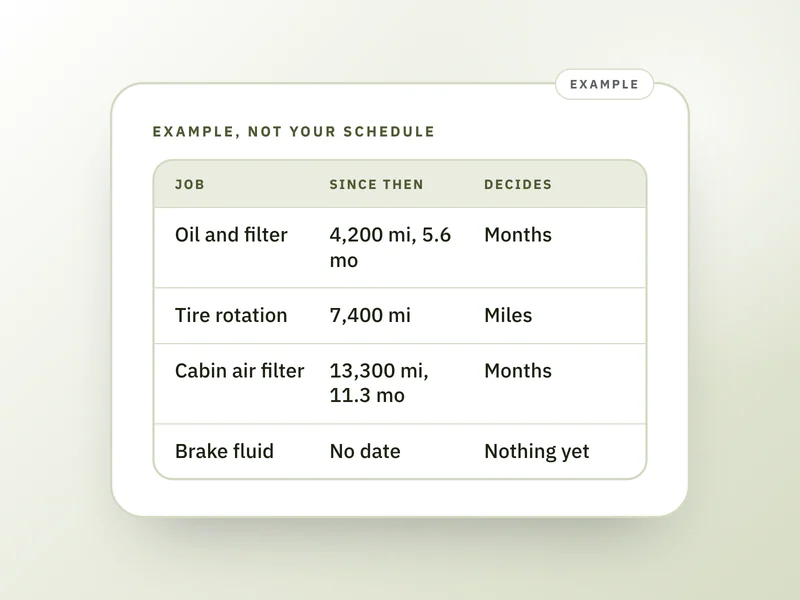
A job is due when you reach its mileage or its months, whichever comes first. Take today's odometer reading, subtract the reading when the job was last done, count the months since that date, and compare both to the intervals in your owner's manual. The one that's closer to its limit decides.
This is for a car you drive in miles, with a manual or a maker's schedule to hand. It can't tell you what your car's intervals are, and it can't judge a job that has no date behind it. For that, start with a recorded date, even a rough one you label as rough.
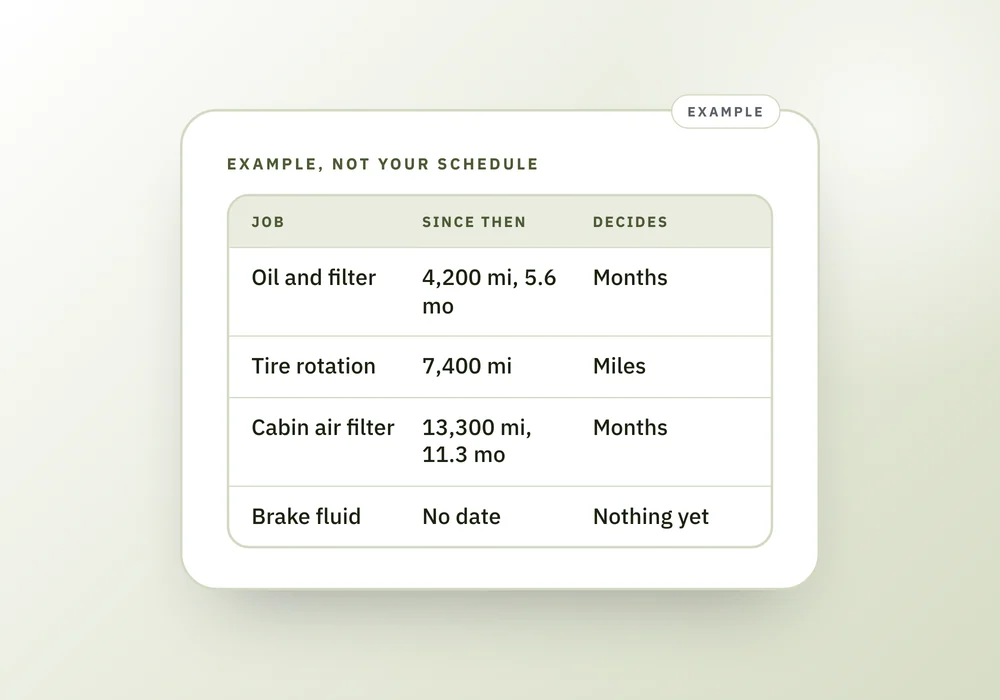
An example: four jobs on one car
Say it's August 20, the odometer reads 52,300, and these are the intervals and last-done facts. They're an illustration, not your car's schedule.
Engine oil and filter
- Interval
- 5,000 mi or 6 mo
- Last done
- Mar 3, at 48,100
- Since then
- 4,200 mi, 5.6 mo
- What decides
- Months: due about Sep 3
Tire rotation
- Interval
- 7,500 mi
- Last done
- Jan 15, at 44,900
- Since then
- 7,400 mi
- What decides
- Miles: about 100 left
Cabin air filter
- Interval
- 15,000 mi or 12 mo
- Last done
- Sep 10 last year, at 39,000
- Since then
- 13,300 mi, 11.3 mo
- What decides
- Months: due about Sep 10
Brake fluid
- Interval
- 24 mo
- Last done
- Not recorded
- Since then
- Unknown
- What decides
- Nothing to judge yet
| Job | Interval | Last done | Since then | What decides |
|---|---|---|---|---|
| Engine oil and filter | 5,000 mi or 6 mo | Mar 3, at 48,100 | 4,200 mi, 5.6 mo | Months: due about Sep 3 |
| Tire rotation | 7,500 mi | Jan 15, at 44,900 | 7,400 mi | Miles: about 100 left |
| Cabin air filter | 15,000 mi or 12 mo | Sep 10 last year, at 39,000 | 13,300 mi, 11.3 mo | Months: due about Sep 10 |
| Brake fluid | 24 mo | Not recorded | Unknown | Nothing to judge yet |
Reading the example
Look at the oil line. Only 4,200 of 5,000 miles are used, so it feels early. But 5.6 of 6 months are gone, so the months limit is the one that's about to be reached. A car that sits in a driveway most of the week hits the months first. A car that does a long commute hits the miles first.
The brake fluid row is the one to notice. No date means no answer, and a guessed date would give a false one. Leave it blank and say so, then find out the real date or start the clock from the next time it's done.
The method, five steps
- Find the intervals. Your owner's manual lists each job by miles, by months, or both. Many manuals also have a second, shorter schedule for severe driving, such as towing, mostly short trips, heavy dust or extreme heat or cold. If that's how you drive, use the shorter one. This guide shows where to look in the manual.
- Write down when each job was last done and the odometer reading at the time. A receipt, a sticker on the windshield or a shop's records can supply it. If you did it yourself, your own note does.
- Read the odometer today. Write the number down beside the date, because the answer is only as good as this reading.
- Subtract. Today's miles minus the last-done miles is the distance since. Count the months from the last-done date to today.
- Compare each to its interval. Whichever is further along its limit is the one that decides, and it tells you how much is left. If both are past, it's due now.
- If the manual gives only miles or only months for a job, use the one it gives. Don't invent the other.
When the answer is wrong
- The odometer reading is stale. If you last looked three weeks ago and you drive a lot, every miles figure is low. Look again before you decide anything.
- There's no last-done date. Don't fill it in from memory of "about last spring". Mark the job as unknown, and either check with the shop that did it or treat the next service as day one. If you bought the car without records, this covers where to look.
- You drive in hard conditions and used the normal schedule. The severe-duty schedule usually comes round sooner, so the job you think is fine may be due.
- The manual and the shop disagree. Shops sometimes suggest sooner intervals than the maker does. You can ask them to show you why for your car, and it's your call. What's due by the maker's schedule and what a shop recommends are two different questions, so keep them apart in your notes.
- You have more than one car. The sum is the same, but the notes get mixed. Keeping each car's jobs on its own line avoids doing the arithmetic on the wrong odometer.
Questions people ask
How do I know when my car is due for service?
Compare two numbers for each job: the miles driven since it was last done and the months elapsed since then. Check both against the intervals in your owner's manual. The job is due when either limit is reached. If you have no record of when it was last done, you can't tell yet.
Is it miles or months, whichever comes first?
When a manual gives both, yes. The job comes due at whichever limit you reach first. Someone who drives little may reach the months limit while the odometer has barely moved, and a heavy driver reaches the miles first. If the manual gives only one, use that one.
What if I don't know when something was last done?
Don't guess a date. Write down that it's unknown. Then either ask the shop that serviced it, look for a receipt, or treat your next service as the starting point. A job with no date can't be called overdue, because there's nothing to measure from.
Where do I find my car's maintenance schedule?
In the owner's manual, usually in a section on maintenance or service. Most makers also post manuals on their owner websites, searchable by year and model. If you drive under severe conditions, look for a separate schedule for that.
How often should I check what's due?
Whenever you fill the tank is too often for most jobs, but every month or two is reasonable, and always right after the odometer passes a round number. A shorter habit is to check when you record a new job, since the reading is already fresh in your mind.
Where the Companion fits
Vehicle Maintenance Companion does the subtraction from the numbers you enter. You type each job's interval in miles, months or both, and when it was last done, and its Due view lists what's due across every car you own, most urgent first. It says so plainly when nothing is due. A job with no recorded date shows as nothing to judge yet, never as overdue. It works in miles only, and it uses your intervals, not a factory schedule. It also asks you to update the mileage once it's more than 30 days old, because the answer depends on it.
Where to go next
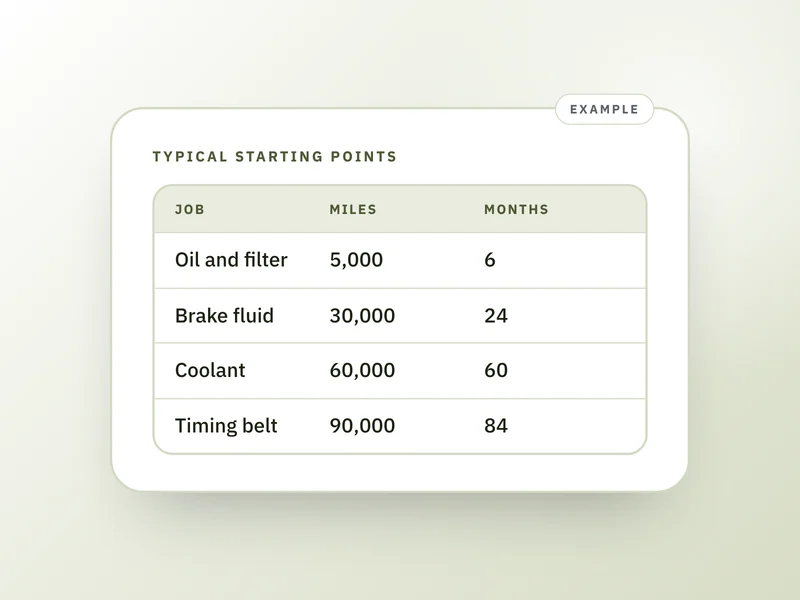 If this is where you areCar maintenance schedule by mileage: check your manualOnce you know what is due, this shows how to pull the mileage and month intervals for your own car from the manual.
- Car maintenance log: what to write down
Keep the dates and odometer readings this answer depends on in a running log, one line per job.
- Winter car prep checklist: what to check before frost
Heading into cold weather, this lists the battery, tire and wiper checks worth doing before the first frost.
- How to track car registration and insurance renewals
Registration and insurance have due dates too, and this shows how to track them alongside the service jobs.