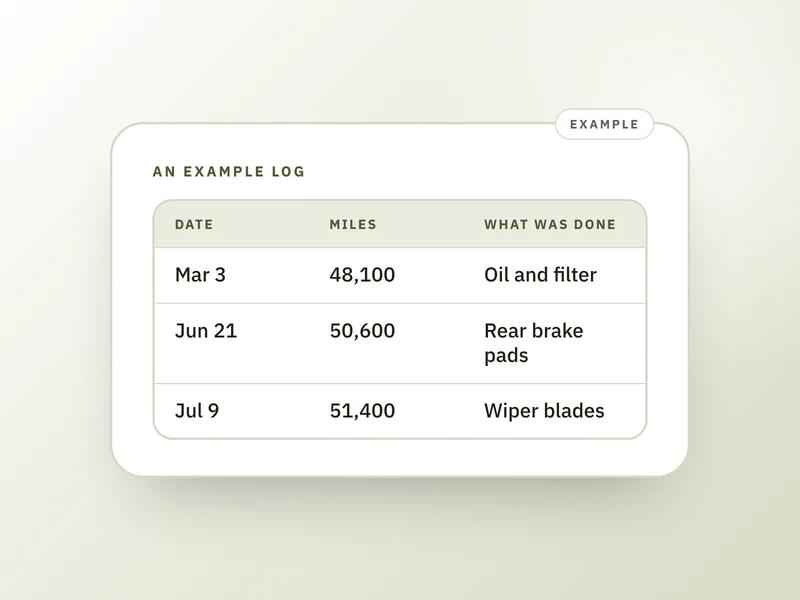
Every line of a car maintenance log needs three things: the date, the odometer reading in miles, and what was done in plain words. Who did it and what it cost are worth adding but optional. A line like "Mar 3, 48,100 mi, oil and filter change" is a complete entry.
This is for a car you want to keep a record of, in a notebook, a spreadsheet or an app. It can't fill in the past for you, and it isn't a schedule: the log says what happened, and your owner's manual says how often it should.
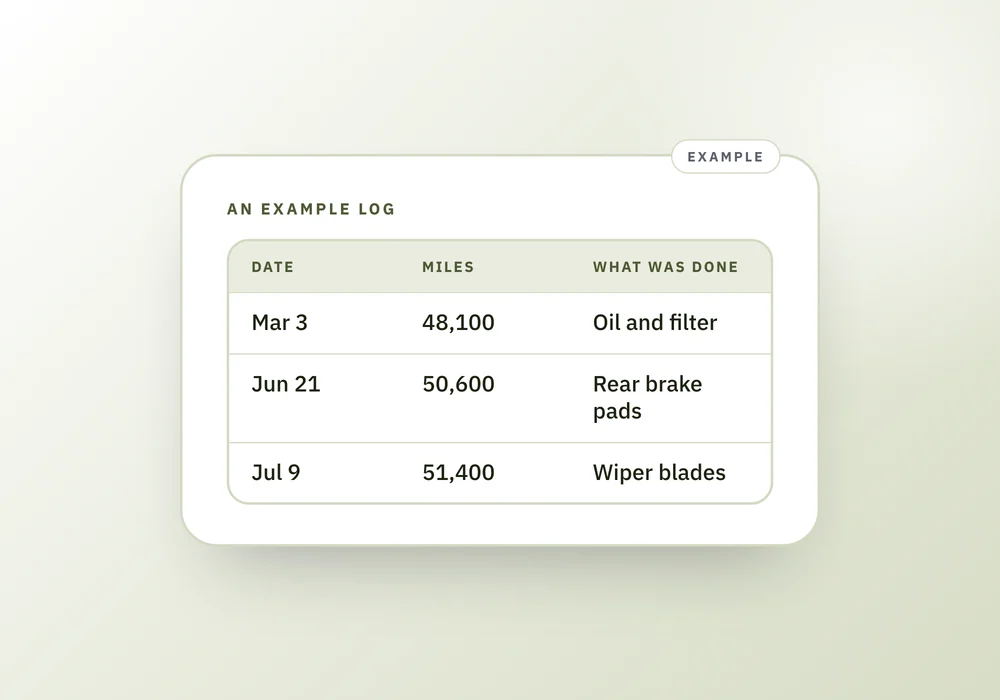
An example log
A filled-in sample with made-up entries, so you can see what a good line looks like.
Mar 3
- Miles
- 48,100
- What was done
- Oil and filter change
- Who
- Main Street Garage
- Cost / note
- $74. 0W-20, filter part on receipt
Mar 3
- Miles
- 48,100
- What was done
- Tire rotation
- Who
- Main Street Garage
- Cost / note
- Included
Jun 21
- Miles
- 50,600
- What was done
- Replaced rear brake pads
- Who
- Kwik Brakes
- Cost / note
- $310. Rotors measured fine
Jul 9
- Miles
- 51,400
- What was done
- Replaced wiper blades
- Who
- Me
- Cost / note
- $26. Both front
Aug 2
- Miles
- 52,000
- What was done
- Battery replaced after a slow start
- Who
- Main Street Garage
- Cost / note
- $165. Old one was 5 years old
| Date | Miles | What was done | Who | Cost / note |
|---|---|---|---|---|
| Mar 3 | 48,100 | Oil and filter change | Main Street Garage | $74. 0W-20, filter part on receipt |
| Mar 3 | 48,100 | Tire rotation | Main Street Garage | Included |
| Jun 21 | 50,600 | Replaced rear brake pads | Kwik Brakes | $310. Rotors measured fine |
| Jul 9 | 51,400 | Replaced wiper blades | Me | $26. Both front |
| Aug 2 | 52,000 | Battery replaced after a slow start | Main Street Garage | $165. Old one was 5 years old |
Why those columns
The dates and miles are what make it useful. Everything in the last two columns is a bonus, and you can leave them out when you're in a hurry. A line with a date, a mileage and three words beats a beautiful log you stopped keeping.
What goes on each line
- Date. The day the work was done, not the day you got the bill.
- Miles. The odometer at the time. If you forget to look, use the number on the receipt, which shops usually print.
- What was done. Plain words: "replaced front brake pads", not "brakes". If a part matters, name it.
- Who did it. A shop name or "me". It helps when you have a question later.
- Cost or note. What it cost, or anything you'd want to remember, like an oil grade or a part number. Costs are optional and you can leave them out.
What else is worth writing
- Repairs, not just scheduled jobs. A brake job after a squeal or a battery after a bad morning is often the line a next owner reads first.
- Jobs you did yourself, with the same three facts.
- Tire changes and rotations, since they're easy to forget when you last did them.
- What a mechanic found, even if you didn't act on it: "Rear tires near wear limit, told to watch." It's a dated fact.
- Oil grade and filter part number in the note, if you'll want to buy the same one again.
What to leave off
- A guess about the past. "About last year" isn't a date. Leave the job blank and start from the next one you do.
- Things you meant to do. "Brakes need doing" is a reminder, and belongs somewhere else. The log records what happened.
- A gap you'd rather hide. If something was done and it doesn't look great, leave it in. A buyer reads gaps, and a full log with a repair on it is easier to trust than a tidy one.
- Anything about you: your address, account numbers, your VIN plate. The car's record doesn't need them.
Where to keep it
Keep the receipts, and photograph each one the day you get it. A photo in a folder titled with the car's name is enough. The log is the summary, and the receipt is the proof.
A notebook works if it lives in the glove box. A spreadsheet works if you open it. What doesn't work is a log in two places, because one of them goes stale. Pick one, and update it the same day as the job. Ten seconds at the counter beats an evening of reconstruction.
Questions people ask
What should be in a car maintenance log?
A date, the odometer reading in miles and a plain description of what was done on every line. Who did the work and what it cost are worth adding but optional. Repairs and one-off jobs belong alongside scheduled ones, since a log is a record of what happened.
How do I start a log for a car I already own?
Start with today: the odometer, the date and anything you know for certain. For older work, add only what you have a receipt or a reliable date for. Mark everything else unknown, and don't backfill guesses. If the car came without records, this helps.
Is a paper log or an app better?
Whichever you'll update the same day. A notebook in the glove box is fine, and so is a spreadsheet. What matters is one place and the habit, not the tool. Keep photos of receipts wherever you keep the log.
Do I need to log oil changes and tire rotations?
Yes. They're the most common jobs and the easiest to lose track of. Each takes one line. The date and mileage are what let you work out what's due next.
Does a log help when I sell the car?
A dated log lets a buyer see how the car was looked after, though it's your own record and not proof. Receipts stapled to it help. Here's how to present it.
Where the Companion fits
Vehicle Maintenance Companion keeps each service with its date, mileage, who did it, an optional cost and a note, grouped by year with the newest first. You can log a service that was never a tracked job, such as a repair. Draftpace doesn't sell a blank log template: the Service record printout is made from what you've entered, and there's no export or photo upload, so keep the receipts wherever you already do.
Where to go next
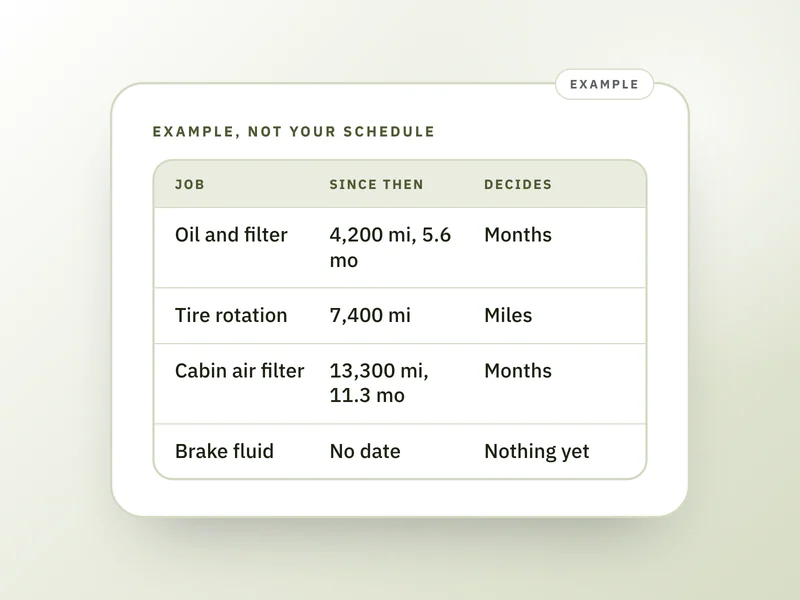 If this is where you areHow to know what maintenance your car is due forWith a log in hand, this shows how to read it against your intervals and see what is due now.
- Car maintenance schedule by mileage: check your manual
Pull the intervals from your owner's manual so each log line has a date and mileage to aim for.
- Selling your car: how to present your service history
When the car changes hands, this turns your log into a service history a buyer can read.
- Bought a used car with no service records? What to do
If the car came with no paperwork, this explains how to begin a record from the day you get it.