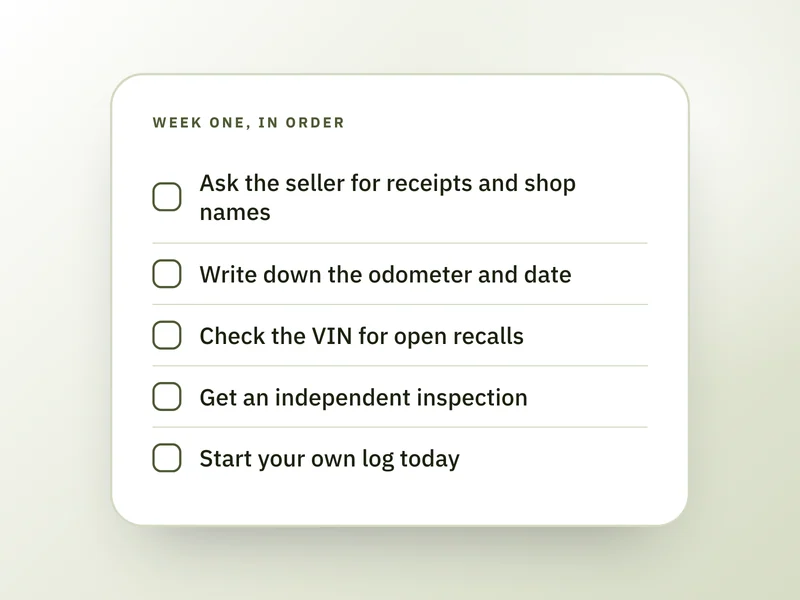
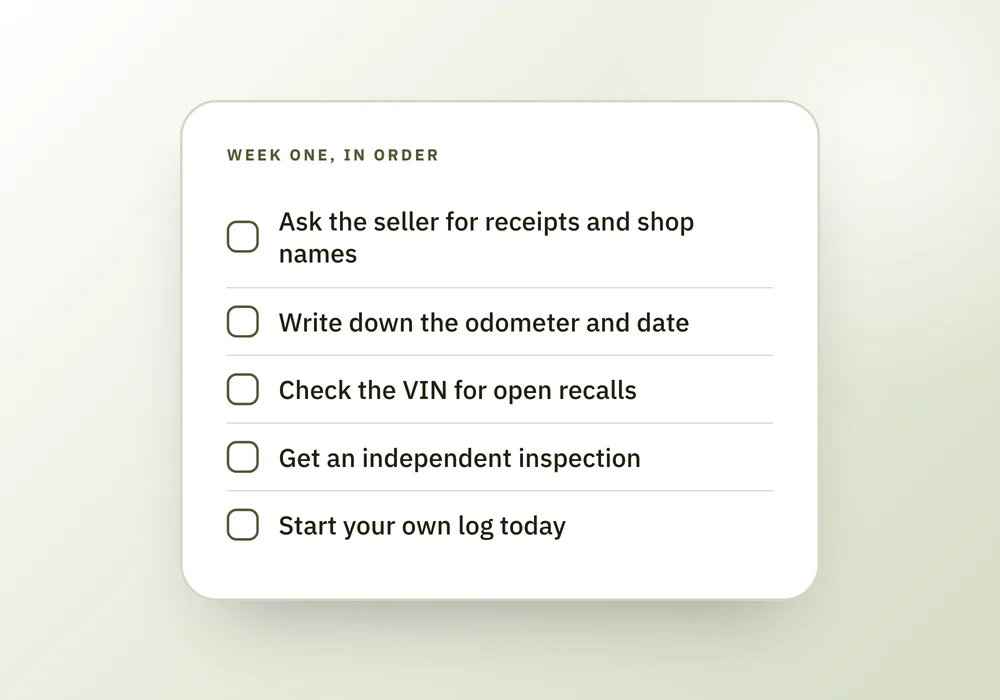
Start with the seller: ask what they remember and whether any receipts exist, then read the odometer and write it down with today's date. Next, have an independent mechanic look the car over, check it for open recalls by VIN, and start your own record from today. Don't assume it was serviced, and don't assume it wasn't.
This is for someone in the United States who already owns a used car with no paperwork, or is about to. It can't tell you what was done to the car, and nothing here is a mechanical diagnosis.
What to ask the seller
If you haven't bought yet, ask before you pay. If you have, ask anyway, in a text so the answer is in writing.
Pick the one you are facing
“Do you have receipts, an invoice folder or notes on anything done to it, even oil changes?”
“Which shop or dealership did you use? I'd like to ask them what they have on file.”
“Do you remember when the brakes, tires or timing belt were last done, even roughly?”
“Did it come with anything from the previous owner, or do you know who they were?”
“Is there anything you know about that I should watch for?”
Where a service history can turn up
None of these is certain. Each is worth one phone call or one lookup.
The seller
- What it can give you
- Receipts, a folder, a remembered date, a shop name
- What it can't
- Anything they can't remember
The shop they name
- What it can give you
- Work they did, if they'll look it up by the car
- What it can't
- Work done anywhere else
A dealer for the brand
- What it can give you
- Some can look up a VIN for warranty and recall work
- What it can't
- Work done by independent shops
A vehicle history report
- What it can give you
- Title, salvage and insurance loss records, sometimes accidents
- What it can't
- Whether the oil was ever changed
NHTSA recall lookup
- What it can give you
- Open safety recalls, by VIN
- What it can't
- Routine maintenance
Your own inspection
- What it can give you
- What the car looks like today
- What it can't
- What happened before
| Where | What it can give you | What it can't |
|---|---|---|
| The seller | Receipts, a folder, a remembered date, a shop name | Anything they can't remember |
| The shop they name | Work they did, if they'll look it up by the car | Work done anywhere else |
| A dealer for the brand | Some can look up a VIN for warranty and recall work | Work done by independent shops |
| A vehicle history report | Title, salvage and insurance loss records, sometimes accidents | Whether the oil was ever changed |
| NHTSA recall lookup | Open safety recalls, by VIN | Routine maintenance |
| Your own inspection | What the car looks like today | What happened before |
The lookups worth doing
The FTC is plain about the middle of that table: a vehicle history report won't identify mechanical problems, so it advises paying an independent mechanic to inspect the car, even when a dealer calls it certified, and asking for a written report with cost estimates and the VIN on it. NHTSA offers a free recall lookup by VIN at its recalls page, and an open recall is repaired at no cost.
If you're still deciding whether to buy, do these before the sale. If you've bought, they still apply, and the inspection is now your baseline.
The first week, in order
- Read the odometer and write down the number and the date. That's day one.
- Record what the seller said, marked as what they said: "Seller says timing belt done around 90,000 miles, no receipt." A receipt you've seen is a different kind of fact. Keep the two labeled differently.
- Look up the VIN for open recalls and run any history report you want.
- Get the owner's manual. If it's missing, the maker's owner website usually has a copy by year and model. It tells you how often each job comes round. Here's how to read it.
- Take it to an independent mechanic and ask what they see: tires, brakes, fluids, belts, leaks. Write down what they say, and what it costs if they quote a job. What to tell them first.
- Decide job by job. For oil and filter, coolant, brake fluid, tires and belts, choose one of three: do it now, check it now, or wait for a real date. You're allowed to do nothing about a job, as long as you write down that you chose to.
- Start your log with these lines and add to it whenever something's done. Here's the format.
An example first entry, invented for illustration
Say the odometer is 84,000 and the seller has no records. You write: "Bought Sep 12, 84,000 mi. Seller says oil changed 'regularly', no receipts. Timing belt: unknown." You get a $200 inspection and the mechanic reports the tires are at the wear limit and the fluid is dark. You write those down, decide to change the oil and coolant now, and leave the belt as unknown until you can check the interval in the manual.
That entry is small, but it's dated and it says what you knew. In two years it's the start of the history you wished you'd been handed.
What can go wrong
- Assuming the worst and paying for a full service of everything at once. You may be replacing fluid that was changed last month.
- Assuming the best and doing nothing. A car with no paper is a car you can't see into, and the risk is yours.
- Writing down a date you don't have. "About two years ago" isn't a fact. Write "unknown" and move on.
- Treating a history report as a service log. It records title and insurance events, not oil changes.
- Doing all of this months later. The seller's memory fades fast, and the shop may stop answering.
Questions people ask
Is a car with no service history bad?
Not by itself. Plenty of well-kept cars have no paper, because nobody wrote it down. It does mean you can't see what was done, so an independent inspection matters more, and the price should reflect that risk. It's a reason to look harder, not to walk away automatically.
How do I find a used car's service history?
Ask the seller for receipts and the names of shops they used, then ask those shops what they have on file. A dealer for the brand may be able to look up warranty and recall work by VIN. A history report shows title events, not routine maintenance.
What should I do first after buying a used car with no records?
Record the odometer and date, check the VIN for open recalls, and get an independent mechanic's look. Then decide job by job whether to do it now or wait, and start your own log so the next owner has something.
Should I change everything right away?
Not automatically. Decide each job separately: oil and filter, brake fluid, coolant, tires, belts. Some are cheap enough that doing them now makes sense. Others are better checked than replaced. Ask the mechanic what they see.
Can I check a used car for recalls?
Yes. NHTSA has a free lookup on its recalls page: enter the 17-character VIN, found on the lower left of the windshield or inside the driver-side door. An open recall is repaired at no cost by a dealer for that brand.
Where the Companion fits
Vehicle Maintenance Companion lets you mark a vehicle's history as unknown from the change screen for that vehicle. After that, no job reads as overdue on a fact you never had. Each job waits at nothing to judge yet until you record when it was last done, and the same is true of any job with no date, on any car. Once you have real dates from the shop, the seller or your own next service, you enter them and the Due view starts working from them.
Sources and how we checked
- Buying a Used Car From a Dealer (FTC Consumer Advice): History report does not show mechanical issues; independent inspection, even for certified cars; written report with cost estimates and VIN.Checked 26 September 2026.
- Check for Recalls (NHTSA): VIN recall lookup, free repair of open recalls. Page blocked automated fetch; content confirmed from search results only.Checked 26 September 2026.
Where to go next
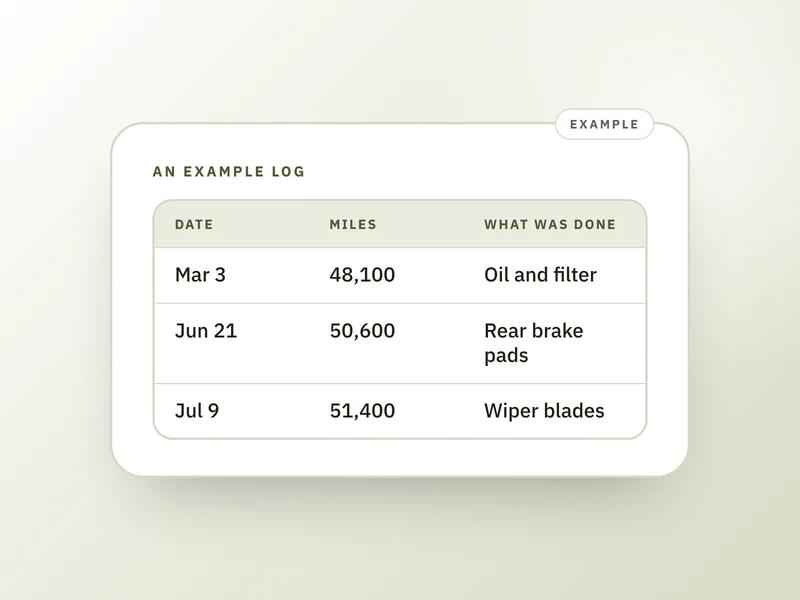 If this is where you areCar maintenance log: what to write downStart your own record today: this lays out the columns and what to write on each line.
- Car maintenance schedule by mileage: check your manual
With no history to go on, find your manual's intervals and write them down using this guide.
- How to know what maintenance your car is due for
Work out what is probably due now, working from the miles and the date you bought the car.
- First car checklist: what to do in the first week
Use the first-week checklist to get the manual, papers and glove box sorted in one pass.