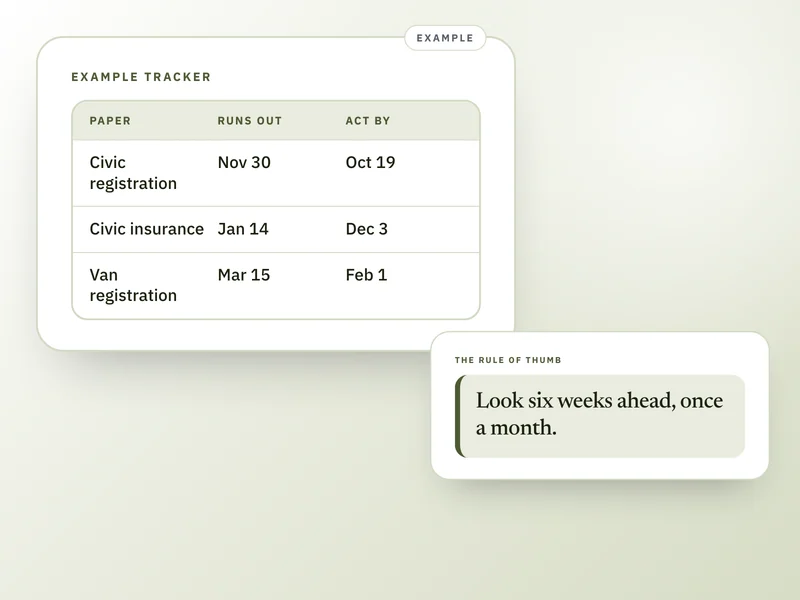
For each car, write down four things on the day a new paper arrives: what it is, the date it runs out, where the paper is, and how it renews. Look at the list once a month and act on anything inside six weeks. That covers registration, insurance, inspection and a warranty.
This is for US drivers who want the dates in one place. It can't tell you what your state requires, how much a renewal costs, or when a lapse becomes a violation. Those live with your state motor vehicle agency and your insurer, and this isn't legal advice.
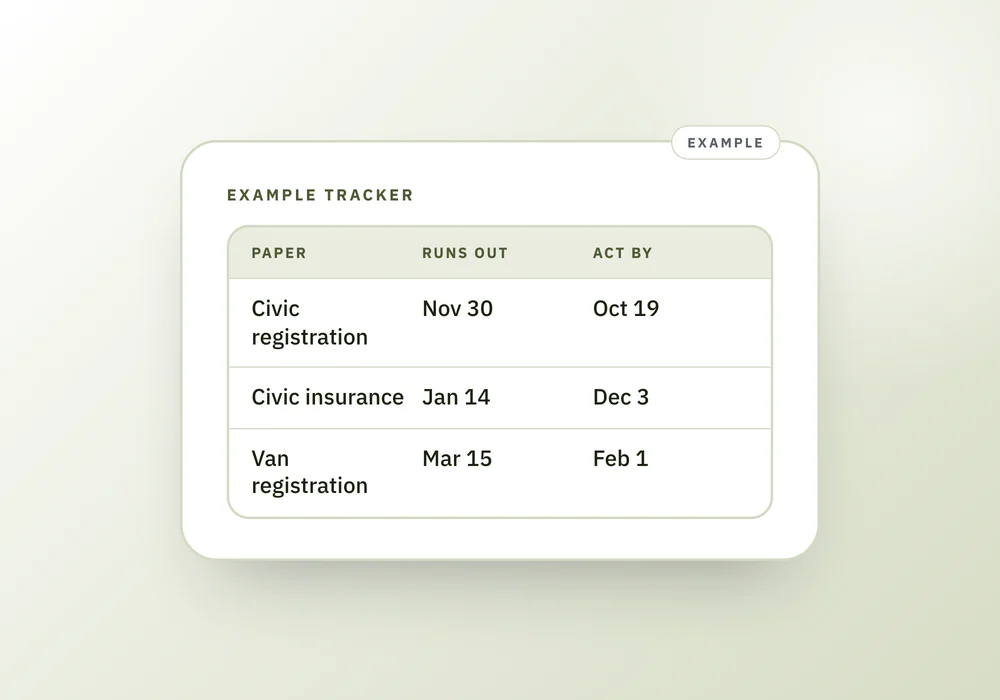
Example: two cars, six papers
Say a household has two cars. This is what the list looks like the week the newest paper comes in. Every date and name is made up. The right column is the date to act by: six weeks before the date, so a mailed form, a payment or an inspection appointment has room.
A filled tracker (example, made-up dates)
Civic, registration
- Runs out
- Nov 30
- Where the paper is
- Glove box and folder
- Act by
- Oct 19
Civic, insurance
- Runs out
- Jan 14
- Where the paper is
- Folder, and app on phone
- Act by
- Dec 3
Civic, inspection
- Runs out
- Feb 28
- Where the paper is
- Sticker, report in folder
- Act by
- Jan 17
Van, registration
- Runs out
- Mar 15
- Where the paper is
- Glove box
- Act by
- Feb 1
Van, insurance
- Runs out
- Jan 14
- Where the paper is
- Folder
- Act by
- Dec 3
Van, warranty
- Runs out
- Apr 1 or 60,000 mi
- Where the paper is
- Folder
- Act by
- Feb 18
| Car and paper | Runs out | Where the paper is | Act by |
|---|---|---|---|
| Civic, registration | Nov 30 | Glove box and folder | Oct 19 |
| Civic, insurance | Jan 14 | Folder, and app on phone | Dec 3 |
| Civic, inspection | Feb 28 | Sticker, report in folder | Jan 17 |
| Van, registration | Mar 15 | Glove box | Feb 1 |
| Van, insurance | Jan 14 | Folder | Dec 3 |
| Van, warranty | Apr 1 or 60,000 mi | Folder | Feb 18 |
How to set it up
- Put the paper in front of you: registration card or renewal, insurance policy or card, any inspection report, the warranty booklet.
- For each one, copy the end date printed on it. For insurance, that's the end of the policy term, not the date the bill is due.
- Write where the paper lives, in words you'd understand in a hurry ('kitchen drawer, blue folder').
- Write how it renews: mailed notice, online at your state's site, or automatic. Note the card on file if it's automatic.
- Subtract six weeks from each date and put that in your calendar or on the list as the act-by date.
- When a renewal comes through, write the next date that day, while the new paper is in your hand.
One renewal, week by week
Six weeks is our rule of thumb, not a legal one. Some renewals take a day and some take a month.
Six weeks out
Look for the notice. If none has come, find out why: an old address, a different insurer, an email in spam.
Four weeks out
Start the renewal. Book an inspection if your state needs one.
Two weeks out
Renewal should be paid or in the mail. If not, treat it as urgent.
The day it runs out
Check the new paper is in hand. Put the old one in the recycling.
The same day
Write the next date on the tracker.
Which dates go on the list
Registration
- What the date is
- The expiry on the card or the sticker
- Watch for
- A renewal notice sent to an old address
Insurance
- What the date is
- The end of the policy term, often six or twelve months
- Watch for
- A bill due date that is not the term date
Inspection
- What the date is
- The date on the sticker or report, if your state has one
- Watch for
- Some states ask for none. Check yours.
Warranty
- What the date is
- Years or miles, whichever comes first
- Watch for
- The miles, which move as you drive
Anything else
- What the date is
- A parking permit, a toll tag, a roadside plan
- Watch for
- One-off dates that nobody else is tracking
| Paper | What the date is | Watch for |
|---|---|---|
| Registration | The expiry on the card or the sticker | A renewal notice sent to an old address |
| Insurance | The end of the policy term, often six or twelve months | A bill due date that is not the term date |
| Inspection | The date on the sticker or report, if your state has one | Some states ask for none. Check yours. |
| Warranty | Years or miles, whichever comes first | The miles, which move as you drive |
| Anything else | A parking permit, a toll tag, a roadside plan | One-off dates that nobody else is tracking |
Where this goes wrong
Most renewals slip for boring reasons. A move means the mailed notice goes to your old address, so update your address with your state's motor vehicle agency and your insurer at the same time. A switched insurer means a new term date, so change the tracker the day you switch. An automatic renewal fails when the card on file expires. Two cars with dates in the same month get treated as one job and one of them gets missed.
Insurance and registration are also linked in many places, and a lapse in one can cause trouble with the other. How that works differs from state to state, so look it up in yours instead of assuming. For the wider habit of catching yearly bills before they arrive, see why you keep missing bill due dates.
Related lists
Service jobs are on a different clock, by miles and months, and belong beside these dates. What is due on my car right now shows how to read them. Once the dates are tracked, what to keep in your glove box covers which papers ride in the car. With two cars, two cars, one household helps keep the sets apart, and a buyer will ask to see current papers, as selling your car with a service history explains.
Questions people ask
How far ahead should I renew my car registration?
There's no single rule, and your state may have its own window. We'd start looking six weeks before the date, because a mailed notice, an inspection or a fee can each take time. Your state's motor vehicle site, found through USA.gov, says when renewal opens and what it needs.
Where do I find my car insurance renewal date?
On your policy declarations page or your insurer's app, as the end of the policy term. That can differ from your bill due date. Your insurer usually sends a renewal notice before the term ends, so if none arrives, call and ask.
Do I need to keep track of both registration and insurance?
Yes. They come round on different dates, are handled by different offices, and can affect each other. Put each on its own line with its own date, and write where each paper lives.
Can my state send me a renewal reminder?
Many states offer email or text reminders, and most mail a notice. Sign up on your state's motor vehicle site if it offers one. Don't rely on it alone, since notices go to old addresses and spam folders.
What if I just moved?
Update your address with your state's motor vehicle agency and your insurer, since a renewal notice goes to whatever address is on file. Rules on how soon you must change it differ by state, so check yours. Then update the tracker's 'where the paper is' line.
Doing it in the Companion
Vehicle Maintenance Companion has a Paperwork screen for this. You pick registration, insurance, inspection, warranty or another date, type the date, and note where the paper is. Nothing is uploaded, and it never says what any place requires. A date shows on the Due screen from 45 days out, or once it has passed. Reminders are off until you switch them on. If you do, you get one notice two weeks ahead and one on the day, on that device. A date already past is not reminded.
Sources and how we checked
- USA.gov, State motor vehicle services: Where to find your state's registration and inspection rulesChecked 26 September 2026.
- LegalClarity, Which states allow electronic proof of insurance: Digital insurance cards and where paper still helpsChecked 26 September 2026.
Where to go next
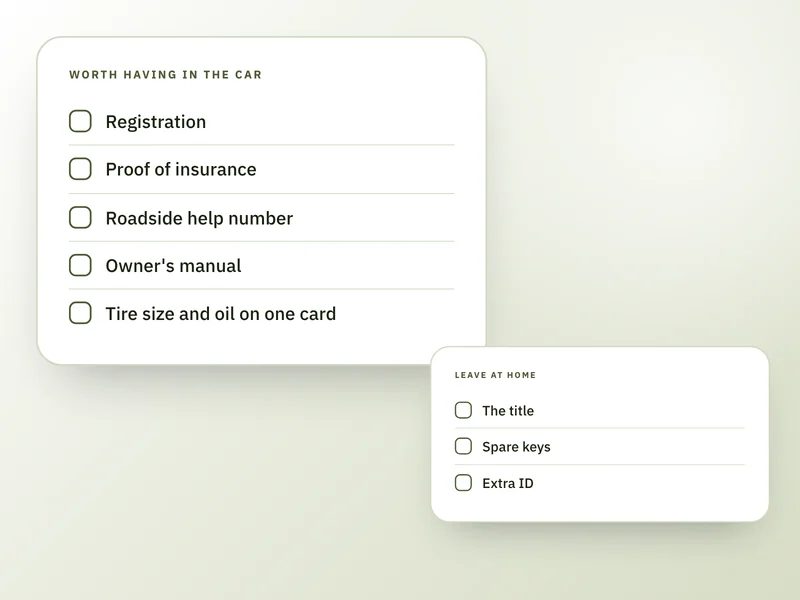 If this is where you areWhat to keep in your glove box (and what to leave home)Once the dates are tracked, this shows which papers to carry in the car and which to keep at home.
- How to keep track of maintenance on two cars
Running two cars doubles the renewals, and this keeps them from getting mixed up.
- Selling your car: how to present your service history
When it is time to sell, this shows how to present the papers and service history to a buyer.
- How to know what maintenance your car is due for
Renewals sit beside service jobs, and this shows how to see what is due by miles and months.