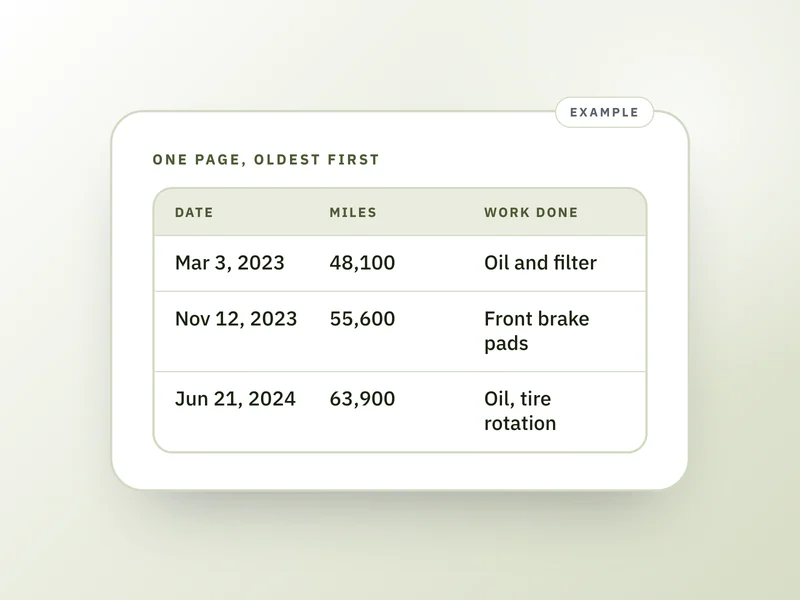
Give the buyer one page: every service in date order, the odometer reading at each, what was done and who did it, with the receipts you kept in a folder behind it. Say at the top that it's your own record, and say where it starts. Print it before you list the car, so the first question gets answered by paper.
This is for a private sale in the United States. It can't tell you what the record will do to your price, and it doesn't cover the title, bill of sale or odometer statement, which your state's motor vehicle agency sets. It isn't legal advice.
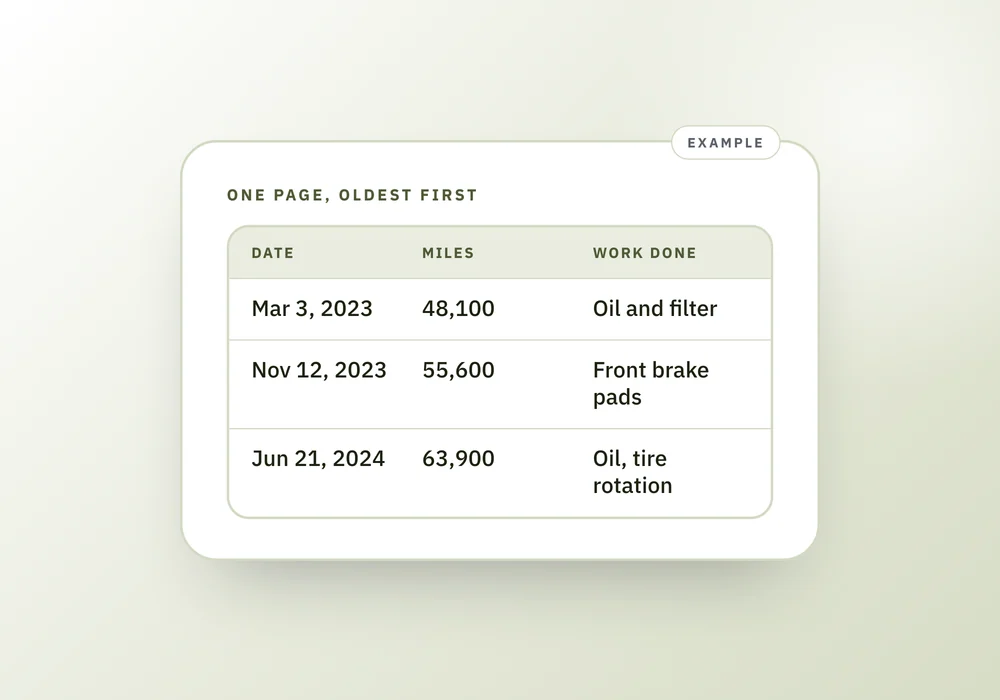
An example: the one page, filled in
Say you're selling a 2018 sedan you bought at 41,000 miles. These entries are made up to show the shape. Note that the page begins where your own knowledge begins, and says so.
Bought at 41,000 miles. No earlier record.
- Miles
- 41,000
- Work done
- Nothing recorded before this date
- By
- Cost
Mar 3, 2023
- Miles
- 48,100
- Work done
- Oil and filter
- By
- Main Street Garage
- Cost
- $74
Nov 12, 2023
- Miles
- 55,600
- Work done
- Front brake pads and rotors
- By
- Kwik Brakes
- Cost
- $412
Jun 21, 2024
- Miles
- 63,900
- Work done
- Oil and filter, tire rotation
- By
- Main Street Garage
- Cost
- $96
Jan 8, 2025
- Miles
- 70,200
- Work done
- New battery after a slow start
- By
- Main Street Garage
- Cost
- $165
| Date | Miles | Work done | By | Cost |
|---|---|---|---|---|
| Bought at 41,000 miles. No earlier record. | 41,000 | Nothing recorded before this date | ||
| Mar 3, 2023 | 48,100 | Oil and filter | Main Street Garage | $74 |
| Nov 12, 2023 | 55,600 | Front brake pads and rotors | Kwik Brakes | $412 |
| Jun 21, 2024 | 63,900 | Oil and filter, tire rotation | Main Street Garage | $96 |
| Jan 8, 2025 | 70,200 | New battery after a slow start | Main Street Garage | $165 |
Why the gap line is worth writing
A record that starts at 48,100 miles on a car showing 71,000 leaves a buyer to guess at the rest. A line that says "no earlier record" answers the question before it's asked. Skipped repairs are the other temptation. Leave in the brake job and the battery, because a buyer who reads a record with the messy parts left out learns to distrust the tidy ones.
How to put the page together
- Collect what exists. Check the glove box, your email for shop receipts and invoices, and your bank statements for garage names. A shop that has serviced the car can usually print its own history if you ask.
- Write one line per job, oldest first: date, odometer, what was done, who did it. Add the cost if you know it. If you did a job yourself, write "Me" and what parts you used.
- Mark the gaps. Where you don't know, write "not recorded" instead of guessing a date. See how to keep the record complete as you go.
- Put the receipts behind the page in the same order as the lines, so the buyer can check one against the other.
- Read the last line against your odometer today. If the last service was long ago, add today's date and mileage at the bottom.
- Print two copies. One goes to the buyer or lies on the seat during a test drive, and one stays with you.
What a record you kept yourself can and can't show
- What you say was done, and when
- How regularly the car was looked after
- That you have nothing to hide about repairs
- Where the paper backing is
- That the work was done well
- Anything that happened before you owned it
- That a job was done to the maker's schedule
- The car's condition today
It can show
- What you say was done, and when
- How regularly the car was looked after
- That you have nothing to hide about repairs
- Where the paper backing is
It can't show
- That the work was done well
- Anything that happened before you owned it
- That a job was done to the maker's schedule
- The car's condition today
What to say when the buyer asks
Short answers, said plainly, tend to read better than long ones.
Pick the one you are facing
“Yes. One page with dates, mileage and who did the work, and the receipts I kept are behind it. It's my own record, not a shop's.”
“I bought it at 41,000 miles and there was nothing on paper before that. The page says so at the top.”
“I did that one myself. I wrote down the date, the mileage and the part I used, but I don't have a receipt.”
“Yes, go ahead. Tell me when suits you and I'll have the page and receipts with the car.”
When it doesn't help
A record doesn't replace an inspection, and a careful buyer will want an independent mechanic to look at the car anyway. The FTC's own advice to used-car buyers is to ask for exactly that and to get a vehicle history report. The FTC's Used Car Rule, with its window sticker, covers dealers rather than private sellers, so in a private sale what you say and hand over is the whole disclosure. A history report also shows title and accident events, not oil changes, so the two documents answer different questions.
A pile of receipts with no page on top is hard to use. If you're short of time, write the page and skip the folder. If you're short of records, write the page and say what's missing. If you bought the car with nothing, start with this guide for a used car with no service records.
Get the other papers ready at the same time
Service history is one page. The buyer will also ask about the title, the registration and whether the car has a loan on it. Find out from your state's motor vehicle agency what the transfer needs, and clear out the glove box before the handover. Car paperwork dates covers the renewal side, and the glove box guide covers what stays with the car and what doesn't.
Questions people ask
Do service records increase resale value?
They give a buyer something to check, which can make the car easier to sell and the price easier to defend. We can't give you a figure for how much, and we haven't found a source we'd trust for one. Treat a record as a way to answer questions, not a promise of a higher price.
What service records should I give a buyer?
One page listing each job by date, odometer reading, work done and who did it, plus the receipts you kept, in the same order. Include repairs, not only scheduled service. If part of the history is missing, say where the record begins.
Can I sell a car with no service history?
Yes. Plenty of cars are sold that way. Say so plainly, write down what you do know, such as when you bought it and what you've done since, and expect the buyer to want an inspection. Price it as a car with no proof, not as one with a full history.
Should I get a vehicle history report before selling?
It can help, because a buyer will probably run one. It shows title, ownership and reported accident events, and it mostly doesn't show routine maintenance, so it won't replace your own page. Look at the report before the buyer does, in case something on it needs an explanation.
Do I need a shop stamp on the record?
No. A record in your own hand is still your own record, and a stamp doesn't change that. What adds weight is a receipt or a shop invoice for individual jobs, so keep those. Where a shop can print its own history for the car, attach that too.
Where the Companion fits
Vehicle Maintenance Companion keeps each service with its date, mileage, who did it, an optional cost and a note. When you're ready to sell, its Service record makes a printout of everything entered for one vehicle, oldest first, with your plate and VIN if you've typed them in. The page says it's your own record, not a dealer or shop history, and that nothing on it was checked against a receipt. Costs print as plain numbers with no currency symbol, and the page is sized A4, so look at the print preview if you're printing on Letter paper. A closed vehicle's record can still be printed after the car is gone. There's no photo upload, so the receipts stay wherever you keep them.
Sources and how we checked
- Federal Trade Commission, Dealer's Guide to the Used Car Rule: The Used Car Rule applies to dealers, not private sellers; buyers are advised to get an independent inspection and a vehicle history report.Checked 26 September 2026.
Where to go next
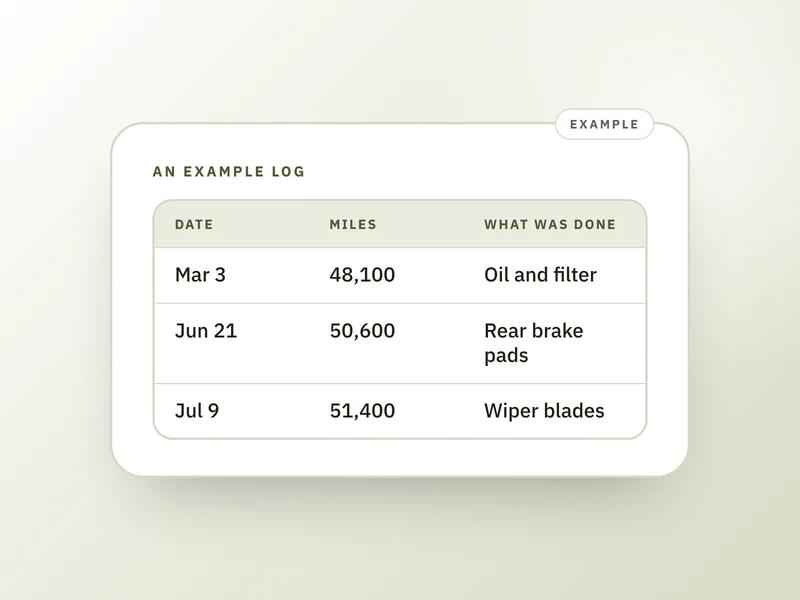 If this is where you areCar maintenance log: what to write downBefore you hand anything over, this shows how to keep the record complete: date, miles and what was done.
- How to track car registration and insurance renewals
Gather the registration, insurance and inspection papers a buyer will ask to see at the same time.
- Bought a used car with no service records? What to do
Buying rather than selling, this covers what to do when the car arrives without any service history.
- What to keep in your glove box (and what to leave home)
Clear out the glove box before the handover and decide which papers stay with the car.