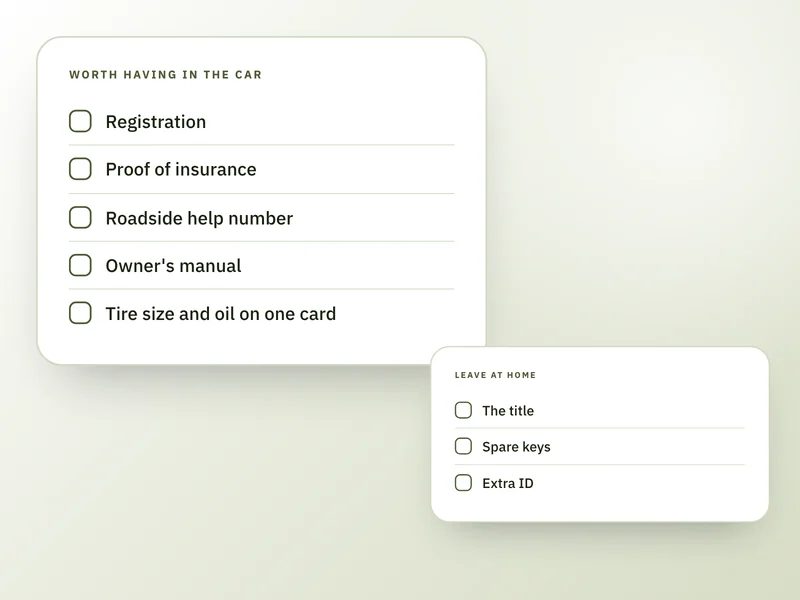
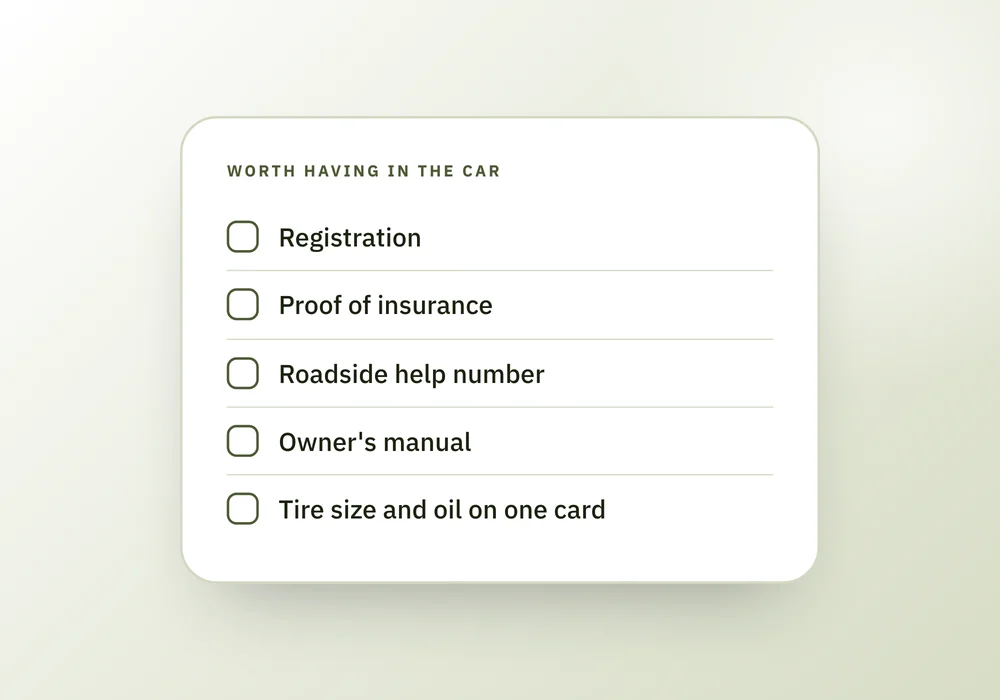
Keep your registration, proof of insurance, a roadside help number, the owner's manual and a card with your tire size and oil type in the glove box. Leave the title, spare keys and anything you would not want a stranger to read at home. Bulky safety gear goes in the trunk.
This is for a car you drive every day in the US. It can't tell you what your state requires you to carry, because that changes by state, and it isn't legal advice. Your state motor vehicle agency is the source for that one item.
Example: one card instead of a folder
Here is a filled card, made up from start to finish. The plate, the numbers and the insurer are invented, and two lines are left blank on purpose. A card like this replaces a folder of papers when you need a number fast: at the shop counter, on the phone with your insurer, or on the shoulder waiting for a tow.
Fill yours by hand, or from a record you already keep.
A glove box card, filled in (example, not real numbers)
8 of 8 rows shown
Registration plate
- Example entry
- 7ABC123
VIN
- Example entry
- Blank (see the trade-off below)
Tire size
- Example entry
- 205/55 R16
Oil
- Example entry
- 5W-30
Mileage, with the date
- Example entry
- 48,200 on Sep 1
Insurer
- Example entry
- Example Mutual
Policy number
- Example entry
- Blank, or written in
Roadside help number
- Example entry
- 800-555-0142
| Line on the card | Example entry |
|---|---|
| Registration plate | 7ABC123 |
| VIN | Blank (see the trade-off below) |
| Tire size | 205/55 R16 |
| Oil | 5W-30 |
| Mileage, with the date | 48,200 on Sep 1 |
| Insurer | Example Mutual |
| Policy number | Blank, or written in |
| Roadside help number | 800-555-0142 |
What is worth having in the car, and why
Ask of each item: would I be stuck without it in the next ten minutes, on the side of a road? If yes, it earns the space.
Registration
- Why it earns the space
- You may be asked to show it at a stop. Many states expect it in the car.
- Also keep
- Photo of it on your phone
Proof of insurance
- Why it earns the space
- Needed at a stop and after a collision.
- Also keep
- App or PDF copy on your phone
Roadside help number
- Why it earns the space
- Easier to read off a card than to search for with a dead battery.
- Also keep
- Saved in your phone
Owner's manual
- Why it earns the space
- Has the oil type, tire pressure and what the dashboard lights mean.
- Also keep
- The PDF, from the maker's site
Tire size and oil type
- Why it earns the space
- The two facts a tire shop or quick-lube counter asks for.
- Also keep
- On the card
Pen and small notepad
- Why it earns the space
- For names, plates and numbers after a collision.
- Also keep
- Phone notes app
Tire pressure gauge
- Why it earns the space
- Pressure is easy to check once a month if the gauge is in reach.
- Also keep
- Nothing else needed
| Item | Why it earns the space | Also keep |
|---|---|---|
| Registration | You may be asked to show it at a stop. Many states expect it in the car. | Photo of it on your phone |
| Proof of insurance | Needed at a stop and after a collision. | App or PDF copy on your phone |
| Roadside help number | Easier to read off a card than to search for with a dead battery. | Saved in your phone |
| Owner's manual | Has the oil type, tire pressure and what the dashboard lights mean. | The PDF, from the maker's site |
| Tire size and oil type | The two facts a tire shop or quick-lube counter asks for. | On the card |
| Pen and small notepad | For names, plates and numbers after a collision. | Phone notes app |
| Tire pressure gauge | Pressure is easy to check once a month if the gauge is in reach. | Nothing else needed |
What is better kept at home
Keep the details, not the originals. Your registration may already show your address, and where your state expects it in the car you carry it. The rule is not to add to it.
- The title. It is the paper that proves you own the car, and it is the one a thief most wants.
- Spare keys. A thief who finds one in the car has the car.
- Bills or letters that show your home address, beyond what your registration already shows.
- Extra ID or a passport. Carry the ID you drive with, and leave the rest at home.
- Old cards, expired policies and receipts you no longer need. They bury the current ones.
The VIN and policy number question
A card that lists your VIN and policy number is handy, and it is also a small piece of paper in a car that can be broken into. That is a trade-off, and it's yours to make. We'd write the plate, tire size, oil and roadside number on the card and leave the VIN and policy number lines blank unless you'd rather have them at hand. Your insurance card and registration already carry those numbers, so a thief gains little from a card that repeats them, and you lose little by leaving them off.
Paper or phone for insurance
Nearly every state now accepts electronic proof of insurance at a traffic stop, according to a state-by-state summary from LegalClarity. A few sources name a handful of exceptions, and they don't all agree on which, so check your own state's motor vehicle site instead of relying on a list.
Even where it's accepted, a phone can die or lose signal, and an officer has some discretion. That is the reason to keep a paper card as well as a screenshot. Rules are different at some borders, and a digital card may not be taken at a motor vehicle office counter, so a paper copy earns its place there too. Keep the paper and the screenshot both current, and swap them the day a new policy card arrives.
A pen card for after a collision
This is the one thing most glove boxes lack. The AARP's after-a-crash checklist lists what to exchange and record, and a short version fits on the back of your card.
- Your name, phone number and insurer, and the other driver's.
- Both policy numbers, and both plates.
- Make, model and VIN of each car, if the other driver is willing to share it.
- The officer's name and badge number, if police come, so you can ask for the report.
- Photos of every car, the damage and the scene, taken before anything is moved if it's safe.
- Direction each car was going, the lanes, and any signals or signs. Write it while it's fresh.
What goes wrong
The usual failure is a glove box that has become a drawer. An expired insurance card sits on top of the current one, and you hand the wrong one to an officer. A manual for a car you sold is still in there. A stack of receipts hides the pen and the gauge.
A second one: papers that are current but cannot be found in the dark. The fix for both is a ten minute clear out on the day a renewal arrives. Put the new paper in and take the old one out in the same motion. There's more on tracking those dates in how to track car registration and insurance renewals.
Things that move around in the glove box (a jack handle, a heavy flashlight) belong in the trunk instead. Winter adds a scraper and a small kit, listed in the winter car prep checklist.
Questions people ask
Do I have to keep my registration in the glove box?
It depends on your state. Many states expect you to be able to show registration when asked, and some accept an electronic copy. Check your state's motor vehicle site through USA.gov, which links to each one. Until you know, keep the paper copy in the car, and keep your title at home.
Can I show proof of insurance on my phone?
In nearly every state, yes, according to LegalClarity's state summary, though sources differ on a few exceptions. Officers have some discretion, a phone can die, and some places may not accept it. Keep a paper card as a backup, and hold your phone yourself instead of handing it over.
Should I keep my car title in the glove box?
No. The title proves ownership, and a thief who has your car and your title has a much easier time selling it. Keep it at home with other important papers, and keep a photo of it if you like. Carry the details, not the original.
What else should I keep in the glove box?
A pen, a small notepad, a tire pressure gauge and your roadside help number cover most needs. Keep bulky items like jumper cables, a flashlight and a first aid kit in the trunk, where they can't slide around or be hard to reach.
How often should I clean out my glove box?
Whenever a renewal arrives, because that is the day an old card should leave. Beyond that, a quick look every few months for expired cards and papers for a car you no longer own is enough.
Making the card
Vehicle Maintenance Companion prints a glove box card from the details you type in: registration plate, VIN, tire size, oil, mileage, insurer, policy number, roadside help number, and the dates you're watching. Every line comes from you, nothing is looked up or checked, and any line you leave blank stays blank for a pen. The card is made in your browser as a PDF, sized for A4 paper, so on a US printer choose fit to page. It labels tire size as Tyre size.
Sources and how we checked
- LegalClarity, Which states allow electronic proof of insurance: Electronic proof accepted nationwide with exceptions; officer discretion; paper backupChecked 26 September 2026.
- AARP, What to do after a car accident: What to exchange and record after a collisionChecked 26 September 2026.
- USA.gov, State motor vehicle services: Links to each state's motor vehicle agency for registration rulesChecked 26 September 2026.
Where to go next
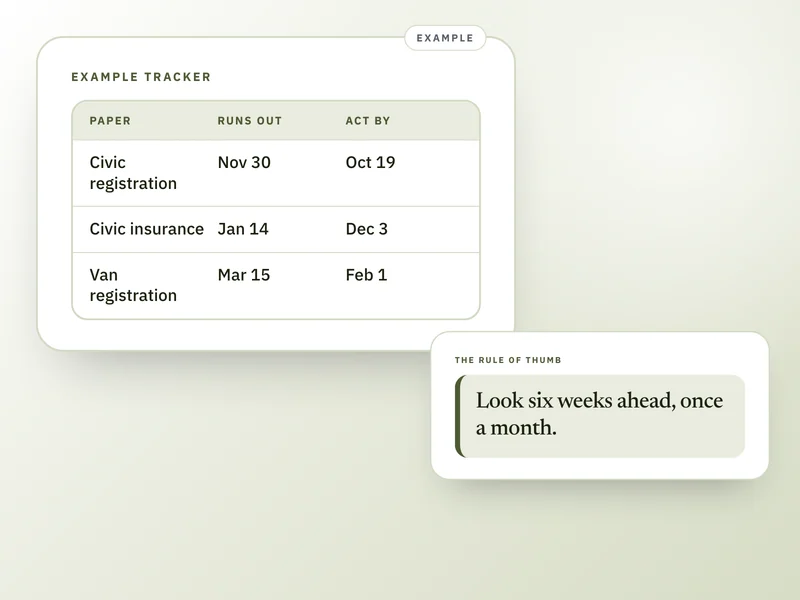 If this is where you areHow to track car registration and insurance renewalsBefore you stock the glove box, this shows how to track the dates on the papers you keep in it.
- First car checklist: what to do in the first week
Set up the glove box as one step in the first-week list for a car new to you.
- What to tell a mechanic before the work starts
A card with your numbers helps at the shop counter, and this covers what to say before work starts.
- Winter car prep checklist: what to check before frost
Winter adds items like a scraper and kit, and this lists the checks to make before frost.