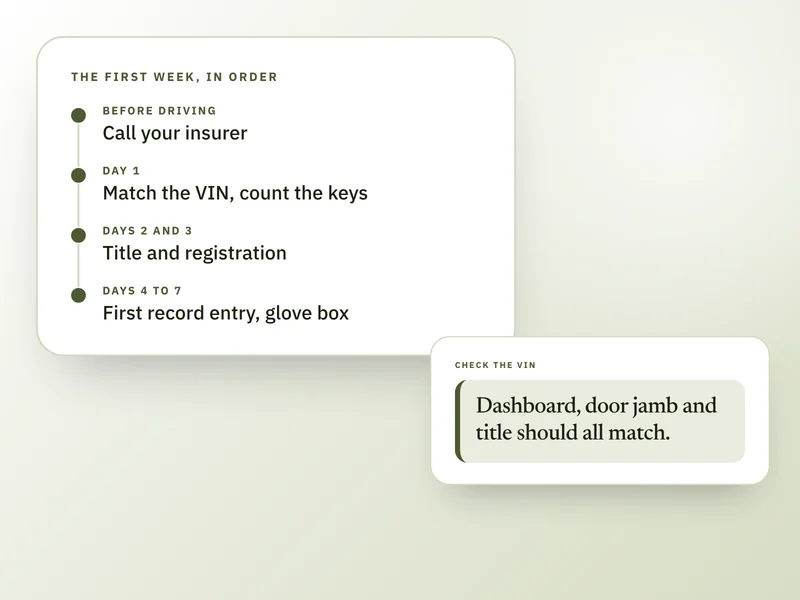
Before you drive it home, have insurance in place. In the first week, match the VIN to the paperwork, sort out title and registration, find the owner's manual and both keys, check the tire pressure, note the mileage and start a record. Do those and you've done the parts that are hard to fix later.
This is for someone getting the keys to a car in the US, new or used. Deadlines and paperwork rules vary by state, so it points you to your state's motor vehicle agency and doesn't say what yours requires. It isn't legal or mechanical advice.
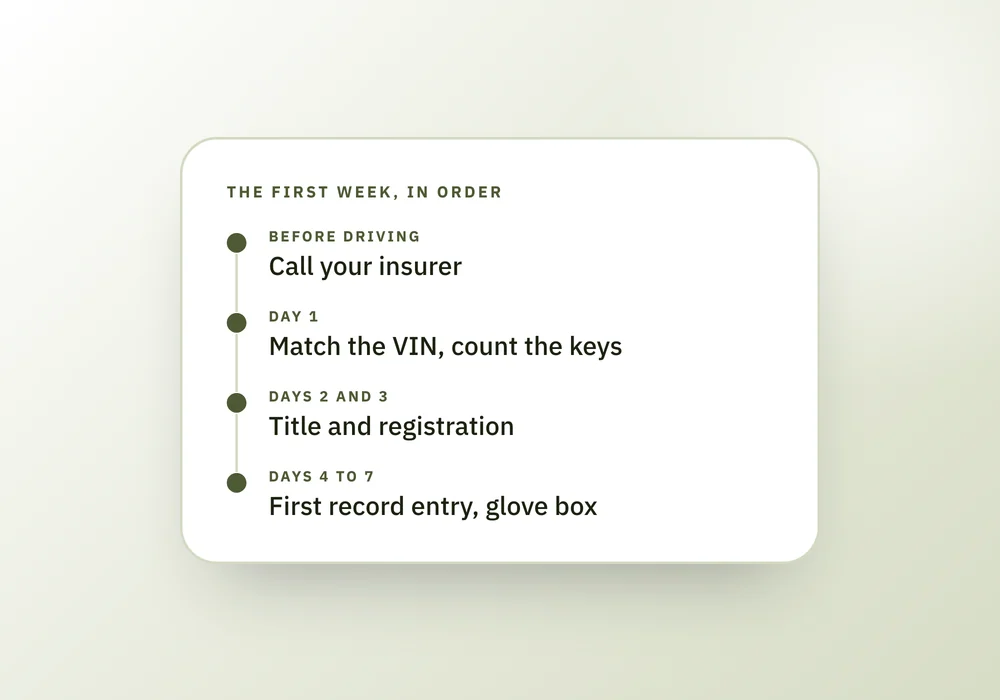
The first week, in order
Insurance comes first because it has to be in place before you drive. The rest is roughly ordered by what is hardest to fix later.
Before you drive it home
Call your insurer. Ask if the car is covered from the moment you own it, and what they need.
Day 1
Match the VIN, count the keys, look at the dash warning lights, find the manual.
Days 2 and 3
Handle title and registration. Ask the seller or dealer who is doing it.
Days 4 to 7
Write the first record entry, check tire pressure, set up the glove box.
Within the month
Look up what is due, and book anything overdue.
Example: a private sale on a Saturday
Say you buy a 2014 hatchback from a private seller on a Saturday. On the way home you call your insurer, who tells you what they need to cover it. On Sunday you sit in the driveway with the title, the registration papers and a phone. The VIN on the dashboard, seen through the windshield, and the VIN on the driver's door jamb should match the VIN on the title. If they don't, you stop and ask before anything else. That is a five minute check, and it's the most useful five minutes of the week.
For a dealer purchase, the dealer usually handles title and registration paperwork. With a private seller, you handle it yourself at your state's motor vehicle agency. Ask which one applies, and how long you have, on day one instead of finding out at day thirty.
The first page of a record (example)
This is the first entry in a car's history. It costs an hour and a pen, and it's what you'll be glad of at the next oil change and at resale.
Date you got it
- Example entry (made up)
- Sat, Sep 12
Mileage that day
- Example entry (made up)
- 62,410
VIN matches the title?
- Example entry (made up)
- Yes, all three places
Keys
- Example entry (made up)
- One key, no spare yet
Front and rear tire pressure
- Example entry (made up)
- Door sticker says 35 psi, gauge reads 31
Last oil change
- Example entry (made up)
- Unknown
Papers, and where they are
- Example entry (made up)
- Title in the folder at home, registration in the glove box
| Baseline page | Example entry (made up) |
|---|---|
| Date you got it | Sat, Sep 12 |
| Mileage that day | 62,410 |
| VIN matches the title? | Yes, all three places |
| Keys | One key, no spare yet |
| Front and rear tire pressure | Door sticker says 35 psi, gauge reads 31 |
| Last oil change | Unknown |
| Papers, and where they are | Title in the folder at home, registration in the glove box |
What to check on day one
6 things to do
Ticks are for this visit only. Nothing here is saved anywhere.
If the car is used
A vehicle history report can show accidents and flood damage, but it typically won't show mechanical problems, and the FTC says it is not a substitute for an independent inspection. If you bought before getting one, you can still ask a mechanic to look the car over this week. A used car with no service records is a common start: used car, no service records covers what to do. If a shop starts quoting jobs, what to tell a mechanic before work starts gives you words for it.
What can go wrong
Insurance that isn't in place before you drive is the costly one, and the seller's word that the car is fine is not a check. The others are quieter: a title that names someone else, a single key, an oil change you assume was done, a warning light you decide to ignore. Each is cheap to sort out in week one and annoying in month six.
Don't try to fix the whole car in a week. Note what you don't know, write it down, and put it on the list. Getting the papers right is the job of the first week, and the car's history is the job of the first year.
After week one
Your manual has intervals for oil, tires, filters and more. Car maintenance by mileage shows how to pull them out, and what is due on my car right now shows how to read them against your mileage and date. Keep the record going with the car maintenance log, and put the essentials on a card with what to keep in your glove box. Date the paperwork with how to track car registration and insurance renewals. Years from now, that record is what you'll hand over in selling your car with a service history.
Questions people ask
What should I do first after buying a car?
Get insurance in place before you drive it, since many dealers ask for proof and your existing policy may cover a new car only for a limited time. Then match the VIN on the car to the title, and sort out title and registration. Everything else can follow in the first week.
How soon do I have to register a car after buying it?
It depends on your state, and the window can be days or weeks. A dealer usually handles it. With a private seller, you do it yourself. Look up your state's rule on day one, through USA.gov's link to your motor vehicle agency, and put the deadline on the calendar.
Where do I find my car's VIN?
Usually on the dashboard, seen through the windshield on the driver's side, and on the sticker inside the driver's door jamb. It's also on the title, registration and insurance card. Check that these agree before you go further.
How often should I check my tire pressure?
At least once a month, when the tires are cold, according to NHTSA. Use the number on the placard in the driver's door jamb or the owner's manual. The pressure printed on the tire sidewall is the maximum, not what your car wants.
Do I need a service history for a first car?
Not to start, but begin one now. A used car may have none, and that's fine. Write the date and mileage you got it, then log each job from here on. It becomes the history the next owner asks for.
Where the Companion fits
Vehicle Maintenance Companion lets you name the car, log a service with its date and mileage, and see what is due from intervals you enter. When you add a car, it offers the usual jobs for that kind of vehicle as a starting point, with intervals you can change, and your manual stays the real source. Paperwork holds your registration and insurance dates. Reminders are off until you switch them on. If you'd rather use a notebook, the steps above are the same.
Sources and how we checked
- FTC, Buying a used car from a dealer: Vehicle history report is not a substitute for an independent inspection; Buyers GuideChecked 26 September 2026.
- USA.gov, State motor vehicle services: Find your state's title and registration rulesChecked 26 September 2026.
- NHTSA, Tire safety and inflation: Check cold pressure monthly; use the door placard, not the sidewall (seen in NHTSA search results, page itself blocked to fetch)Checked 26 September 2026.
Where to go next
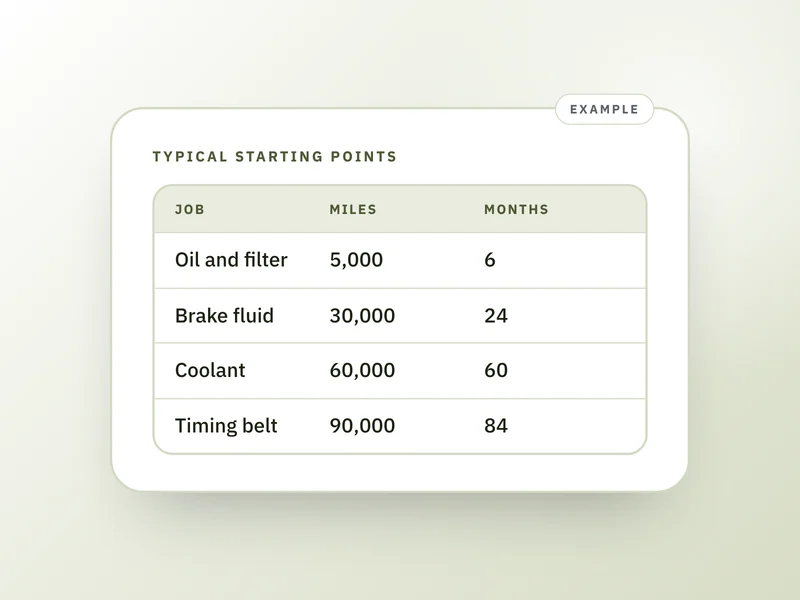 If this is where you areCar maintenance schedule by mileage: check your manualStart with the manual: this shows how to pull your car's intervals from it and write them down.
- Car maintenance log: what to write down
Turn the first-week notes into a proper record using this guide to the columns and habits.
- What to keep in your glove box (and what to leave home)
Put the essentials on one card for the glove box, with blank lines for a pen.
- How to track car registration and insurance renewals
Find and calendar the registration, insurance and inspection dates so none slip by.