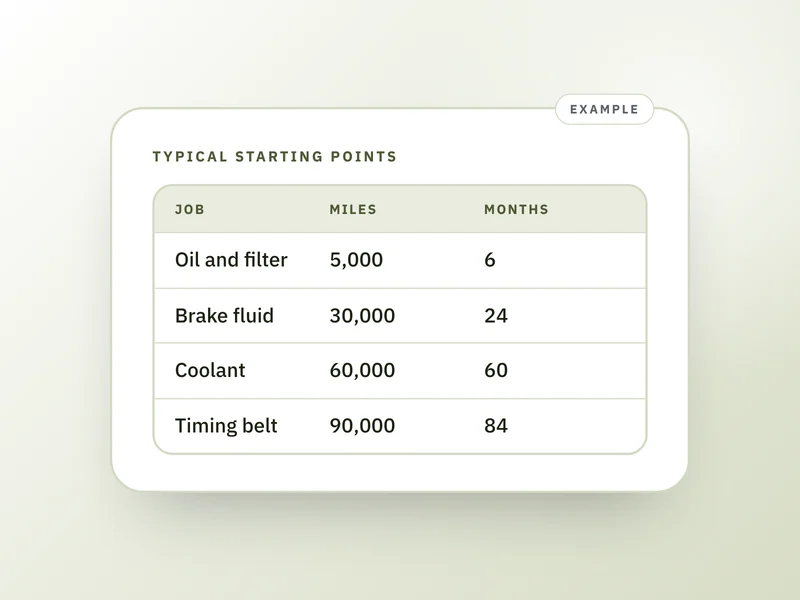
There's no one maintenance schedule by mileage that fits every car. Your owner's manual lists each job by miles, by months or by both, and often gives a second, shorter column for hard use. The table below gives typical starting points to compare it against, so you know what a reasonable number looks like before you open the book.
This is for a car that burns gasoline or diesel and is measured in miles. It isn't your car's schedule, and where the two disagree, your manual wins. Electric cars skip the oil, plugs and belts on this list and have their own items, which the manual covers.
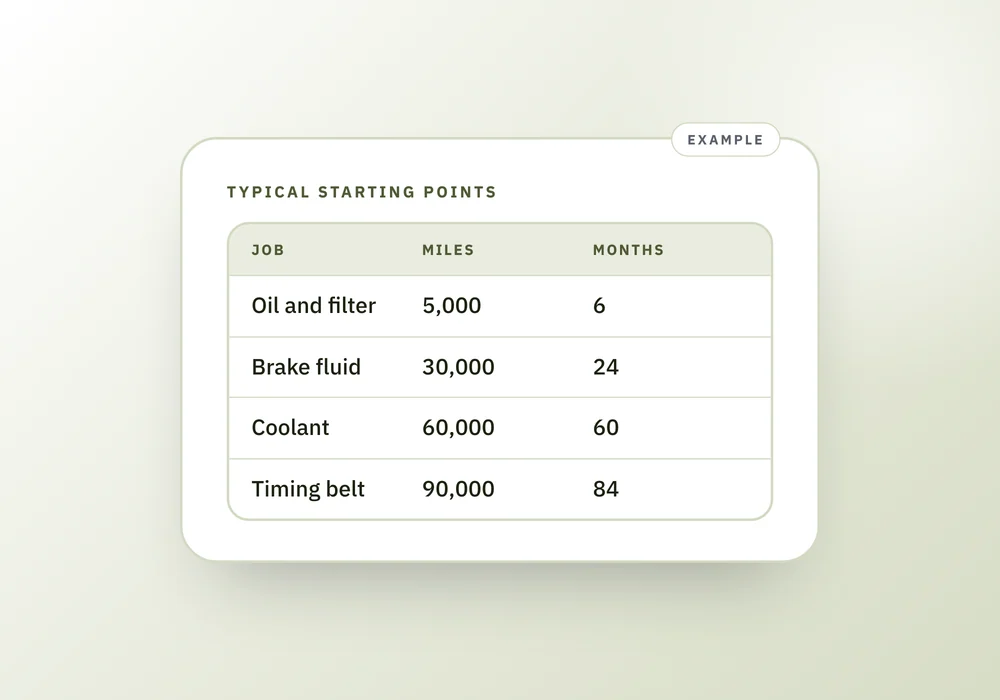
Typical intervals to compare with your manual
These are generic rules of thumb, the same starting points a maintenance tracker might suggest. A blank means there's usually no mileage or no time limit for that job. Newer cars often run longer between oil changes than the first row shows, and some manuals say 7,500 to 10,000 miles.
13 of 13 rows shown
Engine oil and filter
- Typical miles
- 5,000
- Typical months
- 6
Tire rotation
- Typical miles
- 6,000
- Typical months
- 6
Tire tread and pressure check
- Typical miles
- 6,000
- Typical months
- 3
Brake pad and rotor inspection
- Typical miles
- 12,000
- Typical months
- 12
Cabin air filter
- Typical miles
- 15,000
- Typical months
- 12
Engine air filter
- Typical miles
- 15,000
- Typical months
- 12
Brake fluid
- Typical miles
- 30,000
- Typical months
- 24
Fuel filter
- Typical miles
- 30,000
- Typical months
- 24
Coolant
- Typical miles
- 60,000
- Typical months
- 60
Transmission fluid
- Typical miles
- 60,000
- Typical months
Spark plugs
- Typical miles
- 60,000
- Typical months
Timing belt, if your engine has one
- Typical miles
- 90,000
- Typical months
- 84
Battery test
- Typical miles
- Typical months
- 12
| Job | Typical miles | Typical months |
|---|---|---|
| Engine oil and filter | 5,000 | 6 |
| Tire rotation | 6,000 | 6 |
| Tire tread and pressure check | 6,000 | 3 |
| Brake pad and rotor inspection | 12,000 | 12 |
| Cabin air filter | 15,000 | 12 |
| Engine air filter | 15,000 | 12 |
| Brake fluid | 30,000 | 24 |
| Fuel filter | 30,000 | 24 |
| Coolant | 60,000 | 60 |
| Transmission fluid | 60,000 | |
| Spark plugs | 60,000 | |
| Timing belt, if your engine has one | 90,000 | 84 |
| Battery test | 12 |
The same jobs, in the order they come round
A rough milestone view of the table above. Yours will shift to match your manual.
Every 5,000 to 6,000 miles
Oil and filter, tire rotation, a look at tread and pressure.
Every 12 months or so
Brake inspection, cabin and engine air filters (often at 12,000 to 15,000 miles), battery test.
Around 30,000 miles
Brake fluid and fuel filter, if your car has one to change.
Around 60,000 miles
Coolant, transmission fluid and spark plugs.
Around 90,000 miles
Timing belt, on engines that have a belt rather than a chain.
How to read your own manual
- Find the maintenance section. It's usually called maintenance, service or schedule. If the paper copy is gone, the maker's owner website usually has one for your year and model.
- For each job, write down the miles, the months, or both. If the manual gives only one, use only that one. Don't fill in the other from the table above.
- Look for two columns, normal and severe, or a list of special conditions. Many manuals count short trips, towing, stop-and-go traffic, dust, and very hot or very cold weather as hard use. If that's how you drive, write down the shorter figure.
- Note the difference between inspect and replace. Some lines only say to check a part, and the replacement comes later or when the check says so.
- Put the jobs and their intervals on one page and keep it with the log. You shouldn't have to reopen the manual every time.
An example: one job, two columns
Say your manual reads like this. The numbers are made up to show the reading, not a real car's schedule.
Engine oil and filter
- Normal
- 7,500 mi or 12 mo
- Severe
- 3,750 mi or 6 mo
Cabin air filter
- Normal
- 15,000 mi or 12 mo
- Severe
- Not listed
| Job | Normal | Severe |
|---|---|---|
| Engine oil and filter | 7,500 mi or 12 mo | 3,750 mi or 6 mo |
| Cabin air filter | 15,000 mi or 12 mo | Not listed |
Miles or months, and why the months matter
Take the oil line. A driver who covers 4,000 miles a year will reach 12 months long before 7,500 miles, so months set the date. A driver who commutes 20,000 miles a year hits the mileage first. The job comes due at whichever limit you reach first, and the low-mileage car is the one that gets forgotten. Here's how to work out what's due right now from an interval and a last-done date.
On hard use, short trips are the condition people miss. A car that never runs long enough to warm fully lets moisture and combustion byproducts build up in the oil, which is why some manuals shorten the interval for it. Some sources describe cutting the interval about in half as a common adjustment, but the amount varies by maker, so use your manual's figure.
When the chart or the manual won't do
- You have no manual and can't find one online. Use the typical table as a placeholder, label it as one, and ask a mechanic you trust to say what they'd change for your car.
- A shop's sheet disagrees with the manual. Shops sometimes suggest sooner intervals than the maker does. Ask them why for your car. It's your call, and it helps to note both figures.
- Your car is a few years old and has a long history. Don't assume the intervals started at zero on your date. If you have no dates, see how to handle a used car with no records.
- Your manual gives kilometers. Convert once, write the miles down, and note the original beside it.
Questions people ask
What maintenance is done at 60,000 miles?
On many cars, coolant, transmission fluid and spark plugs come due around 60,000 miles, alongside the regular oil, tire and brake checks. That's a typical pattern, not a rule. Your manual lists what your car needs at that mileage, and some cars need more or less.
How often should I really change my oil?
Whatever your manual says for the way you drive. Don't go by a round number you remember. Many current manuals allow well beyond 5,000 miles on the normal schedule, but a car used for short trips or towing usually gets a shorter figure. If it says miles or months, both apply.
Does towing count as severe driving?
In many manuals, yes. Towing, hauling, mostly short trips, stop-and-go traffic, dust, and extreme heat or cold are commonly grouped under severe or special conditions. Check the exact list in your manual, because makers word it differently, and use the shorter schedule if any of it fits.
Where do I find my car's maintenance schedule?
In the owner's manual, in the maintenance or service section. If you don't have the book, the maker's owner site usually posts it, searchable by year and model. A dealer's service department can also tell you what's due at a given mileage.
Is it miles or months, whichever comes first?
When the manual gives both, yes. The job is due when you reach either one. Someone who drives little may reach the month limit with the odometer barely moved. If the manual gives only miles or only months, use only the one it gives.
Where the Companion fits
Vehicle Maintenance Companion has a small table headed From your manual, with three columns: job, miles and months. You type what the book says and it tracks each job against the date and mileage you record. If you'd rather start from something, Start with the usual jobs adds typical jobs, much like the table above, with intervals you can change. They're a generic starting point, not a factory schedule, and the manual is the real source. A severe duty toggle on a job halves the interval you typed. That's the app's own rule, not your maker's, so use it only if your manual doesn't give a hard-use figure.
Sources and how we checked
- U.S. Department of Energy, fueleconomy.gov: Keeping your car in shape: Proper tire pressure and other specifications are found in the owner's manual and on the door jamb sticker, not from generic charts.Checked 26 September 2026.
- Bumper, Severe duty driving and why your maintenance schedule may be wrong: Conditions commonly counted as severe (short trips, stop-and-go, towing, dust, extreme temperatures) and representative shorter oil intervals. A commercial vehicle-history site, so used for description only.Checked 26 September 2026.
Where to go next
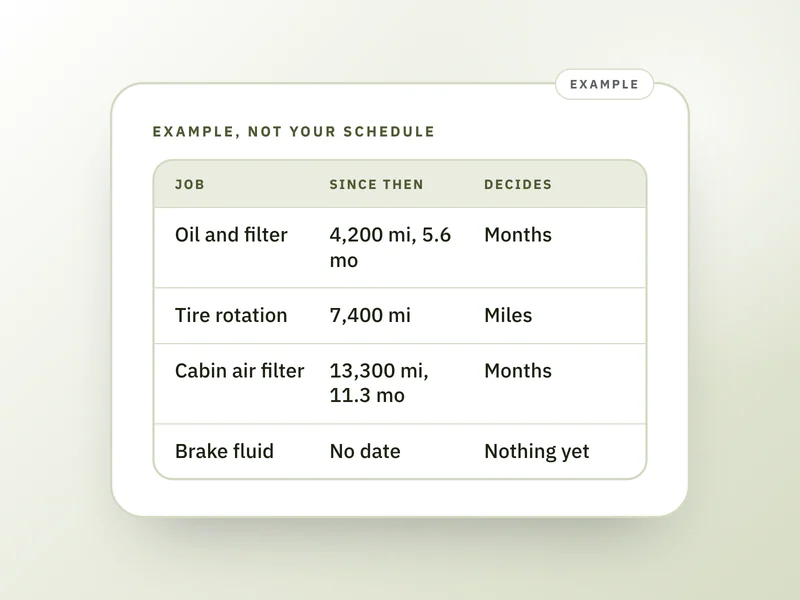 If this is where you areHow to know what maintenance your car is due forAfter you have your intervals, this turns them into a clear answer on what is due right now.
- Car maintenance log: what to write down
Record each interval and the last date it was done in a log so the manual numbers stay useful.
- First car checklist: what to do in the first week
New to the car, this first-week checklist puts finding the manual at the top of the list.
- How to keep track of maintenance on two cars
If you run two cars, this shows how to keep each one's intervals and dates apart.