Keep one record per car, each labeled with a plate or a name you can't confuse, and put the same three things on every line: the car, the date and the odometer. Log a job the day it's done, against the car it was done to. Then read both records together once a month, so you can see which car needs you.
This is for a household with two or more vehicles: cars, a work van, a motorcycle. It can't give you intervals, because each car's come from its own manual. It also can't settle who does the writing in a couple, so agree on that early.
An example: why the two records have to stay apart
Say it's September 12. You own a 2018 sedan that does 4,000 miles a year and a work van that does 20,000. Both take an oil change at 5,000 miles or 6 months, and both were done this year. The numbers are made up.
Sedan
- Odometer now
- 52,300
- Oil last done
- Feb 10, at 49,800
- Since then
- 2,500 mi, 7 months
- What decides
- Months: overdue
Van
- Odometer now
- 88,100
- Oil last done
- Jun 20, at 84,300
- Since then
- 3,800 mi, 2.7 months
- What decides
- Miles: about 1,200 left
| Car | Odometer now | Oil last done | Since then | What decides |
|---|---|---|---|---|
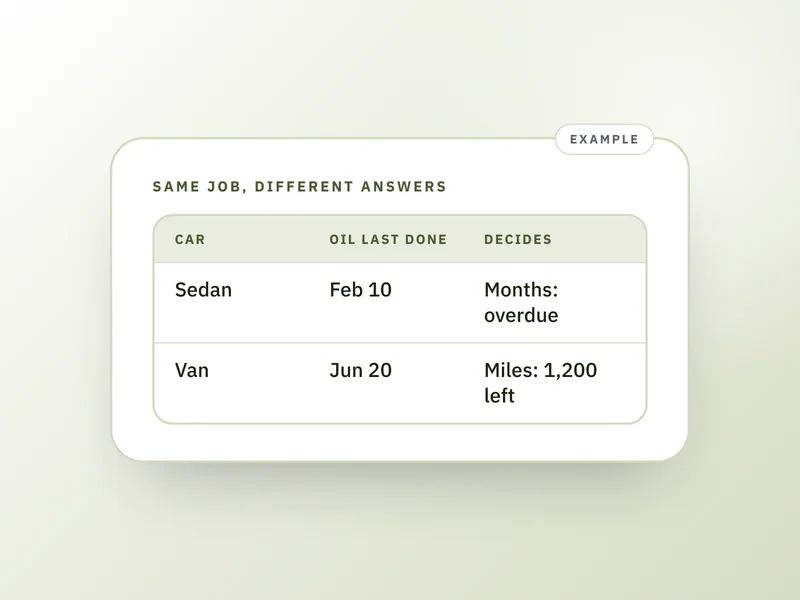
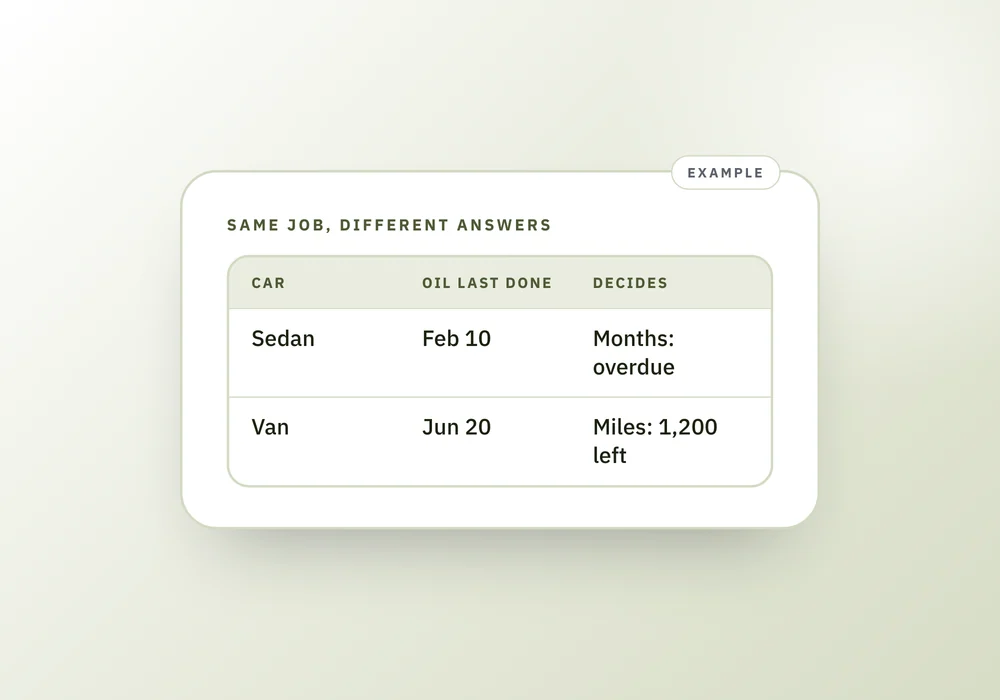
| Sedan | 52,300 | Feb 10, at 49,800 | 2,500 mi, 7 months | Months: overdue |
| Van | 88,100 | Jun 20, at 84,300 | 3,800 mi, 2.7 months | Miles: about 1,200 left |
Reading the example
The sedan has barely moved and it's the one that's late, because months ran out first. The van has used about three quarters of its mileage in under three months and will be due within weeks. If both jobs sat on one shared list, you'd probably notice the van. Kept apart, each with its own date and mileage, both answers are visible. Here's how to work out what's due for a single car.
How to set it up
- Give each car a label. A plate is the safest, or a name that can't be mistaken, like the work van. Put the year and make beside it, so a stranger could tell them apart.
- Start one page, tab or notebook section per car, with the same columns on each: date, odometer, what was done, who did it. Here's what a good log line has.
- Write each car's intervals on its own page, from its own manual. Don't copy one car's numbers to the other. Here's how to pull them out of a manual.
- Log the job on the day, and start the line with the car's label. If you're at the shop with both keys, write it down before you leave the lot.
- Once a month, read both odometers on the same day and check each page. Pick a date you'll remember, such as the first Sunday.
- Keep the paperwork on the same per-car footing: registration, insurance and inspection dates belong to one plate, not to the household. Here's how to track those dates.
If two people share the job
One record works best when one person keeps it and the other tells them. If you both drive both cars, agree that whoever pays for a job writes it down, or that receipts go in one place and one person enters them weekly. A copy of each car's page in its own glove box also helps. A page in the wrong car is worse than none, so check the label first.
Where it goes wrong
- A job is logged against the wrong car. It usually happens when both cars are serviced on the same day at the same shop. Check the plate on the invoice.
- The odometer readings get swapped. Write the reading and the label together, not on separate lines.
- A shared spreadsheet gets edited by two people at once, and one entry vanishes. If you use one, give each car its own tab and note who edited last.
- You sell one of the cars and the page stays in the pile. Move its record out, and print or hand it over. Here's how to present it to a buyer.
- A trailer, a motorcycle or an older car you rarely drive gets no page at all. If it has a plate and a date, it gets a page.
Questions people ask
How do I keep track of maintenance for two cars?
Give each car its own record, labeled by plate or name, with its own intervals from its own manual. Log every job the day it's done against the car it belongs to. Once a month, read both odometers on the same day and check each record for what's due.
Should each car have its own maintenance log?
Yes. Different cars have different intervals, different mileage and different paperwork dates, and mixing them makes every entry uncertain. Use the same columns on every page so they're easy to compare, and put the car's label on each line if the pages ever end up together.
What's the best way to track maintenance on multiple vehicles?
The best way is the one you'll keep up. A notebook per car in each glove box works, as does a spreadsheet with one tab per car. A tracker that holds several cars can show them side by side. What counts is a label on every line and a monthly check of both.
How often should I check what's due on each car?
Once a month is enough for most jobs, plus whenever you log something, since the odometer reading is fresh. A low-mileage car reaches its month limits with the odometer barely moving, so check the dates as well as the miles. Set a fixed day so it doesn't depend on remembering.
Can a couple share one car maintenance record?
Yes, if one place holds it and one person writes to it. If both of you enter jobs, agree on the rule: whoever pays writes it down. Otherwise you'll get duplicates or gaps. Some tools have one login per household, so check before you assume two people can each sign in.
Where the Companion fits
Vehicle Maintenance Companion holds as many vehicles as you add under one account, each with its own jobs, history and dates. With two or more, a strip of plates appears at the top of Due: ALL, then one chip per car, each with a lamp. A filled dot means something is due, a ring means something is close, and an empty ring means clear. Tap a chip and Due filters to that car; tap it again to clear. Until you type a plate under Paperwork, the chip shows the car's label. It's one account and one sign-in, with no sharing to a second person, so one of you enters the data. A car you sell can be closed, and its record stays in History and can still be printed.
Where to go next
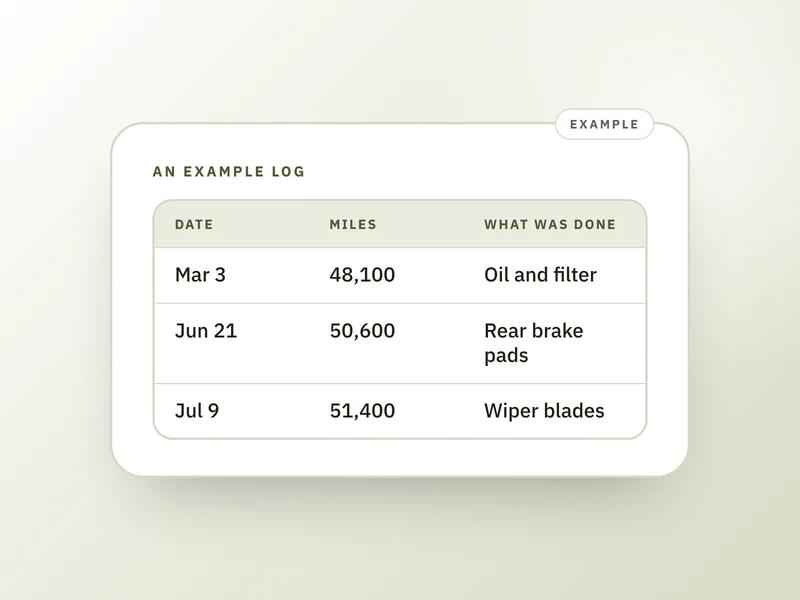 If this is where you areCar maintenance log: what to write downGive each car its own record, and this shows the columns and what to write on every line.
- How to track car registration and insurance renewals
Two cars means two sets of renewals, and this shows how to track each registration and insurance date.
- How to know what maintenance your car is due for
Check what is due on each car in turn with this method, one after the other.
- Car maintenance schedule by mileage: check your manual
Each car has its own intervals, and this shows where to find them in each manual.