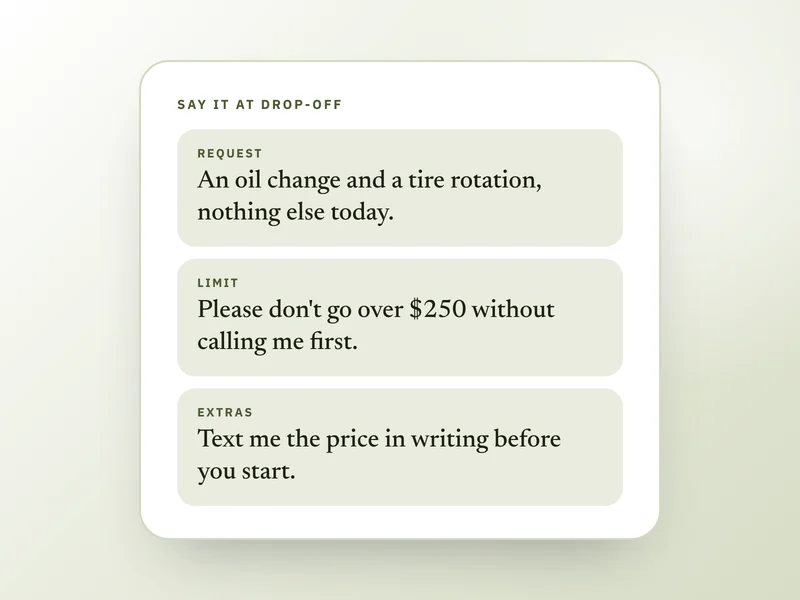
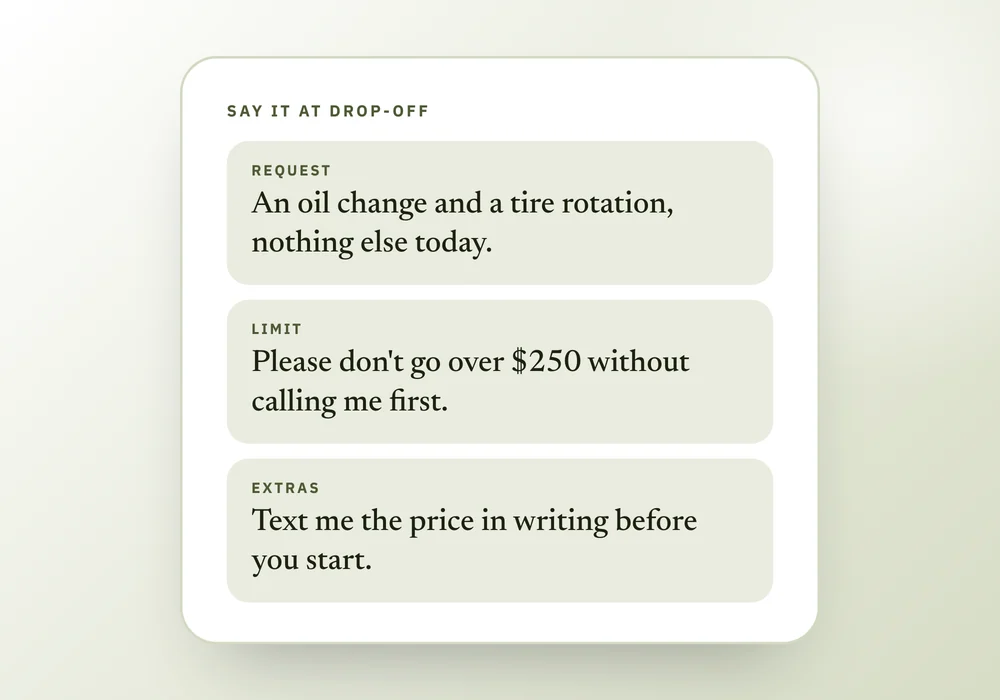
Before the keys change hands, say three things: what you're asking for today, the most you'll approve without a call, and that you want any other work described and priced in writing before it starts. Then get that in a text or on paper, because a spoken request is easy to lose.
This is for a car going in for scheduled work or a repair in the United States. It can't make a shop do anything, and the rules on estimates and approval differ by state, so it's not legal advice. It makes your request clear, and a clear request is easier for a shop to follow and easier to point to later.
What to say, by moment
Say these in your own words. The point is that each one names something the shop can act on.
Pick the one you are facing
“I'm asking for an oil and filter change and a tire rotation, and nothing else today. If you find anything else, please call me before you do any of it.”
“Please don't go over $250 without calling me first, and wait for my answer.”
“The brakes squeal when I slow down. Please find out why and give me an estimate in writing before you fix anything.”
“What exactly did you find, what does it cost with parts and labor, and can you text me that so I have it in writing?”
“Thanks for telling me. Please don't do that part today. I'll call you back by this afternoon.”
“Please keep the parts you replace so I can see them when I pick up.”
An example of how the call goes
Say it's Tuesday and you drop off a car for an oil change. Your written request is one line. At noon the shop calls: the brake pads are thin and the job is $480. You didn't have a limit, so it's a live decision made over a phone in the middle of your workday.
With the sentence already said, the shop knows to wait. You can say "text me that", read it at your own pace, and answer yes, no or not today. That's the whole value of saying it first: the decision happens when you're ready, not when they are.
The short version, in order
- Say what you're asking for in specific terms. "An oil and filter change and a tire rotation" is a request. "Have a look at it" gives the shop room to decide what's needed.
- Give a limit if you have one, and a number to reach you on during the day.
- Ask what a diagnosis costs before it starts. A shop can charge to find a problem, and whether that fee comes off the repair is worth knowing first.
- Ask that any further work be estimated in writing, by text or email if you can, so you have a record with a date.
- Note the odometer reading and the date on your own copy, and take a photo of the dash.
- When the work is done, compare the final bill to the approved estimate line by line before you pay.
What the rules say, and where they stop
The FTC's advice is that a written estimate should describe the problem, the parts and the expected labor, and should say the shop will contact you for approval before going past a set amount of time or money. It also says shops should give you back replaced parts, and that state law may require it.
Some states go further. California's Bureau of Automotive Repair, for example, says a shop must give an estimate before starting and must contact you and get your approval for extra work, and it accepts your approval in written, oral or electronic form. Your state's attorney general or the agency that licenses repair shops will tell you what applies where you live.
When it goes wrong
- The bill is higher than the estimate and you didn't approve the difference. Ask the shop to show where the approval came from. Keep your text or your copy of the request.
- Something was done that you didn't ask for. Ask the manager, in writing if you can, what authorized it. The FTC suggests speaking with the shop manager or owner first, then contacting your state attorney general or a local consumer protection agency, and it lists small claims court as an option that doesn't need a lawyer.
- You're tempted to refuse the bill or take the car. Before you do, call your state's consumer office, because what a shop can do with a car and an unpaid bill depends on the state.
- It's an emergency tow. You may have to say yes on the spot. Ask for the price before they hook up, and do the paper afterward.
- You did everything right and the shop still went ahead. A written request is your evidence, not a guarantee. Keep it, along with the invoice and the dates.
Questions people ask
Can a mechanic charge more than the estimate?
In many states a shop needs your approval before going past the estimate, but the details depend on where you live. California's Bureau of Automotive Repair, for example, says the shop must contact you for approval of extra work. Check your state attorney general's consumer page for the rule that applies to you.
Do I need a written estimate before a repair?
The FTC advises getting one, listing the problem, parts and labor. Some states require it. If you can't get it on paper, ask for it by text or email so there's a dated record. Then keep it with the final invoice.
Should I tell the mechanic my budget?
Giving a limit isn't required, but it's useful. A sentence like "call me before you go past $250" tells the shop when to stop and ask, rather than deciding for you.
Can I ask for my old parts back?
Yes, you can ask. The FTC says shops should return replaced parts, and some states require it. It's best to ask before the work starts, not at pickup, and California's Bureau of Automotive Repair notes you can request them before authorizing.
What do I do if I was charged for work I didn't approve?
Keep every record, then talk to the shop manager or owner. If that fails, the FTC suggests your state attorney general or a local consumer protection agency, and small claims court is an option. Don't stop there if the shop is licensed, because a licensing agency may take complaints too.
Where the Companion fits
Vehicle Maintenance Companion prints a page called the Service Boundary from the jobs you're tracking. It lists what you're requesting today with the date and mileage, says that anything not listed is not authorized, asks the shop to call before further work and to give a written estimate, and has an optional line for the most you'll go without a call. There are lines for you and the shop to initial. It's a written request, not a contract, and the app doesn't check or use the amount. It's made in your browser when you click.
Before you hand over the keys
4 things to do
Ticks are for this visit only. Nothing here is saved anywhere.
Sources and how we checked
- Auto Repair Basics (FTC Consumer Advice): Written estimate contents, approval past a limit, old parts, dispute steps.Checked 26 September 2026.
- Maintenance and repairs (California Bureau of Automotive Repair): California example: estimate, authorization in written, oral or electronic form, extra work, returned parts.Checked 26 September 2026.
Where to go next
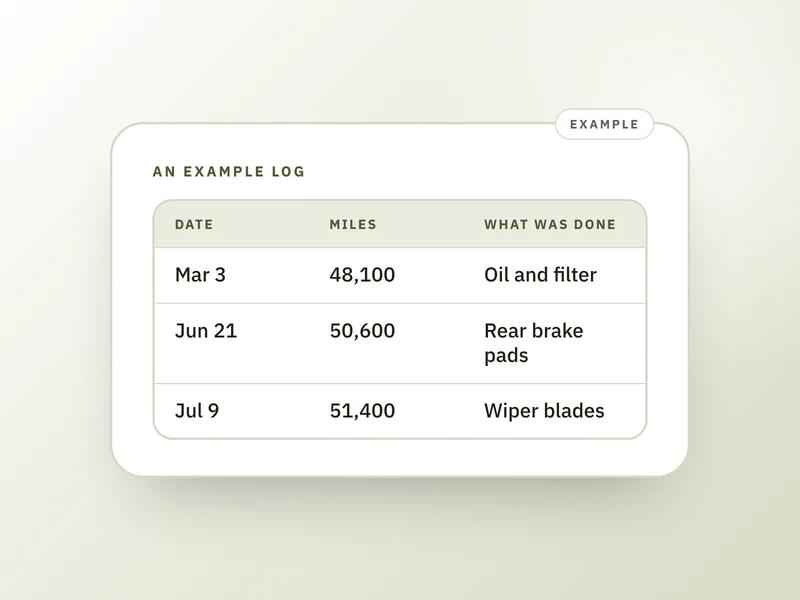 If this is where you areCar maintenance log: what to write downAfter the work is done, write it down with date and mileage so the next shop or buyer can see it.
- How to know what maintenance your car is due for
Before you book the shop, check which jobs are actually due so you ask for the right work.
- What to keep in your glove box (and what to leave home)
Keep the shop estimate and a pen card with your essential numbers where you can reach them.
- How to keep track of maintenance on two cars
If two cars go to the same shop, this keeps each job filed against the right vehicle.