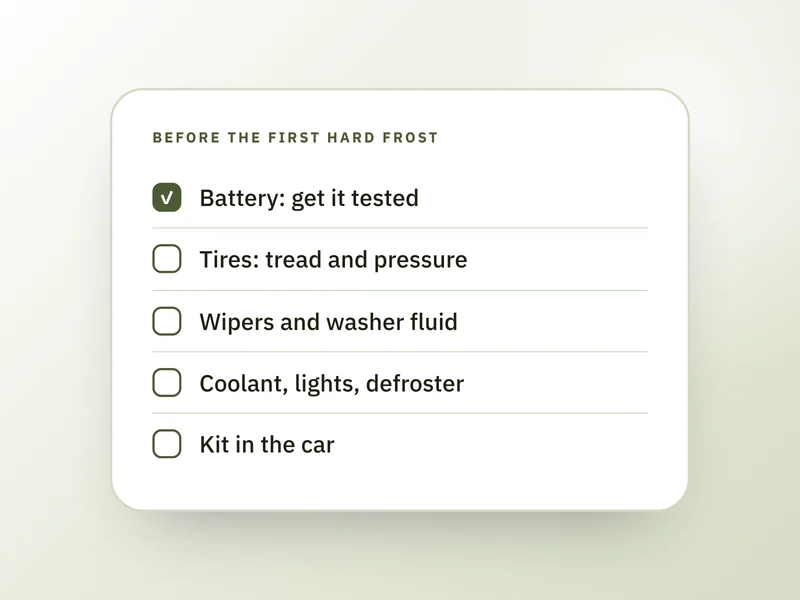
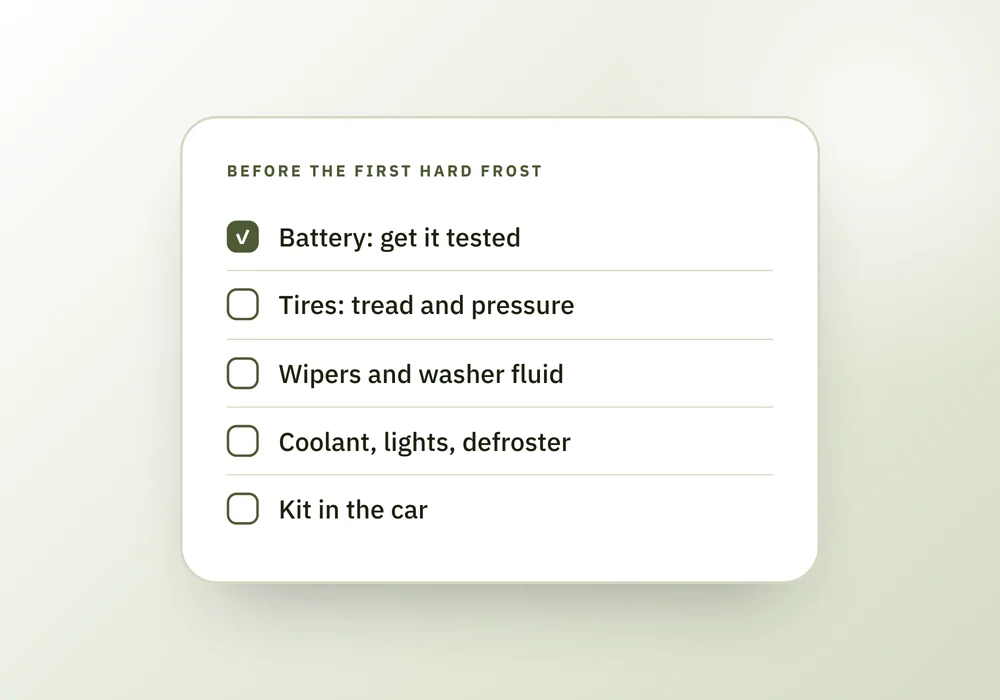
Before the first hard frost, check seven things: the battery, tires, wipers and washer fluid, coolant, lights, the heater and defroster, and the kit you keep in the car. Do it on a dry weekend in October or November, when a slow start or a worn blade is an errand and not a roadside problem. Write down what you find, even when the answer is fine.
This is for a gas, diesel or hybrid car in the United States where winters bring frost or snow. It's a list of what to look at, not how to repair it, and your owner's manual outranks it. Anything you can't judge yourself is a job for a mechanic.
What to look at, and what to write down
8 of 8 rows shown
Battery
- What to look for
- Slow cranking, dim lights, a battery three or more years old. Have a shop test it; most will.
- What to write down
- Date tested, result, battery age if you know it
Tires
- What to look for
- Tread depth, uneven wear, and pressure set to the sticker in the driver's door jamb or the manual, not the number on the tire.
- What to write down
- Date, pressure in each tire, and any tire swap
Wiper blades
- What to look for
- Smearing, chatter, split rubber. Replace both if one is bad.
- What to write down
- Date replaced
Washer fluid
- What to look for
- Full, and a winter-rated fluid that won't freeze in your area.
- What to write down
- Date topped up
Coolant
- What to look for
- Level in the reservoir, and a shop test that it's still the right strength.
- What to write down
- Date checked, and the mileage
Lights
- What to look for
- Headlights, brake lights, turn signals and hazards. Ask someone to watch from outside.
- What to write down
- Date, and anything replaced
Heater and defroster
- What to look for
- Both blow warm and clear the glass in a few minutes.
- What to write down
- Date, and any problem
Kit in the car
- What to look for
- Everything in the list below is there and in date.
- What to write down
- Date checked
| Check | What to look for | What to write down |
|---|---|---|
| Battery | Slow cranking, dim lights, a battery three or more years old. Have a shop test it; most will. | Date tested, result, battery age if you know it |
| Tires | Tread depth, uneven wear, and pressure set to the sticker in the driver's door jamb or the manual, not the number on the tire. | Date, pressure in each tire, and any tire swap |
| Wiper blades | Smearing, chatter, split rubber. Replace both if one is bad. | Date replaced |
| Washer fluid | Full, and a winter-rated fluid that won't freeze in your area. | Date topped up |
| Coolant | Level in the reservoir, and a shop test that it's still the right strength. | Date checked, and the mileage |
| Lights | Headlights, brake lights, turn signals and hazards. Ask someone to watch from outside. | Date, and anything replaced |
| Heater and defroster | Both blow warm and clear the glass in a few minutes. | Date, and any problem |
| Kit in the car | Everything in the list below is there and in date. | Date checked |
Why these come first
AAA says a car battery loses about 35 percent of its strength at 32 degrees Fahrenheit and about 60 percent at 0, and that the average battery lasts three to five years, closer to three with today's electronics. A battery that started fine in September can fail on the first cold morning, which is why the test comes before the frost.
The U.S. Department of Energy notes that tire pressure drops in cold weather and that cold engine oil is thicker. Low tires wear faster and grip worse, so pressure is worth checking again after the first big temperature drop, with the tires cold. Fuel economy is lower in winter too, roughly 15 percent lower at 20 degrees than at 77 in city driving, according to the same source.
An example: what a winter entry might look like
Say it's October 14 and the odometer reads 61,200. You write: "Battery tested at the shop, passed, about four years old. Tires 33, 33, 32, 33 psi, set to the sticker. New front wipers, $28. Washer fluid topped up. Lights all working. Coolant level fine, not tested. Kit checked, replaced the flashlight batteries." That's six lines and a date, and next October you'll know that the battery is five and worth a second look.
What goes in the car
Ready.gov's vehicle kit list is short. The last two are our own additions.
7 things to do
Ticks are for this visit only. Nothing here is saved anywhere.
Keep the tank fuller in winter
Ready.gov advises keeping a full tank of gas in cold weather. If you're stuck and running the engine for heat, a full tank buys time, and if you're stopped in a snowstorm, the fewer stops you make the better. A rule you can live with is to refill when the gauge reaches half.
If you drive a hybrid or an electric car
The Department of Energy's figures show electric range dropping about 41 percent in its cold-weather test conditions, and much of the extra energy goes to heating the cabin. Its advice is to preheat while the car is still plugged in. The tires, wipers, washer fluid, lights and kit apply to you as they do to everyone. The oil and spark plug items in other guides don't, and the manual covers the battery and charging checks that do.
When the checklist doesn't help
- The battery passes today and fails in January. A test shows the state of the battery now, not next month. If it's old, replacing it early can be cheaper than a tow.
- You skipped the tire pressure recheck. Pressure changes with the air, so a reading in a warm garage in October isn't a reading in a January driveway.
- Everything looks fine but you hear something new. A new noise, a warning light or a pull to one side is a reason to see a shop now, and what to tell the mechanic before work starts shows how to describe it.
- You live somewhere with mild winters. Most of the list still applies, but the kit and the winter fluid count for less.
Questions people ask
When should I winterize my car?
Before the first hard frost, so for most of the northern U.S. that means October or early November. Book the battery test and any tire swap a few weeks ahead, because shops fill up when the first snow comes. In milder areas, do it before the coldest month.
How do I get my car ready for winter?
Have the battery tested, check tire tread and pressure, replace worn wipers, fill the washer fluid with a winter-rated one, check the coolant, test the lights, the heater and the defroster, and stock the kit. Write the date and result of each so you know when you last looked.
What should be in a winter emergency kit for a car?
Ready.gov lists jumper cables, sand, a flashlight, warm clothes, blankets, bottled water and non-perishable snacks, and advises keeping the tank full. We'd add an ice scraper and a phone charging cable. Check it once a season, since batteries and snacks go out of date.
Does cold weather drain a car battery?
It weakens it. AAA says a battery loses about 35 percent of its strength at 32 degrees Fahrenheit and about 60 percent at 0, while the engine needs more power to turn over. An older battery may have little to spare, so it's worth testing early.
Do I need winter tires?
It depends on where you drive and how often the roads are icy or snowy. Winter tires are made for the cold and snow, and all-season tires are a compromise. A tire shop can tell you what suits your climate and car, and your manual may say what sizes are approved. That's a decision for you and a shop.
Where the Companion fits
Vehicle Maintenance Companion has a starter list called Before winter. It adds a battery test, a winter and summer tire swap, a tire tread and pressure check, wiper blades, a washer fluid top-up, a lights check and an emergency kit check. Each comes with a typical interval you can change and nothing recorded against it, so none of it reads as overdue until you say when it was done. Coolant isn't on that list. You can add it as a job of your own, or take it from the By the miles list. The lights job uses the word indicators, which means turn signals. It's a starting point, not advice for your car.
Sources and how we checked
- Ready.gov, Winter Weather: Vehicle kit contents (jumper cables, sand, flashlight, warm clothes, blankets, water, snacks) and the advice to keep a full tank of gas.Checked 26 September 2026.
- AAA Oregon/Idaho, Temperatures are dropping and so is your car's battery power: Battery loses about 35 percent of its strength at 32 F and about 60 percent at 0 F; average life of three to five years.Checked 26 September 2026.
- U.S. Department of Energy, fueleconomy.gov: Cold weather effects on fuel economy and EV range: Tire pressure drops and oil thickens in the cold; about 15 percent lower gas mileage at 20 F; EV range and preheating while plugged in.Checked 26 September 2026.
- U.S. Department of Energy, fueleconomy.gov: Keeping your car in shape: Correct tire pressure is on the driver's door jamb sticker or in the manual, not the sidewall maximum.Checked 26 September 2026.
Where to go next
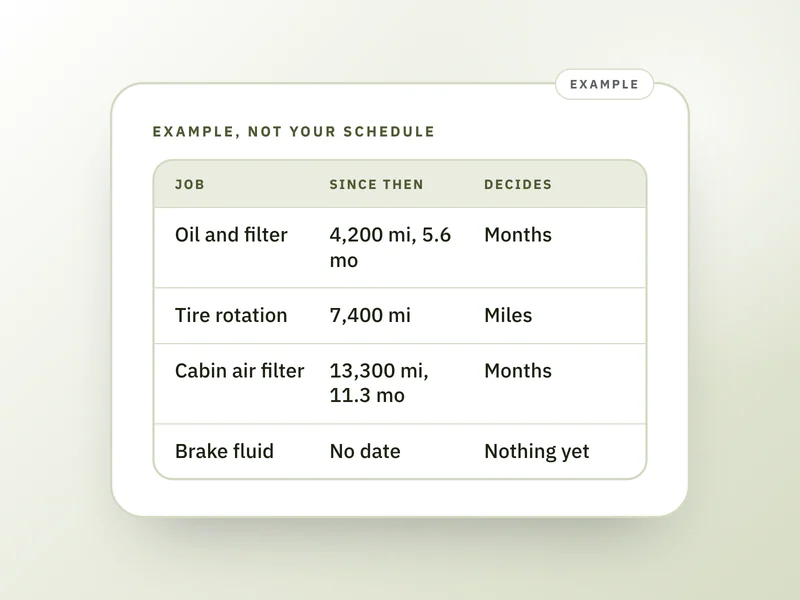 If this is where you areHow to know what maintenance your car is due forAlongside the cold-weather checks, see what else is due by miles or months before the season starts.
- Car maintenance schedule by mileage: check your manual
For fluids and other jobs with intervals, look up your manual's figures with this guide.
- Car maintenance log: what to write down
Write down the battery, tire and wiper checks you do so next winter starts from facts.
- What to tell a mechanic before the work starts
If a check turns up a worn part, this covers what to say to the shop before the repair starts.