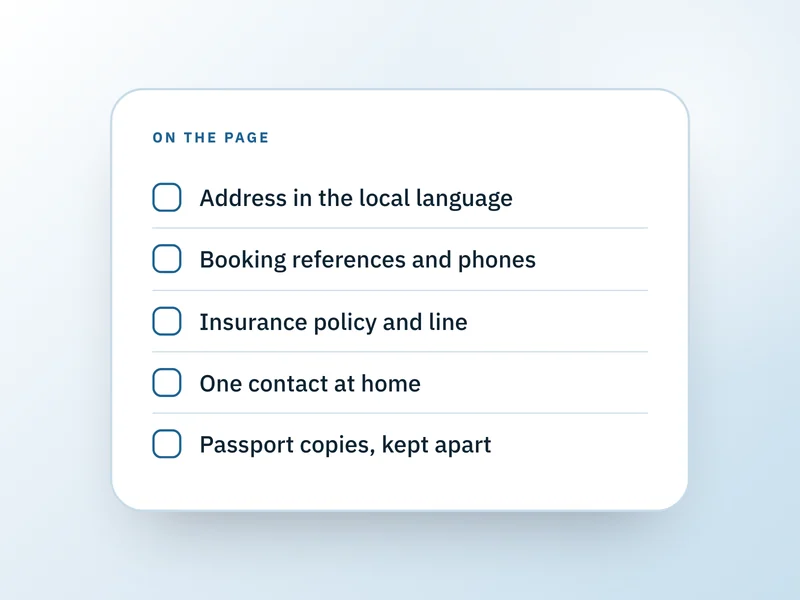
Print one page: where you're staying, with the address in the local language if you don't read it; a booking reference and phone number for each flight, stay and transfer; your insurance policy number and assistance line; one contact at home; and a copy of each passport's photo page, kept away from the passport. Print two copies and put them in different bags.
This is for anyone traveling with a phone that will, at some point, be at 4 percent, in a taxi, in a city where you can't read the signs. It won't replace your passport or a boarding pass, and it can't help if you forget to print it.
The taxi at midnight
You've landed. There's no signal yet, or roaming hasn't switched on. The driver asks where you're going, and the address is in your booking email, which is on a phone that won't load it. A printed page with the address written the way the driver reads it is the cheapest fix in this whole guide.
Example: what the page looks like
An illustration with invented details. The whole page fits on one side, or it doesn't get printed. Write phone numbers that a person answers, not a general help line you'd need a code to reach.
Staying
- What to write
- Name, and address as written locally
- Example
- Hotel Aurora, Rua das Flores 12, 1200-195 Lisboa
Flights
- What to write
- Reference and airline phone
- Example
- Ref K7QD2M, airline desk 555-0100
Transfer
- What to write
- Company, reference, phone
- Example
- Airport shuttle, ref 8841, 555-0142
Insurance
- What to write
- Policy number, assistance line
- Example
- Policy 4471, 24-hour line 555-0177
At home
- What to write
- One person who knows your plans
- Example
- Jo, 555-0123
Passports
- What to write
- Photo page copies, kept apart
- Example
- In the second bag
| Line | What to write | Example |
|---|---|---|
| Staying | Name, and address as written locally | Hotel Aurora, Rua das Flores 12, 1200-195 Lisboa |
| Flights | Reference and airline phone | Ref K7QD2M, airline desk 555-0100 |
| Transfer | Company, reference, phone | Airport shuttle, ref 8841, 555-0142 |
| Insurance | Policy number, assistance line | Policy 4471, 24-hour line 555-0177 |
| At home | One person who knows your plans | Jo, 555-0123 |
| Passports | Photo page copies, kept apart | In the second bag |
The address in the local language
It earns its place more often than anything else on the page and almost no one adds it. A driver who doesn't read your alphabet can read the address as it's written locally. It costs nothing, and it fixes the moment when you're tired, in the wrong place and can't explain where you need to be. Copy it from your booking, or from the property's own website, exactly as it's written there.
What to leave off
- Card numbers, passwords, and anything that would hurt if the page were lost. The page is meant to be carried around, so treat it as something that could go missing.
- Full passport numbers are a judgment call. They help when reporting a loss, but a photo-page copy kept in a separate bag does the same job, and we'd choose that.
- Anything you'd have to update every day. If it changes, it belongs on the phone.
Two copies, in different bags
Put one copy in your hand luggage and one in a different bag, or with another traveler. The thing you're guarding against includes losing a bag, and a single copy in the lost bag helps no one. For a family, give each adult a copy.
Paper and phone should agree
- Save the same information offline on your phone as a screenshot or a downloaded file. A page you have to load won't open without signal.
- Send it to one person at home, so someone can read it to you if everything else fails.
- Keep your itinerary in the same form: see how to write a one-page trip itinerary.
- Do the printing the evening before, with the night-before list.
What paper can't do
A printed page isn't a travel document. It doesn't replace a passport, a visa, a boarding pass or a ticket you're required to show, and the airline or border officer decides what they accept. For the documents themselves, see the travel document checklist. If the worst has happened and the paper is what you have left, what to have ready if you lose your passport, wallet or phone says who to tell first.
What the Companion does with this
Travel Companion makes a one-page trip card from what you've recorded: who's going, where, how you're getting there and where you're staying, with children marked. It leaves out booking references, documents and notes on purpose, so you write those beside it in pen. It also prints My Trip Book, a blank planner of roughly 70 pages by default, in Letter or A4, and you print only the pages you want. Nothing you enter is copied into the book. See the Travel Companion page.
Questions people ask
Should I print my travel documents?
Print the ones you'd need if the phone failed: booking references, addresses, insurance details and a copy of each passport's photo page. Printing doesn't replace the originals. Carry the paper in a different bag from the passport, so one loss doesn't take both.
Should I carry a photocopy of my passport?
We'd carry a copy of the photo page, kept apart from the passport. It's not a travel document and it won't get you across a border, but it makes reporting a loss quicker. Keep an offline copy on your phone as well.
What should I print before an international trip?
One page: the address of where you're staying in the local language, references and phone numbers for each booking, insurance details, a contact at home, and any consent letter for a child. Add your itinerary if it's short enough for one page.
Do I need a printed hotel address in the local language?
It isn't required, but it helps when a driver or passerby doesn't read your alphabet. Copy the address exactly as the property writes it, and print it large enough to read in a moving car.
Is it enough to screenshot my bookings?
A screenshot works with no signal, but it depends on the phone still having battery and working. It's a good second copy, not a first one. Paper keeps working when the phone doesn't.
Where to go next
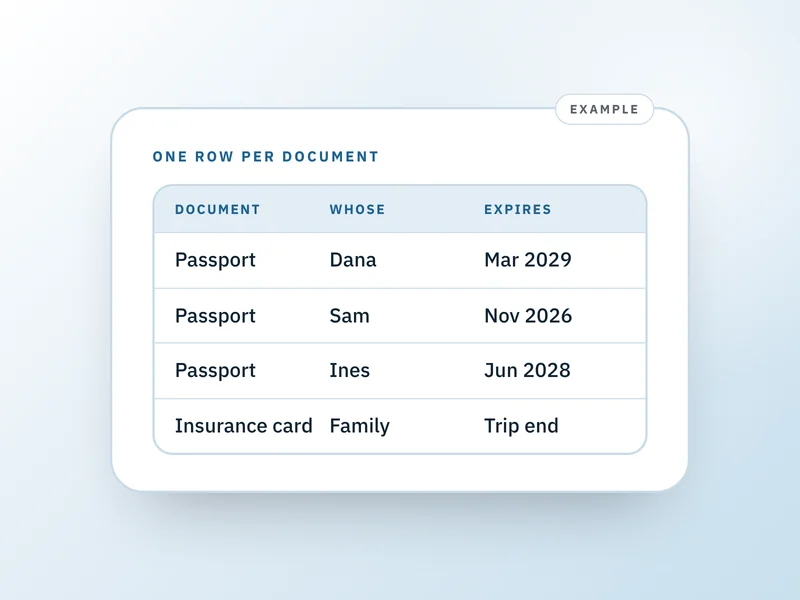 If this is where you areTravel document checklist: what to carry and whereFor the full list of what each traveler needs and where each document is kept, read this next.
- How to write a one-page trip itinerary
The printed page works best as a short timetable, and this shows what goes on each line.
- Lost passport, wallet or phone abroad: what to have ready
If the paper copy is all you have left, this covers what to gather and who to tell first.
- Night before a trip checklist: the fifteen-minute version
Do the printing the evening before with this short list of six checks that leave the morning free.