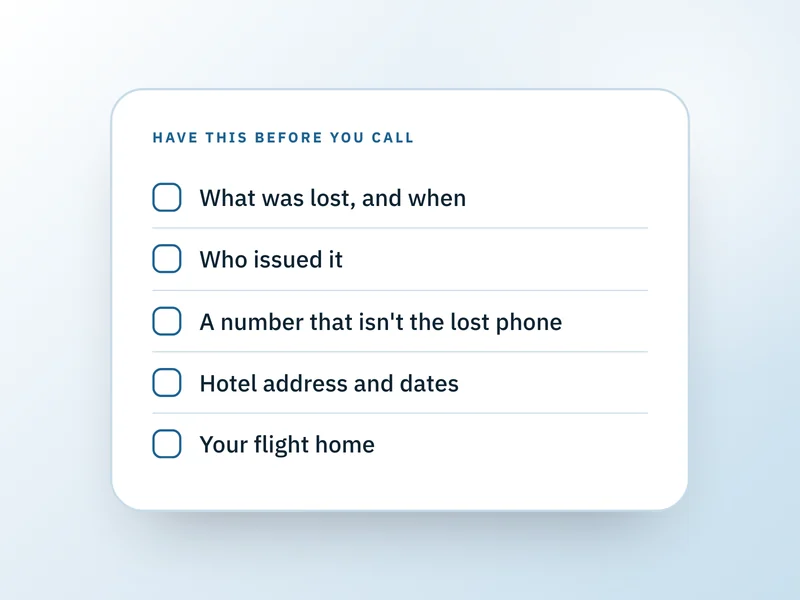
If your passport is gone abroad, report it to the local police, then contact the nearest U.S. embassy or consulate to replace it. If cards are gone, call the issuer first. If your phone is gone, lock or erase it from another device, then cover the accounts it opens. Before any call, write down what's missing, when you last had it and a number where you can be reached.
This is for U.S. citizens. The steps for a passport come from the State Department, and the rest depends on your bank, carrier and insurer. This guide can't tell you what an embassy will do in your case or how long it will take.
When it's not in the bag
Your passport isn't in the bag. Check the two obvious places, the hotel room safe and the last place you paid for something. If it's still gone, stop looking and start a page of notes, because the next hour is a series of calls, and each one asks you the same questions.
Have this in front of you first
Ten minutes of gathering saves a call you'd otherwise have to make twice.
6 things to do
Ticks are for this visit only. Nothing here is saved anywhere.
What to do, by what you lost
The order we'd follow: undo the damage first, then start the replacement.
Passport
- Do first
- Report to local police, note the report number
- Then
- Contact the nearest U.S. embassy or consulate to replace it
- Have ready
- Where and when it was lost, the police report, ID, travel plans
Bank cards or wallet
- Do first
- Call the card issuer, freeze the card
- Then
- Ask about a replacement card and cash options
- Have ready
- Card issuer's number, last purchase, where you are
Phone
- Do first
- Lock or erase it from another device, ask your carrier to suspend the SIM
- Then
- Change passwords, move two-factor codes
- Have ready
- Account logins, carrier account, a borrowed phone
Bag or tickets
- Do first
- Tell the airline, hotel or transport provider
- Then
- Ask for a replacement confirmation
- Have ready
- Booking references, names, what the bag looked like
| Lost | Do first | Then | Have ready |
|---|---|---|---|
| Passport | Report to local police, note the report number | Contact the nearest U.S. embassy or consulate to replace it | Where and when it was lost, the police report, ID, travel plans |
| Bank cards or wallet | Call the card issuer, freeze the card | Ask about a replacement card and cash options | Card issuer's number, last purchase, where you are |
| Phone | Lock or erase it from another device, ask your carrier to suspend the SIM | Change passwords, move two-factor codes | Account logins, carrier account, a borrowed phone |
| Bag or tickets | Tell the airline, hotel or transport provider | Ask for a replacement confirmation | Booking references, names, what the bag looked like |
If it's your passport
Report the loss to the local police as soon as you can, and note the police report number. Then contact the nearest U.S. embassy or consulate. The State Department's lost or stolen passport page says you'll fill in a replacement application, Form DS-11, and a statement that the lost passport is lost or stolen, Form DS-64, which the online DS-11 generates for you. If there isn't enough time to receive a regular passport, the consular section may offer an emergency passport, which the State Department says can be valid for up to a year. Embassies have after-hours duty officers for life-or-death emergencies, or if you need to travel or are the victim of a serious crime. How long it takes depends on the embassy, so ask at the first contact.
You need a new passport to fly home, so tell the embassy the date you're due to travel when you first call. The passport photo page you photographed before you left, or the one your travel companion has, helps with identity but is not a travel document.
If it's the wallet
Call the phone number on the back of the card or in the issuer's app. You'll be asked to confirm your identity, so have your name, address and recent transactions in mind. Ask them to freeze or cancel the card and ask what they can do abroad: an emergency replacement card, cash, or a temporary number. Then check the card is the only thing you lost. If your driver's license was in the wallet, note that TSA accepts identification up to two years past its expiration, and for someone with no acceptable ID, TSA offers an identity verification service called ConfirmID for a fee, which may help with a domestic connection. A passport in the wallet is the bigger problem, and it goes back to the section above.
If it's the phone
From another device, use your phone maker's find-my feature to lock it, and to erase it if you don't expect to see it again. Call your carrier to suspend the SIM, so no one can run up charges or intercept text codes. Then change the passwords on email and any accounts it opens, and move two-factor codes to another device. Photos and boarding passes stored on the phone will be gone from your hands too, which is why a printed copy helps. See what to keep on paper when you travel.
What to say
Use these as written or change the words. They are short on purpose, because you'll say them several times.
Pick the one you are facing
“My passport was taken at about 4 this afternoon near the train station. I need a written report with a number, because my embassy will ask for it.”
“My U.S. passport is lost. I'm due to fly home on Thursday. What do I need to bring, and what are my options for getting home?”
“I've lost my card while traveling. Please freeze it now. Can you send an emergency replacement to where I'm staying?”
“My passport is lost. I'm safe and I'm fine. I'll message from a borrowed phone and I may need you to call the bank.”
Do one thing at a time
Start with whatever is hardest to undo, which is often a card or a phone that gives access to accounts. Write down who you spoke to, when and what they said would happen next. Then tell one person you trust, in a sentence: what was lost, where you are and what you need. If your phone is gone, borrow one and use a number you know by heart.
What can go wrong
- Reporting to the bank and not the police, or the reverse. Passport loss goes to both police and the embassy.
- Erasing a phone before you've checked the taxi or the hotel desk. Lock it first, and erase only when you've given up.
- Not writing down who you spoke to, so a second call starts from zero.
- Leaving the phone as your only copy of boarding passes and the hotel address.
- Waiting to tell the embassy about your flight date.
Related guides
If you lose your only card and can't pay, the hotel desk guide covers what to say tonight. Before your next trip, the travel document checklist shows how to note where each document is kept, so you can say exactly what's gone. And the first international trip checklist covers sorting money and insurance early.
What the Companion does with this
In Travel Companion, dealing with something lost or stolen is a set of questions: a passport or ID, bank cards or a wallet, a phone, a bag or luggage, or tickets or booking confirmations. It helps you gather what you need before you make the call, and a separate Let somebody know step drafts the wording for someone with you, someone waiting to meet you or someone at home. The wording stays in your browser and isn't saved or sent. The steps for a passport, cards or a phone come from the sources above, since the Companion gives no embassy, police or legal steps. And it never stores a passport number, because there isn't a field for one. See the Travel Companion page.
Questions people ask
What do I do if I lose my passport abroad?
Report it to the local police and note the report number. Then contact the nearest U.S. embassy or consulate, tell them when you're due to travel, and ask what to bring. You'll fill out Form DS-11 and a lost or stolen statement, and the embassy decides between a regular and an emergency passport.
How long does an emergency passport take?
It varies by embassy and by your circumstances, so ask when you first contact them. The State Department says an emergency passport may be valid for up to a year, and it's issued when there isn't time to get a regular one. Tell them your flight date and they can advise on timing.
What should I do first if my wallet is stolen abroad?
Call the card issuers and freeze the cards, then report the theft to the local police for a report number. Ask each issuer what they can do abroad, such as an emergency replacement card or cash. Cancel anything else in the wallet that gives access to accounts.
What should I do if I lose my phone while traveling?
Lock or erase it from another device using your phone maker's find-my feature, and call your carrier to suspend the SIM. Change passwords for email and any accounts the phone opens, and move two-factor codes. Then tell one person that you're reachable on a different number.
Can I fly home without a passport?
Not generally: you need a passport or an emergency passport to enter the United States as a citizen. Contact the nearest U.S. embassy or consulate right away, tell them your travel date, and ask what documents to bring. The embassy decides what it can issue.
Sources and how we checked
- U.S. Department of State: lost or stolen passport abroad: Police report, contacting the embassy, DS-11 and DS-64, emergency passport up to one year, after-hours duty officers. Re-check the current wording on state.gov before relying on details.Checked 26 September 2026.
- TSA: acceptable identification: Expired ID accepted up to two years after expiration; ConfirmID verification for travelers without acceptable ID.Checked 26 September 2026.
Where to go next
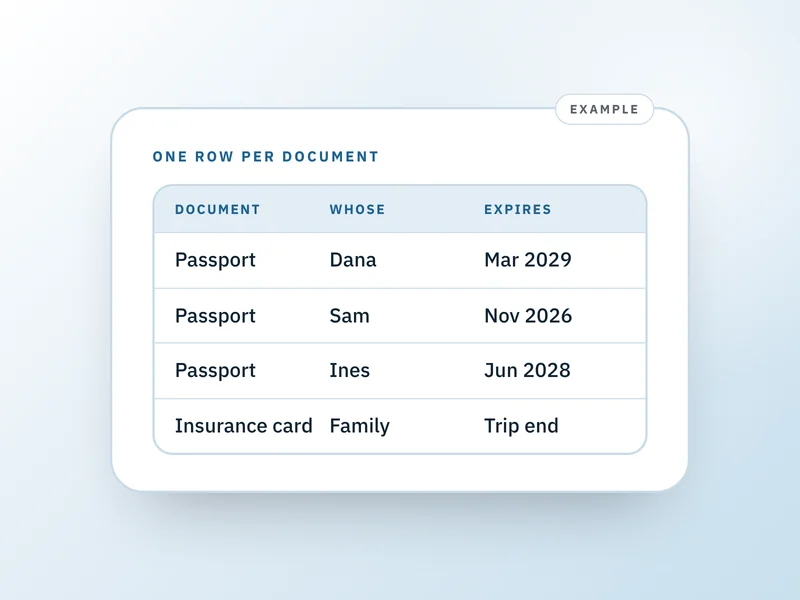 If this is where you areTravel document checklist: what to carry and whereBefore anything goes missing, this shows how to note where each document is kept so you can say what is gone.
- What to print before you travel: a one-page paper list
Paper copies and the hotel address in the local language help when a phone is the thing you lost.
- Hotel can't find your reservation: what to say
If the loss leaves you without a card or booking, this covers what to say at the hotel desk tonight.
- First international trip checklist: what to do and when
For a first trip abroad, this covers sorting money, insurance and phone before you leave, so a loss hurts less.