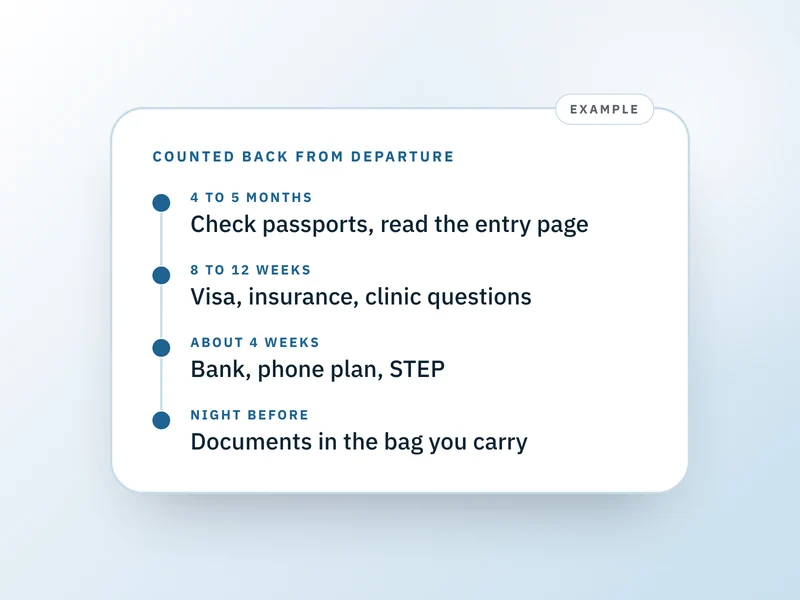
Start with the passport, because it's the one item you can't fix in a weekend. Check each traveler's expiry date, look up the destination's entry page for how much validity it wants, then book. After that come insurance, your bank card, your phone plan and enrolling with the State Department, and last comes the paper you carry.
This is written for U.S. citizens leaving the United States. It can't tell you what a particular country requires, because those rules differ and change. The destination's official entry page and the State Department's country information are the only place to confirm them.
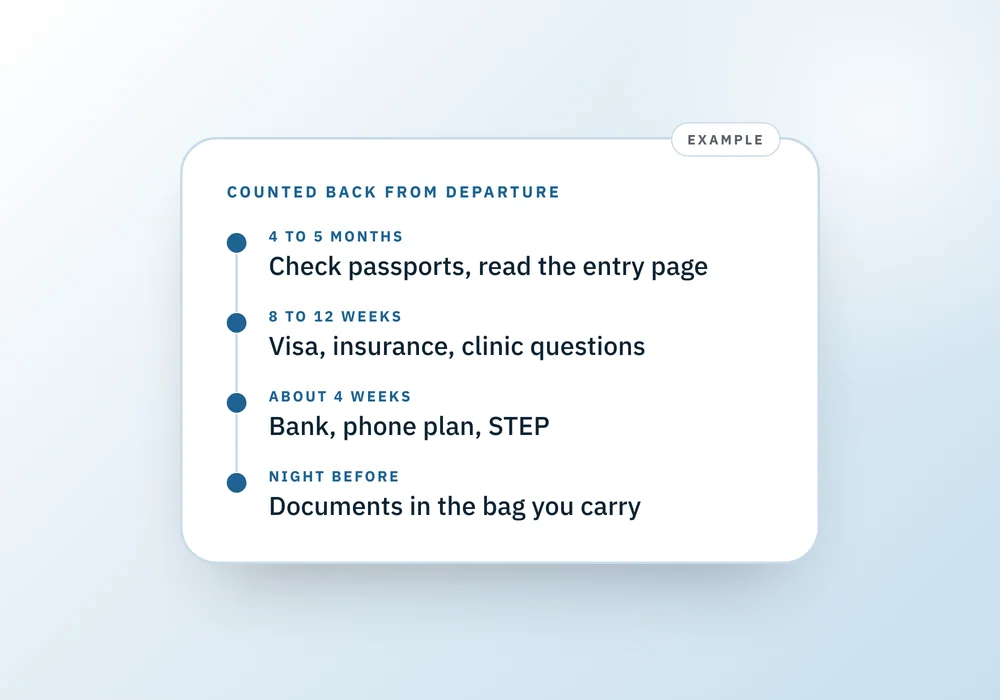
Example: working backward from a departure
An illustration of the order, not a rule about timing. Lead times are counted back from the day you fly, and the first row is the one people skip.
4 to 5 months out
- Job
- Read every passport's expiry. Open the destination's entry page.
- Why then
- A renewal can take weeks. The entry page may want months of validity left.
Before you pay for anything
- Job
- Check the visa or entry authorization question. Match names to passports.
- Why then
- A name that differs from the passport is easiest to fix at booking.
8 to 12 weeks out
- Job
- Start any visa or authorization. Get insurance quotes. Ask a doctor or travel clinic what the destination calls for.
- Why then
- Some of these have their own processing time.
About 4 weeks out
- Job
- Call your bank. Sort the phone plan. Enroll in STEP.
- Why then
- Each one is a ten minute job that's slow only if you leave it.
One week out
- Job
- Print one page of references. Confirm the airline's bag rules.
- Why then
- Leaves a week to fix what you find.
Night before
- Job
- Documents in the bag you carry, phone charged.
- Why then
- See the night-before list below.
| When | Job | Why then |
|---|---|---|
| 4 to 5 months out | Read every passport's expiry. Open the destination's entry page. | A renewal can take weeks. The entry page may want months of validity left. |
| Before you pay for anything | Check the visa or entry authorization question. Match names to passports. | A name that differs from the passport is easiest to fix at booking. |
| 8 to 12 weeks out | Start any visa or authorization. Get insurance quotes. Ask a doctor or travel clinic what the destination calls for. | Some of these have their own processing time. |
| About 4 weeks out | Call your bank. Sort the phone plan. Enroll in STEP. | Each one is a ten minute job that's slow only if you leave it. |
| One week out | Print one page of references. Confirm the airline's bag rules. | Leaves a week to fix what you find. |
| Night before | Documents in the bag you carry, phone charged. | See the night-before list below. |
The steps, in order
- Open every passport to the photo page and write the expiry date next to the person's name. Include children. If a date is close, renew before you book, not after. The State Department has been quoting about 4 to 6 weeks for routine service and 2 to 3 weeks for expedited, before mailing time, and it changes, so read the current figure on travel.state.gov.
- Find the destination's official entry information. Write down, in one line, how long the passport must stay valid, whether it wants blank pages, and whether you need a visa or an electronic authorization. Some countries ask for six months beyond your dates, and the State Department's own checklist says so. Check each country on the route, including any you only change planes in.
- Book with names exactly as they appear on the passport. Keep each confirmation and its reference in one place.
- Ask your doctor or a travel clinic what the destination calls for, and take your own prescriptions in their original packaging. CBP advises carrying medication prescribed to you, and carrying your travel documents rather than packing them.
- Buy travel insurance if you want it, and first ask your health insurer two things: does it cover care outside the U.S., and does it pay to get you home. Write the policy number and the assistance line on your paper page.
- Call your bank or card issuer. Ask whether it charges a fee on purchases abroad, and whether it wants to know you're traveling. Take a second card that lives in a different bag.
- Sort your phone. Ask your carrier what an international plan costs, or whether your phone can take an eSIM or a local SIM. Bring a plug adapter for the country you're visiting.
- Enroll in the State Department's Smart Traveler Enrollment Program. It sends you alerts from the U.S. embassy for your destination and helps the embassy reach you or your emergency contact if something happens.
- Print one page: the address of where you're staying in the local language, booking references and phone numbers, the insurance line, one contact at home. Keep a copy of each passport's photo page in a different bag from the passport. What to keep on paper when you travel has the full list.
Coming home is part of the trip
Coming back into the U.S., CBP says the duty-free exemption is $200, $800 or $1,600 depending on where you've been, and you declare what you bought abroad on a customs declaration. Keep the receipts. If you carry more than $10,000 in cash or monetary instruments, you file FinCEN Form 105. Food, plants and animal products are the usual surprise, and CBP wants agricultural items declared and shown to an officer. Officers can ask questions and search bags, so repack without rushing.
CBP also suggests registering new electronics like a camera or laptop before you go if they're less than six months old, with Form 4457, so you can show they were yours when you left.
What goes wrong on a first trip
These are the ordinary failures, each avoidable with a date or a phone call.
- The passport is valid on paper but not for the destination's rule. Cheap to fix in the spring, expensive at the check-in desk.
- The rule you read was for your destination, and you missed the country you connect through.
- The name on the ticket has a middle name or a spelling the passport doesn't.
- The card is declined on day one because the bank didn't recognize the country, and it's your only card.
- The phone is the only place the hotel address and confirmations live, and it's at four percent in a taxi. If that happens, what to do if a passport, wallet or phone is lost abroad covers the first hour.
Where Travel Companion fits
Travel Companion has a Documents section where you record each passport, visa and insurance policy: whose it is, where it's kept and its expiry date. If a date falls before or during the trip, or in the six months after, it shows under "Dates worth a look". It only compares the dates you typed and states no country's rules, so the entry page stays your job. The Preparation list takes to-dos in seven kinds (Documents, Packing, Transport, Money, Home, People, Bookings) that you tick off by hand, and it holds one trip at a time, the one you're about to take. Details are on the Travel Companion page.
The last evening
Once the weeks of admin are done, the last night is a ten minute check, not a new job. The night-before list covers it, and the travel document checklist goes deeper on who carries which passport.
Questions people ask
How far in advance should I prepare for my first international trip?
Four to five months is comfortable, because the slow parts are passport renewal, a visa or authorization, and anything a doctor needs to see you for. If your passports are valid and the destination needs nothing extra, a few weeks is workable, but you won't know that until you've checked.
How long should my passport be valid for international travel?
It depends on the country. The State Department's checklist notes that some countries, especially in Europe, want at least six months of validity after your travel dates. Others need less. Check the entry page for every country on your route, including connections, and write the answer beside the expiry date.
Do I need travel insurance for my first international trip?
No rule says every traveler must buy it, and some countries require proof of coverage. Ask your own health insurer whether it covers you abroad and whether it pays for transport home. If either answer is no, decide whether you're comfortable with that before you pay for nonrefundable bookings.
Should I tell my bank I'm traveling?
Ask your bank or card issuer. Some want a travel notice, others handle it inside their app, and some charge a fee on foreign purchases. Ask the fee question too. Either way, carry a second card and keep it in a different bag from the first.
What is STEP and should I enroll?
STEP is the State Department's Smart Traveler Enrollment Program. When you enroll, you get alerts from the U.S. embassy or consulate for your destination, and the embassy can reach you or your emergency contact in an emergency. It takes a few minutes, so we'd do it once your bookings are made.
What do I need to declare when I come back to the U.S.?
You declare what you bought abroad, keep the receipts, and declare food, plants and animal products. CBP says the duty-free exemption is $200, $800 or $1,600 depending on where you traveled. Cash or monetary instruments over $10,000 need FinCEN Form 105. Read CBP's page before you fly home.
Sources and how we checked
- U.S. Department of State: International Travel Checklist: Six months of validity for some countries, STEP enrollment. The page returned 403 to the fetch tool, so this comes from search excerpts of the page; verify before publishing.Checked 26 September 2026.
- U.S. Department of State: Get Your Processing Time: Routine 4 to 6 weeks and expedited 2 to 3 weeks, before mailing. Also a 403; from search excerpts. Figures change.Checked 26 September 2026.
- CBP: Know Before You Go, Traveling Abroad: Carry documents, prescription medications, Form 4457 for electronics, $10,000 reporting, match names.Checked 26 September 2026.
- CBP: What to Expect When You Return: $200, $800 or $1,600 exemptions, declaration form, inspection.Checked 26 September 2026.
- CBP: Prohibited and Restricted Items: Declare agricultural items; own prescribed medication.Checked 26 September 2026.
Where to go next
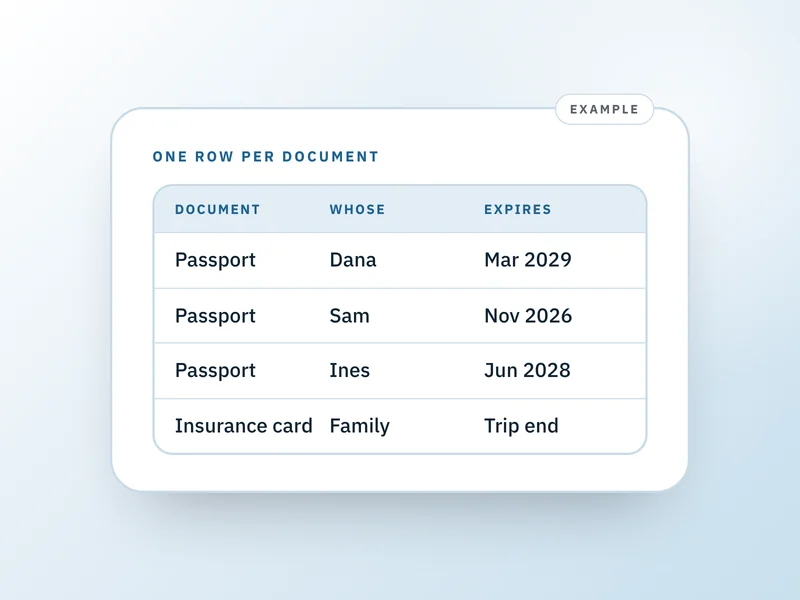 If this is where you areTravel document checklist: what to carry and whereOnce the rules are checked, this covers the documents each traveler carries and where to note each one.
- Night before a trip checklist: the fifteen-minute version
On the last evening, this six-check list confirms nothing from the timeline was missed.
- Lost passport, wallet or phone abroad: what to have ready
Know who to tell and what to gather if a passport, wallet or phone disappears abroad.
- Packing list for a week away, by person
After the paperwork, this shows how to build a packing list by person that you can tick off.