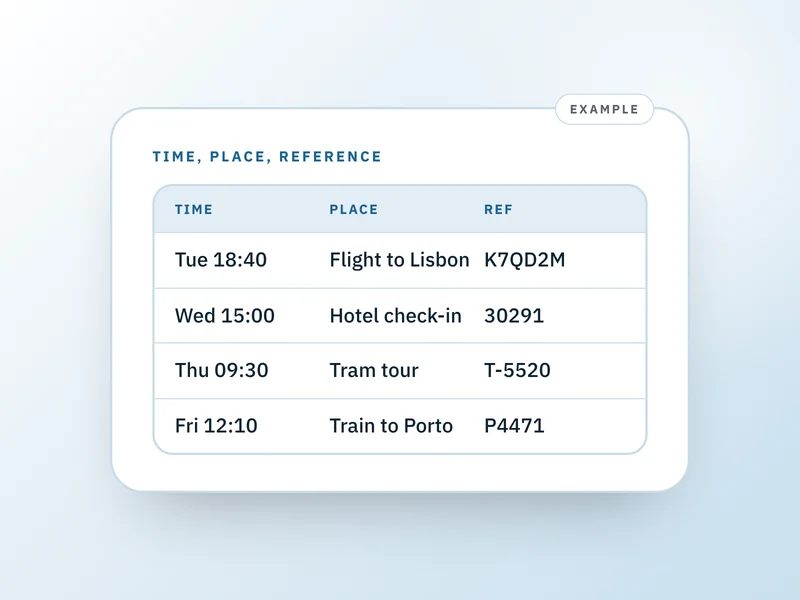
A one-page trip itinerary is a timetable, not a guidebook: one line per booking, in time order, with the time, the place and the confirmation reference. Group the lines by day, leave unbooked ideas off, and print it. If a line changes, you can see what it touches.
This is for trips with several bookings, alone or with others. It won't plan the trip for you and it doesn't suggest what to do, because it only records what's already booked.
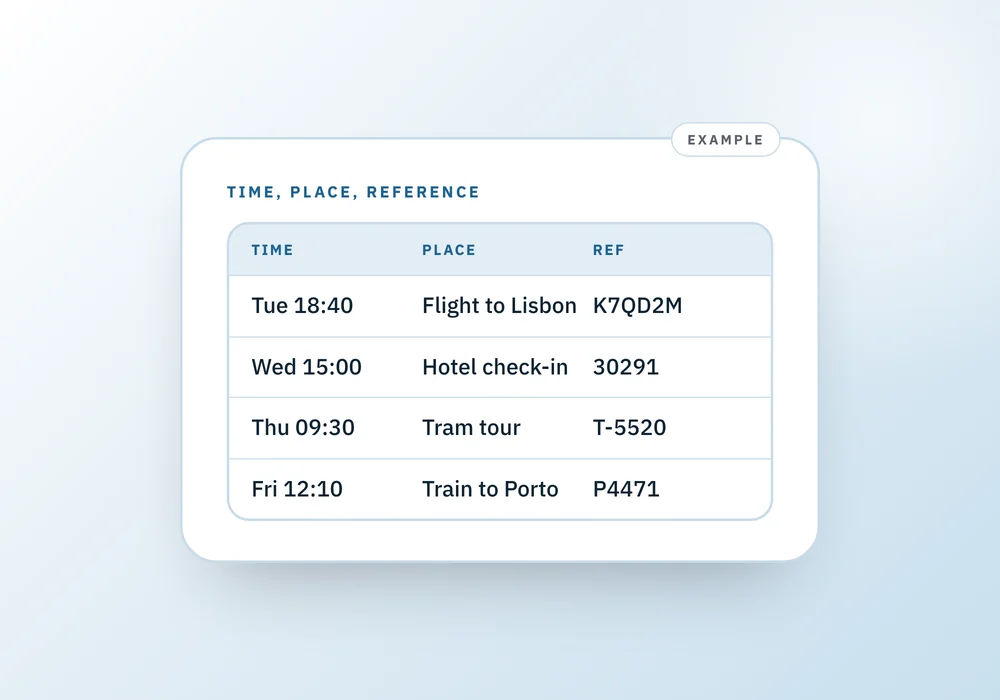
Example: three days of a longer trip, on one page
An illustration with invented bookings. Each line answers three questions: when, where and which booking. Note the Wednesday flight lands at 07:55 but hotel check-in is 15:00. That gap is visible on the page, which is the point.
Tue 14 Oct, 18:40 (New York)
- Place
- Flight to Lisbon, terminal 1
- Reference
- Ref K7QD2M
Wed 15 Oct, 07:55 (Lisbon)
- Place
- Land. Shuttle to hotel
- Reference
- Shuttle ref 8841
Wed 15 Oct, 15:00
- Place
- Hotel check-in, Rua das Flores 12
- Reference
- Hotel ref 30291
Thu 16 Oct, 09:30
- Place
- Tram tour, Praca do Comercio
- Reference
- Ticket ref T-5520
Fri 17 Oct, 12:10
- Place
- Train to Porto
- Reference
- Train ref P4471
Sun 19 Oct, 10:45
- Place
- Flight home
- Reference
- Ref K7QD2M
| Time | Place | Reference |
|---|---|---|
| Tue 14 Oct, 18:40 (New York) | Flight to Lisbon, terminal 1 | Ref K7QD2M |
| Wed 15 Oct, 07:55 (Lisbon) | Land. Shuttle to hotel | Shuttle ref 8841 |
| Wed 15 Oct, 15:00 | Hotel check-in, Rua das Flores 12 | Hotel ref 30291 |
| Thu 16 Oct, 09:30 | Tram tour, Praca do Comercio | Ticket ref T-5520 |
| Fri 17 Oct, 12:10 | Train to Porto | Train ref P4471 |
| Sun 19 Oct, 10:45 | Flight home | Ref K7QD2M |
How to write it
- Collect every confirmation in one sitting. You want the time, the place and the reference for each.
- Write one line per booking, with the time exactly as it appears on the booking. If you cross time zones, write local time and say so, as in "18:40 (New York)". The line for a landing is in the destination's time, not yours.
- Put the lines in time order and give each day its own block. Fixed things first: flights, trains, check-in, anything with a reserved time.
- Write the place in a few words. A name and a town are enough. Leave the address for the paper page described in what to keep on paper when you travel.
- Copy the confirmation reference beside the line, not in an inbox.
- Mark what depends on what. A shuttle built on a flight, a check-in built on a train. When the first moves, the rest need a look, which is the subject of what else in your trip is affected when a flight changes.
- Leave the rest of each day empty on purpose. An empty afternoon isn't a hole in the plan, it's slack.
What to leave off
5 things to do
Ticks are for this visit only. Nothing here is saved anywhere.
When it doesn't work
A page that runs to two sheets is usually a guidebook in disguise. If you can't fit it on one side, move the unbooked material to a separate note and look again. If the trip is genuinely long with many stops, do one page per stop and a summary page on top, and see organising a multi-stop trip. If several people are traveling, add a name to each line, the way how to plan a group trip does.
The other failure is stale paper. An itinerary printed a month ago and never updated is worse than none, because you'll trust it. Change the page when a booking changes, and reprint the night before, per the night-before list.
What the Companion does with this
In Travel Companion you name the trip and give it rough dates, and it's laid out day by day at once. You add each booking with its reference, its time and, if it rests on something else, what it depends on. Add the upstream booking first, because the dependency has to be picked when the booking is created. A day with nothing recorded says so and isn't filled in for you. Save as PDF makes the itinerary, and a separate button makes a one-page trip card. Dates print like "Wed 8 Oct" and times as "15:00", so a 3 p.m. check-in shows as 15:00. It records bookings you made elsewhere by hand. It doesn't book anything, track flights or suggest places. See the Travel Companion page.
Questions people ask
What should a trip itinerary include?
For each booking: the time, the place and the confirmation reference. For a group, add who's on it. Everything else, such as opening hours, ideas or long descriptions, belongs in a separate note. If you can't tell at a glance where to be, the page has too much on it.
How detailed should an itinerary be?
Detailed enough to act on, short enough to fit on one side. One line per booking is plenty. Leave the empty spaces in each day empty. If you find yourself adding descriptions, you're writing a guidebook.
How do I handle time zones on an itinerary?
Write the local time of each event and label the place, for example 18:40 (New York) for a departure and 07:55 (Lisbon) for the arrival. Don't convert to your home time. The booking shows local times, so the page should match it.
Should I print my itinerary?
Yes. A printed page works when the phone doesn't, and you can hand it to whoever is meeting you. Print two copies and keep them in different bags. Reprint if anything changes.
How do I share a group itinerary?
Send the page itself, as a file or a printout, rather than a link to a chat. Add the names of the people on each line, so everyone can see which items are theirs.
Where to go next
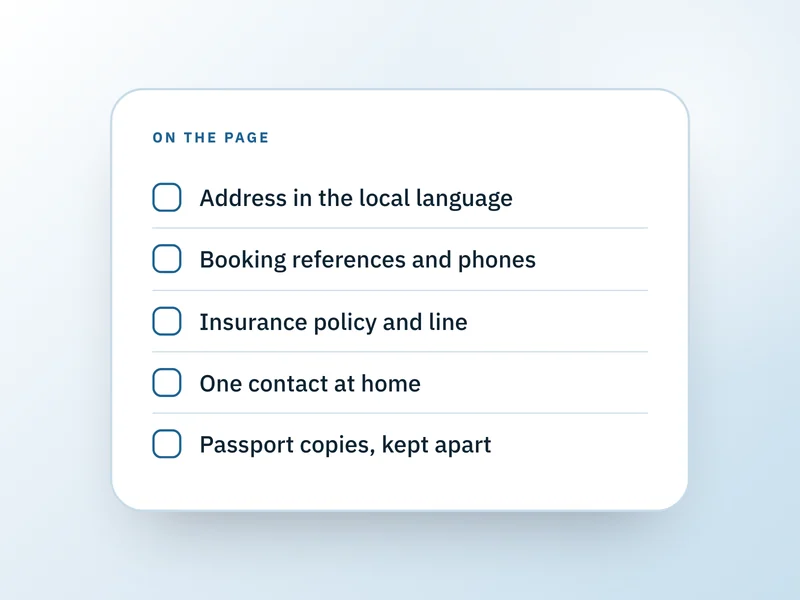 If this is where you areWhat to print before you travel: a one-page paper listWith the itinerary written, this covers what else belongs on paper and why to print two copies.
- Multi-stop trip planner: organize it without a spreadsheet
For a trip with many bookings resting on each other, this shows how to record them without a spreadsheet.
- How to plan a group trip (without being the organizer)
A one-page itinerary is also what you send the group, and this covers who books what and who is on it.
- Flight schedule changed? What else in your trip to check
When a departure time moves, this shows which lines on the itinerary need checking first.