When an airline changes your flight, do two things in order. First, decide about the flight itself: accept the new time, ask for a free change, or ask for a refund if the change is big enough. Then walk through everything you booked after that flight and check each item against the new time, one at a time.
This is written for trips on U.S. airlines, where the Department of Transportation sets the refund rules. It can't tell you what your particular fare allows, and it doesn't cover compensation for a delay.
Example: a 3 hour 15 minute change
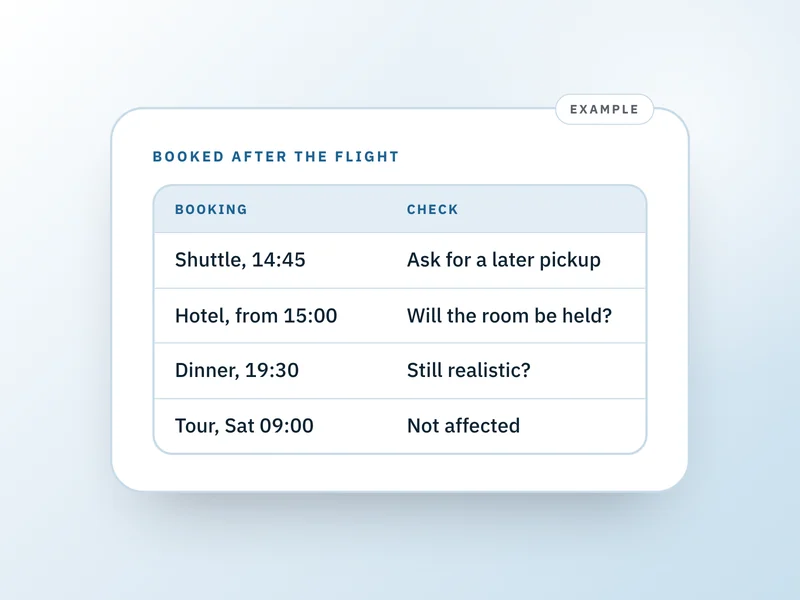
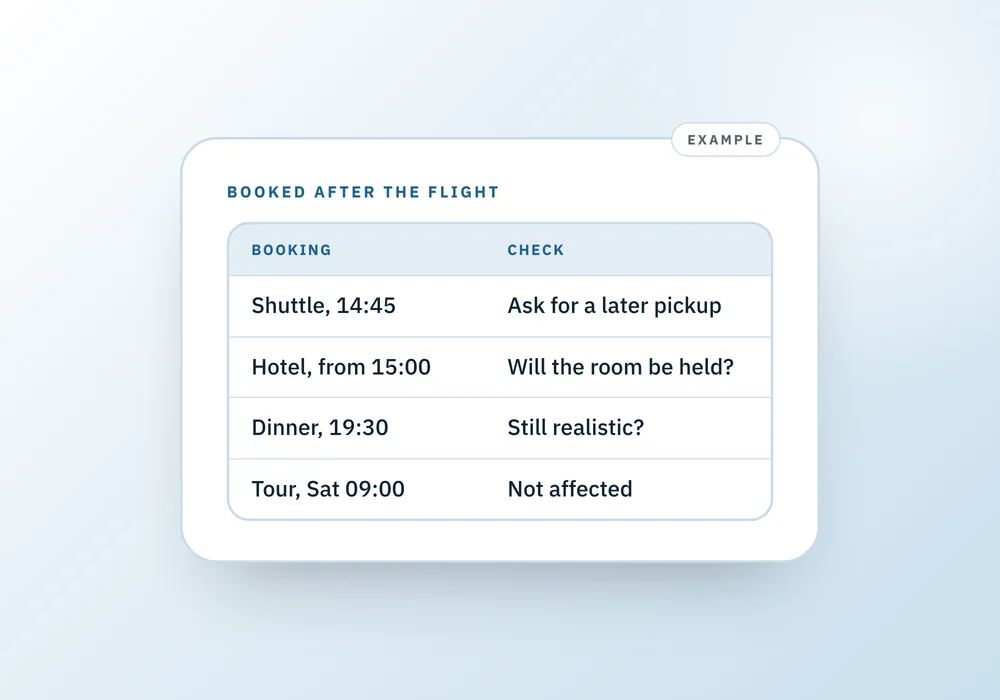
Say the email arrives on a Tuesday. Your domestic flight, which was due to land at 14:10 on Friday, now lands at 17:25. Nothing else in your trip has been told. This is what was booked around it, in the order it happens.
What that flight was holding up
An illustration. The last column is what you'd do, and only the first three rows need anything.
Airport shuttle, pickup 14:45
- Built on the flight?
- Yes, it waits for the landing
- What to check
- Is there a later pickup, and by how much notice?
- Who to tell
- The shuttle company
Hotel check-in from 15:00
- Built on the flight?
- Yes, through the shuttle
- What to check
- Will the room be held for a 19:00 arrival?
- Who to tell
- The front desk
Dinner, Friday 19:30
- Built on the flight?
- Yes, indirectly
- What to check
- Bags, ride and check-in leave about an hour. Is 19:30 still real?
- Who to tell
- The restaurant
Tour, Saturday 09:00
- Built on the flight?
- No, it's the next day
- What to check
- Nothing, unless the hotel changes
- Who to tell
- No one
Flight home, Monday
- Built on the flight?
- No, it comes after the trip
- What to check
- Nothing
- Who to tell
- No one
| Booked | Built on the flight? | What to check | Who to tell |
|---|---|---|---|
| Airport shuttle, pickup 14:45 | Yes, it waits for the landing | Is there a later pickup, and by how much notice? | The shuttle company |
| Hotel check-in from 15:00 | Yes, through the shuttle | Will the room be held for a 19:00 arrival? | The front desk |
| Dinner, Friday 19:30 | Yes, indirectly | Bags, ride and check-in leave about an hour. Is 19:30 still real? | The restaurant |
| Tour, Saturday 09:00 | No, it's the next day | Nothing, unless the hotel changes | No one |
| Flight home, Monday | No, it comes after the trip | Nothing | No one |
Step one: decide about the flight
Before you touch the hotel, settle what you're doing about the flight, because everything else follows from it. You have three real options: accept the new time, ask the airline for a different flight at no charge, or, if you'd rather not travel at all, ask for a refund.
The refund option depends on how big the change is. Federal regulation 14 CFR 260.2 defines a significant change as a departure at least 3 hours earlier or an arrival at least 3 hours later on a domestic flight (6 hours on an international one), or a different airport, an added connection, or a downgrade in class of service. Our example flight, 3 hours 15 minutes later, meets the domestic line. If your change does, and you'd rather not fly, ask the airline in those words whether it's a significant change and whether you can have a refund instead of a credit. DOT has been revising parts of its refund rules, so check the current wording on its site before you rely on a number.
Step two: walk downward through what depends on it
Do this on paper or in a note. It takes ten minutes and saves the guessing.
- Write the old time and the new time, side by side, with the booking reference and the name it's under.
- List everything you booked that comes after the flight in time: the transfer, the check-in, the first night's dinner, a pickup, a rental car.
- For each item, write the one thing it was built on. A check-in is usually built on a transfer, and a transfer on a flight.
- Go down the list in order. For each item ask whether it still works with the new time. Often two of five are fine.
- Fix one item, write the new fact beside it, and only then move to the next.
- Tell the people who were counting on the old time: whoever was meeting you, and anyone traveling with you who's on a different booking.
Only walk downward. A later booking can depend on an earlier one, and not the other way around. A changed check-in doesn't move your flight, and knowing that halves the list.
Words for each call
Say what changed, then say what you need. Use these as written or change them.
Pick the one you are facing
“My flight was changed from 14:10 to 17:25. Is that a significant change under the refund rule, and if it is, can I have a refund instead of the new time?”
“The new time breaks my plans. Is there another flight the same day, or the day before, that you can move me to at no charge?”
“My flight moved, so I'll arrive around 19:00 instead of 15:00. Can you note that and confirm the room will be held?”
“My flight now lands at 17:25 instead of 14:10. Can you move my pickup, and what happens if it lands later still?”
What can go wrong
- You accept the change in an app before asking about a refund. Ask first if you might want one, because tapping accept can be treated as agreeing to the new flight.
- The flight moved earlier, not later. That's worse in one way: it can break your ride to the airport and a checkout, not just what follows the landing.
- Your connection was on a separate ticket. The airline that changed the first flight may not owe you anything on the second. See what to do when a delay costs you a connection.
- You cancel the wrong booking in a hurry. Cancel nothing until you've changed the thing that moved and written down its new time.
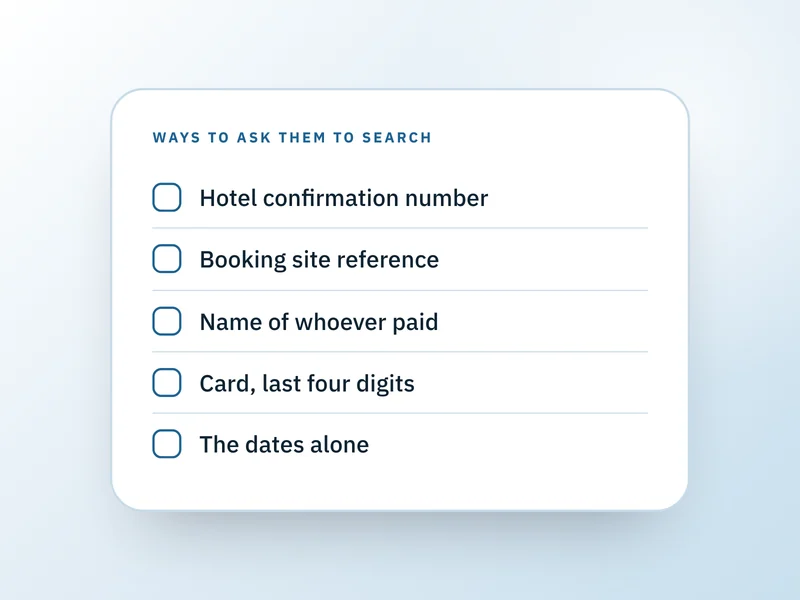
- The hotel took your late arrival note and still gave the room away. Get the name of who you spoke to, and read what to say when the hotel can't find your reservation.
Questions about a changed flight
Can I get a refund if the airline changes my flight time?
Sometimes. Under 14 CFR 260.2 a change counts as significant at 3 hours or more on a domestic flight and 6 hours or more on an international one, as well as a different airport, an added connection or a downgrade. If yours does and you don't want the new flight, ask for a refund rather than a voucher. Rules are being revised, so confirm the current wording.
What counts as a significant schedule change?
The regulation lists departing at least 3 hours earlier or arriving at least 3 hours later on a domestic flight, and 6 hours on an international one. It also lists a different origin or destination airport, more connection points, and a lower class of service. A shift of 30 or 45 minutes generally isn't on that list, though it can still break a tight connection.
Should I cancel my hotel when my flight changes?
Not first. Call the hotel, say your arrival moved and ask them to hold the room. Cancel only if you decide not to go. A nonrefundable rate can cost you the whole stay, so check the terms before you cancel anything, and keep the name of whoever you spoke to.
What if the new flight makes me miss my connection?
Tell the airline that the change broke the connection and ask them to rebook you. If both flights are on one ticket, that's normally theirs to solve. On separate tickets each airline treats its own segment as its own trip, so you may have to buy a new one. Check how you booked before you call.
How do I find out what else a flight change affects?
List what you booked after the flight and write beside each one what it was built on. Then go down the list in time order and check each against the new time. Later bookings depend on earlier ones, and never the reverse, so anything before the flight is safe.
Where a Companion helps
Travel Companion is built around this walk. When you add a booking, you say which earlier booking it depends on. Later, when you record the flight's new time with Record a change, it lists every booking downstream of it, with its current time, marked unchanged so far. It edits none of them for you, and it only knows the change because you typed it in. There's also a flight-problem walkthrough with an opening line you can use or replace. One catch: you choose what a booking depends on when you add it, so add the flight before the transfer, and the transfer before the check-in.
Sources and how we checked
- 14 CFR 260.2, Definitions (significantly delayed or changed flight): Significant change: 3 hours domestic, 6 hours international, different airport, added connection, downgrade.Checked 26 September 2026.
- 14 CFR 260.4, Ancillary service refunds: Fees for services not delivered after a cancellation or significant change must be refunded automatically.Checked 26 September 2026.
- JetBlue: Delays and cancellations: Example of an airline's own rebooking path (Manage Trips, app, contact).Checked 26 September 2026.
Where to go next
 If this is where you areHotel can't find your reservation: what to sayOnce you know which bookings hang off the flight, this covers what to do when the hotel desk has no record of yours.
- Flight delayed with a connection: what to do first
If the change is a delay with a connection to catch, this covers the first twenty minutes and what to say at the desk.
- How to write a one-page trip itinerary
A short itinerary with a reference beside each booking makes it quick to see what a new departure time knocks over.
- Multi-stop trip planner: organize it without a spreadsheet
With many stops, every booking rests on another, so this shows how to record what depends on what.