Before anyone books, settle four things in writing: who is in, who books each thing, what's fixed versus optional, and where the answers live. Then keep one list of bookings with a name beside each and the people attached. That list ends most of the messages that start with "what time are we leaving".
This is for the person who ends up running a trip for four to twelve people, whether or not they wanted the job. It doesn't cover picking a destination by vote or splitting the money, which are separate problems that need their own tools.
The 14 messages
Say you open your phone and there are 14 unread messages in the group chat. Three of them ask what time you're leaving Thursday. One asks whether Lee is on the rental car. One is a photo of a menu. You know the answers, and so does the person who asked last week. The trouble is that the answers live in your head and in six email threads, so every question comes to you.
Example: the one page that stops the questions
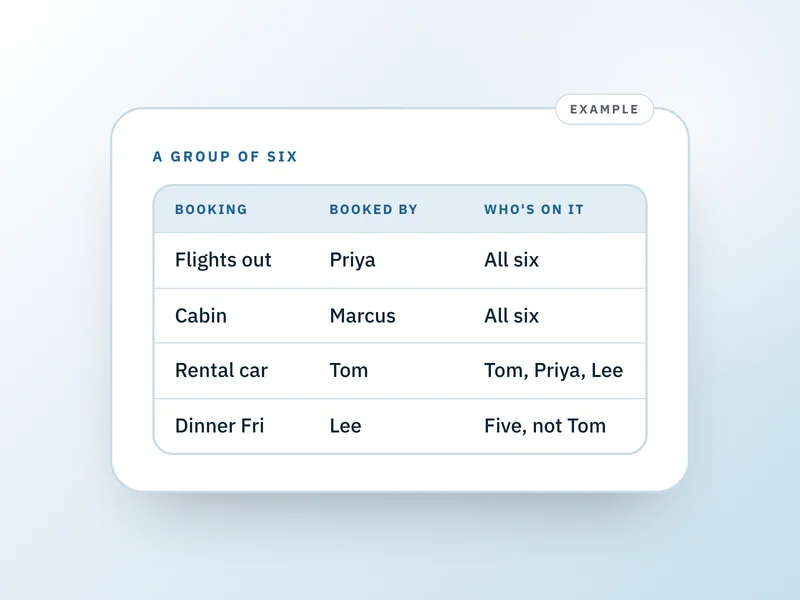
An illustration for a group of six. Every row answers two questions at once: whose job is it, and who does it involve. The dinner row is the one that saves an argument, because Tom knew he was skipping it and nobody else did.
Flights out, Thu 9:15
- Booked by
- Priya
- Who's on it
- All six
- Reference
- Priya's email
Cabin, 3 nights
- Booked by
- Marcus
- Who's on it
- All six
- Reference
- Marcus, ref on his page
Rental car
- Booked by
- Tom
- Who's on it
- Tom, Priya, Lee
- Reference
- Tom's email
Dinner Friday, 7:30
- Booked by
- Lee
- Who's on it
- Five, not Tom
- Reference
- Restaurant, Lee
| Booking | Booked by | Who's on it | Reference |
|---|---|---|---|
| Flights out, Thu 9:15 | Priya | All six | Priya's email |
| Cabin, 3 nights | Marcus | All six | Marcus, ref on his page |
| Rental car | Tom | Tom, Priya, Lee | Tom's email |
| Dinner Friday, 7:30 | Lee | Five, not Tom | Restaurant, Lee |
The method
- List everyone who is definitely in, and everyone who is a maybe with a date you'll stop waiting. A maybe with no deadline holds up every booking.
- List what needs booking: transport, lodging, anything with a reserved time. For each, name one person who makes the booking. Not who pays, who makes it.
- Mark each item fixed or optional. Flights and lodging are usually fixed. Everything else should be optional in plain words, so nobody feels obliged to join the museum.
- Write down who is on each booking. Four on the flight, three in the car, five at the dinner. This is the step people skip, and it's the one that stops someone discovering at the airport that they were never on a booking.
- Note what each person needs once: meals, a seat, mobility, medication that changes timing. Recorded against the person, it's there when a booking is made, not remembered afterward.
- Put the answers on one page and send that page, not a link to a chat. See how to write a one-page trip itinerary for the layout.
Three messages worth having ready
Use them as written or change the words. The point is to say what you'll do and by when.
Pick the one you are facing
“I'm booking the cabin Sunday night. If you're in, tell me by then. If I haven't heard, I'll book for the people who've said yes.”
“Thanks for telling me early. I'll take you off the flight and the cabin list today. If you need anything from the booking, ask me now.”
“The flight moved to 11:40. That affects everyone on it, and I'm checking what else it touches before I tell you about the car.”
When something moves, it moves for some of you
The hard part comes when something moves. A delayed flight affects the four people on it, not the two who came separately, and working out who to tell is a job of its own. Look up what depends on what, the way what else your trip depends on does, then add one question: which of these people are on it? If the group splits across stops, organising a multi-stop trip without a spreadsheet helps with the dependencies.
What can go wrong
- One person books everything and everyone assumes they know the details. Spread the booking, but keep the page in one place.
- Optional things drift into being mandatory. Say "optional" out loud.
- Someone isn't on a booking they thought they were. Check the who's-on-it column before the week of travel.
- Half the group never opens the shared document. Print or send the page, and see what to keep on paper when you travel.
- Money. Nothing here settles who owes whom, and we'd settle that before deposits go down, in writing.
What the Companion does with this
Travel Companion holds one traveler list, links each booking to the people actually on it, and keeps each person's requirements, such as meals or a seat. When you record a change to one booking, it shows what was built on top of it, so working out who to tell starts from what's recorded. It's one person's record, not a shared one: travelers don't get accounts, and there's no share link. To hand the shape of the trip to the others, send the itinerary PDF or the one-page trip card. It also doesn't split costs. See the Travel Companion page.
Questions people ask
How do you plan a group trip without being the organizer?
You can't fully avoid the job, but you can shrink it. Give each booking to a named person, put the answers on one page anyone can read, and mark what's optional. The organizer's load drops when questions become lookups instead of decisions.
What is the best way to keep a group trip organized?
One page with each booking, who made it, who's on it and the reference. Everything else is detail. Send that page rather than pointing people at a chat thread, and update it whenever something changes.
How far ahead should you plan a group trip?
Book the fixed things, flights and lodging, as soon as the group is settled and you've put a deadline on the maybes. Leave optional things loose. Prices and availability change, so we'd avoid giving a fixed number of months.
How do you handle someone dropping out of a group trip?
Ask them to tell you early, take them off each booking they were on, and check whether any of those bookings has a per-person price or minimum. Then tell the rest of the group what changed, not only who left.
What should a group itinerary include?
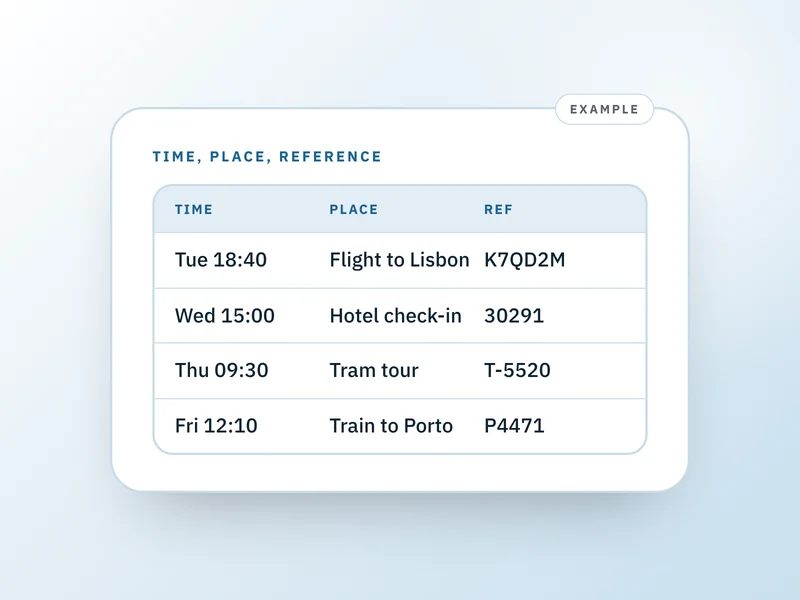
Time, place and reference for each fixed item, with the names of the people on it. Leave off unbooked ideas and unconfirmed hours. Keep those in a separate note so the page stays short enough to be read.
Where to go next
 If this is where you areHow to write a one-page trip itineraryAfter deciding who books what, this shows how to write the one page you hand to everyone else.
- Multi-stop trip planner: organize it without a spreadsheet
When the group splits across stops, this shows how to record which bookings depend on which.
- Traveling with kids or a baby: packing and planning
If some of the group are children, this covers what to pack per child and how to plan a day with slack.
- What to print before you travel: a one-page paper list
Not everyone will open a phone app, so this covers the paper page worth handing out.