Next: one step, on a page of the book, showing what the answer becomes
Who decides, and who to call
One thing worth taking care of.
Write down who should be called first.
Everything else assumes somebody knows to look. If nobody knows to call, nothing else on this list is ever found.
About 2 minutes
Personal Life Affairs Companion
Everything the people you love would need to find, in one place and kept current. It tells you the one next step, skips whatever does not apply to you, and prints a book you can hand over when you are ready.
One payment. Yours for life.
Only you can see your data. It saves to your account, on every device.
What you end up with
- One next step at a time, with why it matters and roughly how long it takes
- A current picture of what has been established about your affairs, by area
- My Affairs, a printable book somebody who has never used this could pick up and use
- A record of what changed, and when, and what it said before
- Delivery
- In your account the moment you pay
- Runs on
- Any browser, or installed as its own app
- Renews
- Never. One payment, kept for good
On your devices
It works like an app, without an app store.
Affairs runs in your browser, and installs to your phone from there. No App Store, no Play Store, no download, and no update to remember. Add it once and it gets its own icon and its own window, like any other app on your phone.
On iPhone and iPad
Open it in Safari, tap Share, then Add to Home Screen. It opens full screen from then on, with no browser bar.
On Android
Chrome offers to install it, or you can tap Install in the product's own settings. One tap and it is on your home screen.
On computers
It works in any modern browser as it is. Chrome and Edge will also install it as its own desktop window if you would rather it were not a tab.
- A hand-built list of 46 things that belong in order, across eight areas of life
- 105 questions answered in a sentence, one at a time, only where they apply to you
- Personalisation from eight questions, so a simpler life makes a genuinely shorter product
- Forty-one entries that come back for a second look, each on its own interval
- Where your executor stands on proving their authority, so nobody finds out at a bank counter
- Nine life events, from moving to separating to a named person dying, each bringing forward what it made untrue
- My Affairs: a printable book, blank to fill in by hand or current with everything recorded
- The book opens on "if you need to": most urgent first, not a contents page to translate
- A handoff check on whether somebody else could manage, by what they'd be trying to do
- A record of every change, so you can still see what it used to say
- A private, real account, not a shared demo
Works in any modern browser · No download required
What this solves
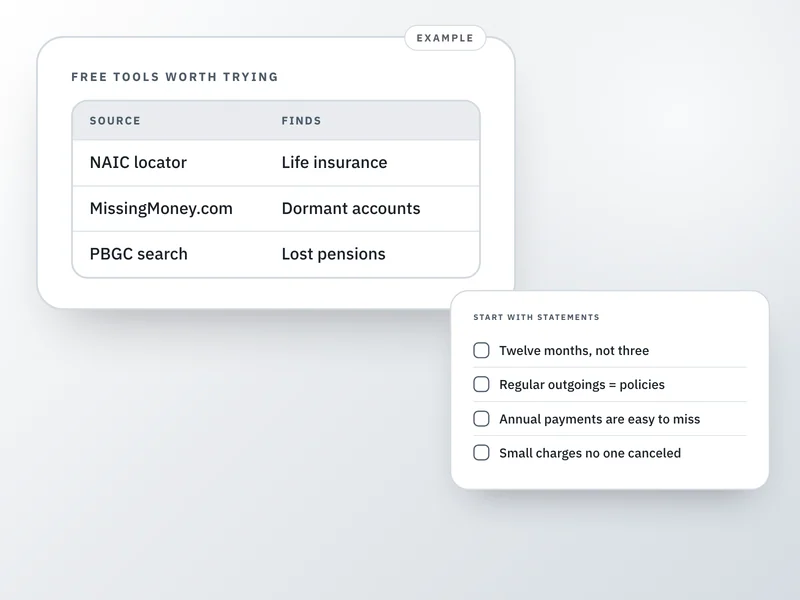
Almost everybody means to get this done. Where the will is. Who to call. Which pension is with whom. The reason it never happens is not that people are careless: it is that nobody knows what the list is, so the job has no beginning, and a folder of blank forms is exactly the thing nobody starts. Meanwhile the form naming who receives a pension quietly overrides a will, and it is usually the one filled in on somebody's first day at a job they left years ago.
One question on screen at a time, chosen for you, instead of a blank folder to organise yourself.
Which of these sounds like you?
Maybe not for you if
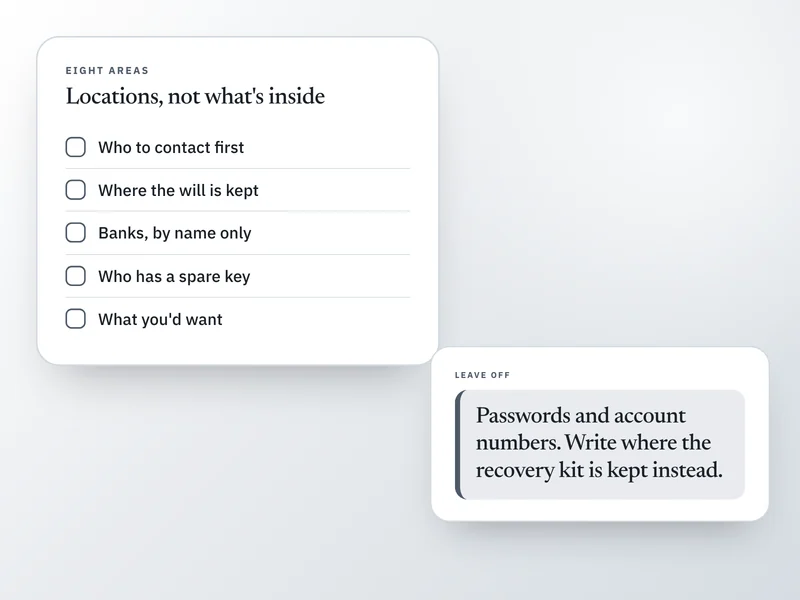
- You want somewhere to keep passwords, account numbers or scans of documents. This is deliberately not a vault. It records what exists, where it is, and who knows about it, and never the thing itself.
- You want a legal will drafted. It records whether you have one and where it is kept. Where a solicitor is genuinely the answer, it says so plainly instead of pretending otherwise.
- You want a shared account so a partner or a sibling can see and edit the same records. It is single-account for now.
- You want it to read your paperwork for you. Everything here is entered by you, on purpose. There is no upload, no scanning, and no AI reading anything.
Show 1 more reasonsShow fewer reasons
- 1Eight short questions about your situation. Children, a partner, a pension, whether you own or rent, life cover, anyone who depends on you, pets, a business. They decide what you will and will not be asked about, permanently.
- 2Then one thing at a time. The step you are shown is the one whose absence would cost the people around you most, with an honest estimate of how long it takes and a sentence on why it matters.
- 3It asks rather than presenting a form. Who should someone contact first, what they are to you, how to reach them, anything they should know. Four questions at most, usually fewer, and you can skip or stop at any point.
- 4Your answer becomes a record, in your words. Not a tick against a task: the actual name, the actual place, the actual instruction.
Show the other 4 stepsShow fewer steps
- 5Not sure yet? Say so. It is kept as its own answer, not filed as a no, and it will come back later without nagging you about it.
- 6Years later, entries that have been standing a long time come back as a question rather than a task you failed to do. Still true, or update it.
- 7Something changed? Tell it you moved, separated, had a child, changed jobs. It works out what that could have made untrue and brings those back one at a time.
- 8Print whenever you like. Never at 100%, never gated: a blank copy with only your relevant sections and room to write, or the current book with everything you have established. Either one opens on what somebody would be trying to do first.
Is this only about what happens after somebody dies?
No, and most of it is not. Who can speak for you about medical care, who has a spare key, who would collect the children on a Tuesday, how somebody would reach your accounts if you were in hospital for a fortnight. It is about your affairs being in order, which is a different thing.
Tried a binder or a template and abandoned it?
Those hand you every page at once, most of which does not apply to you, and leave you to work out where to begin. This asks eight short questions and then shows you one thing, chosen by what it would cost the people around you to leave it undone. Not a list of what remains, and no percentage anywhere.
Not sure you have enough going on to bother?
Then your copy is short, and short is finished rather than failing. Somebody who rents, has no children and no business is asked about 33 things instead of 46, and the rest never appear at all. There is no denominator in the product to make a small life look incomplete.
Will it be out of date the moment you finish?
That is the part a binder cannot do. Forty-one entries come back on their own after a year or two and ask whether they are still true, and telling it your situation changed brings forward only what that could have made untrue. Nothing is sent to you: a standing entry appears in your Draftpace updates the next time you open it.
Does it store my passwords or my documents?
No, and it never will. It is deliberately not a vault: it records what exists, where it is, who knows about it, and what somebody should do. Where you would be tempted to write down a master password, it asks where your recovery instructions are kept instead. The printed book is made on your own device, so the assembled picture never exists on a server.
Can I print it before I have finished?
At any point, and nothing is hidden behind a completeness bar. The blank copy is useful on day one because it already contains only the sections that apply to you. The current book says plainly what is recorded and what is not.
Can my partner or my executor use it with me?
Not yet. It is built around a single account for now. What you hand somebody is the printed book, which is the point: it needs no login, no app and no password to be useful.
Is this a one-time purchase, and do I need an account?
One time, and yes. That matters more here than elsewhere: a record meant to outlive you is a poor fit for something that stops working when a card expires. The account is what keeps your records private and available wherever you next sign in.
What happens to my data?
Your records are private to your account. Draftpace does not sell your data or use it for advertising, and nothing here is read by an AI model. This is deliberately not a vault: it never stores a password, an account number, a security answer, or an uploaded document, and where your instinct would be to write one down it asks where the access instructions are kept instead. The printed book is generated in your own browser, so the assembled picture of your affairs never reaches a server. Nothing here is legal advice, and where a solicitor or a specialist is genuinely the answer the product says so rather than standing in for one.
What's your refund policy?
Personal Life Affairs Companion is a digital product delivered the moment your payment clears, so there are no refunds once access is granted. If something is not working, is not what you understood it to be, or you were charged in error, write to us and we will put it right.
Contact support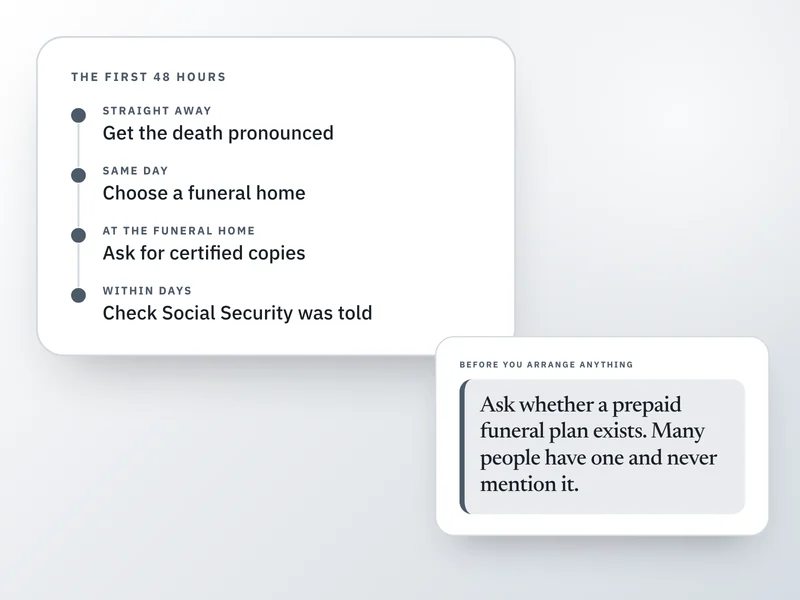
Buy it once. Keep it for good.
No subscription, no renewal, no upsell later. One payment and Personal Life Affairs Companion is yours, on every device you sign in on.
51% off $99. Digital product, no refunds once access is granted.