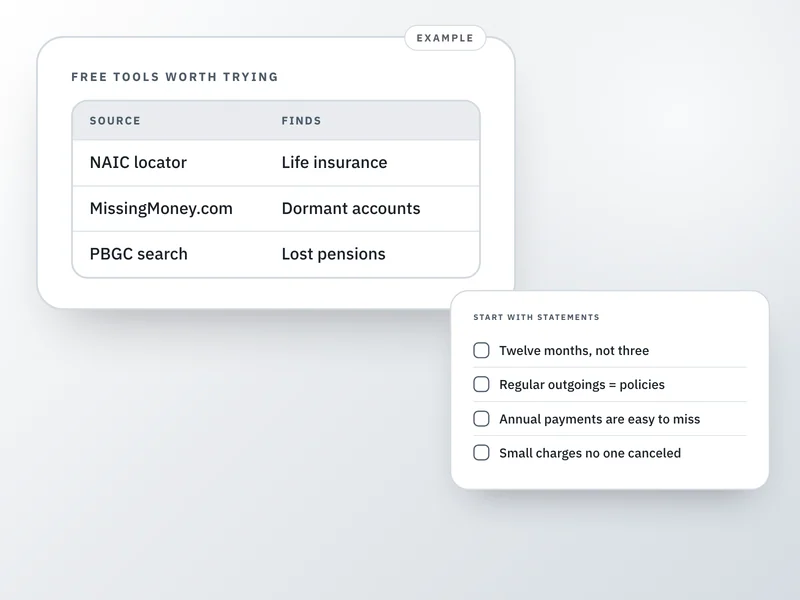
There's no single database that lists everything a person owned. What works instead is a search in order: twelve months of their bank statements and mail, their email, then four free US locator services built for exactly this, life insurance, pensions and unclaimed property, before you spend money on a paid search.
This is written for a search in the United States. It can't promise you'll find everything, and it isn't legal or financial advice, so an attorney or the local probate office in the county where the person lived can tell you what your role actually lets you ask for.
An example: a search that took six weeks
Say your mother kept nothing written down. (This is an example, not a case.) Her bank statements show a mortgage payment to a lender you'd never heard of and a small monthly premium with no name attached to it. Her email, searched for 'statement' and 'policy,' turns up a pension from a job she left in 1994.
The unnamed premium takes longer. Three weeks in, the NAIC's life insurance locator turns up a policy from a company that's since been bought twice, worth around $22,000. (This is an example figure, not a promise of what you'll find.) The pension and the policy together are worth more than the six weeks it took to find them.
Start with twelve months of statements, not three
This is the single most useful hour you'll spend on the whole search.
4 things to do
Ticks are for this visit only. Nothing here is saved anywhere.
Where to search, and what you need to start
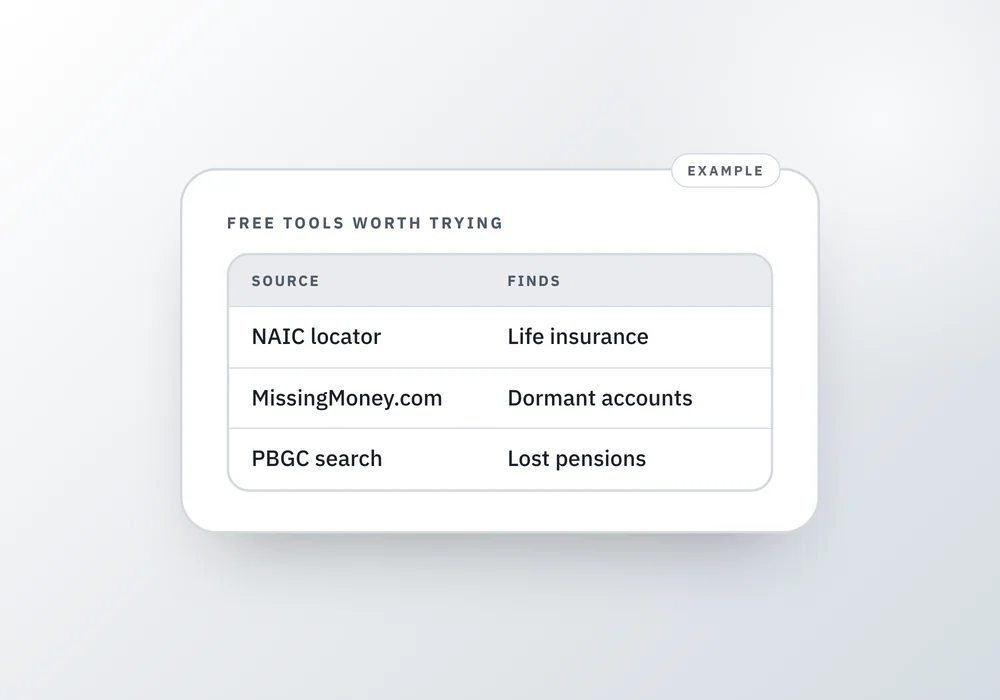
Once the statements and mail are read, these four free services are built for exactly this search.
NAIC Life Insurance Policy Locator
- What it can find
- Life insurance policies and annuities from participating companies
- What you need to start
- Legal name, Social Security number, date of birth, date of death
MissingMoney.com, run by NAUPA for 49 states
- What it can find
- Dormant bank accounts, uncashed checks and unclaimed utility deposits
- What you need to start
- Full name and the states they lived in
PBGC's unclaimed retirement benefits search
- What it can find
- Pension benefits from plans that ended and couldn't locate the person owed
- What you need to start
- Last name and the last four digits of their Social Security number
A credit report, requested as executor
- What it can find
- Every open account currently reporting to Equifax, Experian or TransUnion
- What you need to start
- Proof of death and proof of your authority to act for the estate
| Where to search | What it can find | What you need to start |
|---|---|---|
| NAIC Life Insurance Policy Locator | Life insurance policies and annuities from participating companies | Legal name, Social Security number, date of birth, date of death |
| MissingMoney.com, run by NAUPA for 49 states | Dormant bank accounts, uncashed checks and unclaimed utility deposits | Full name and the states they lived in |
| PBGC's unclaimed retirement benefits search | Pension benefits from plans that ended and couldn't locate the person owed | Last name and the last four digits of their Social Security number |
| A credit report, requested as executor | Every open account currently reporting to Equifax, Experian or TransUnion | Proof of death and proof of your authority to act for the estate |
Where else to look, once the statements are read
- Their email, searched for the words statement, policy, renewal, premium and pension.
- Their phone, for banking and two-factor apps that name the institution in the notification.
- Their tax return or last year's 1099 forms, which list every account and pension that paid them interest, dividends or income.
- Their accountant or attorney, who often knows more than the family does.
- The safe, the filing box and the drawer no one has opened, which sound obvious and are where a great deal of this actually turns up.
What you'll need before anyone will talk to you
Almost every institution wants the same three things: a certified copy of the death certificate, proof of your own identity, and proof of your authority to act, usually the court document called the executor's or administrator's court paperwork. Assemble that set once and keep copies together, because you'll be asked for it again at every stop.
What can go wrong
Some accounts and pensions are never traced, usually because the one person who knew about them has died. A search can be thorough and still miss something, and that isn't a failure on your part. It's what happens when the only record lived in someone's memory rather than on paper.
Watch for scams that specifically target people doing this search: a caller claiming to be from a locator service and asking for a fee upfront, or for the deceased's Social Security number over the phone rather than through a written form. Every tool in the table above is free, and none of them calls you first.
Questions people ask
Can I just call the bank and ask if my parent had an account there?
You can ask, but most banks will only confirm an account exists once they've seen a certified death certificate and some proof of who you are. They generally won't share the balance or let you act on the account until you can show you're the executor or a named beneficiary.
Are a deceased person's accounts frozen automatically?
Often, once the bank learns of the death, though the timing varies by bank and by account type. A joint account usually passes to the surviving owner and stays usable. A sole account is typically frozen for anyone but the executor once the bank has a certified death certificate.
What if there's no will?
The local probate office, in the county where they lived, appoints someone, usually the closest relative, as administrator, with the same authority an executor would have. The clerk's office can explain how to apply. Where to look for a will covers the search worth doing first, in case one turns up.
Do I need the executor's court paperwork just to search, or only to withdraw money?
Searching itself rarely needs it. The free locator tools above only ask for identifying details from the death certificate. the executor's or administrator's court paperwork become necessary once you want an institution to confirm an account, release funds, or discuss anything beyond whether a record exists.
Is there a fee to use the NAIC or MissingMoney search?
No. Both are free, run by the National Association of Insurance Commissioners and the National Association of Unclaimed Property Administrators. Anyone charging you to search a public unclaimed-property database, rather than to help file a claim afterward, is worth treating with caution.
For your own affairs, later
Going through someone else's paperwork from the outside is usually what convinces people their own shouldn't work that way. Personal Life Affairs Companion records the names of your banks, every pension you've paid into and your life insurance, plus where the paperwork for each is kept, so this search never has to happen to the people who'd do it for you. It never asks for an account number or a password, and it prints a book someone could actually follow. See Personal Life Affairs Companion.
Sources and how we checked
- NAIC: Life Insurance Policy Locator Service: How the free tool works and what identifying details it asks forChecked 26 September 2026.
- NAIC: Life Insurance Policy Locator Tool matches over $16 billion in benefits: That the locator is free and how matching worksChecked 26 September 2026.
- NAUPA: MissingMoney.com, search beyond your state: MissingMoney.com is free, NAUPA-endorsed, and covers 49 statesChecked 26 September 2026.
- PBGC: Find unclaimed retirement benefits: Free federal pension search by last name and last four digits of Social Security numberChecked 26 September 2026.
- FTC: Debts and deceased relatives: Who a debt collector can and can't contact about a deceased person's accountsChecked 26 September 2026.
Where to go next
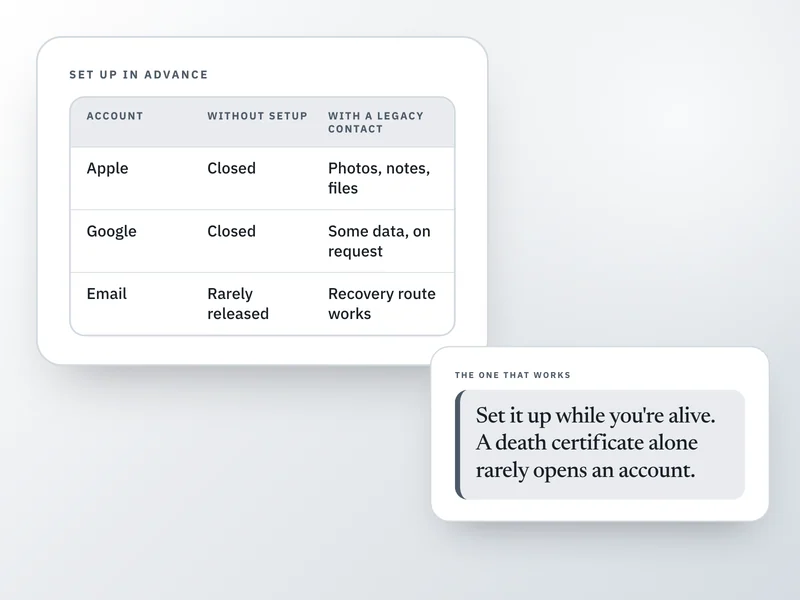 If this is where you areDigital accounts after a death: what can be recoveredOnce the money is traced, this covers photos, email and subscriptions, and what providers will and will not release.
- Who to notify when someone dies, in order
When you find an account, this tells you who else to notify next and in what order.
- How to find a will after someone dies
A will often lists the assets you are searching for, so this shows where to look for one.
- What to do when a parent dies: the first two weeks (US)
For everything else in the first two weeks around the search, this gives the whole order of tasks.