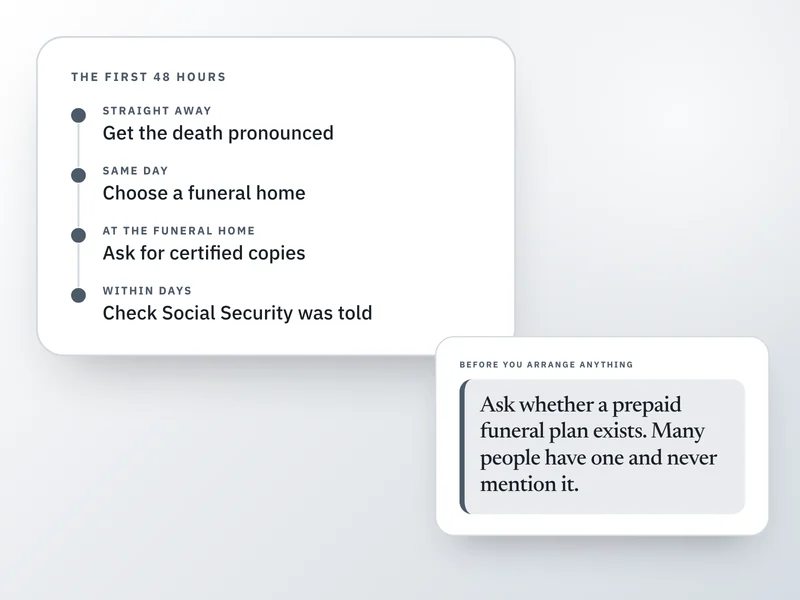
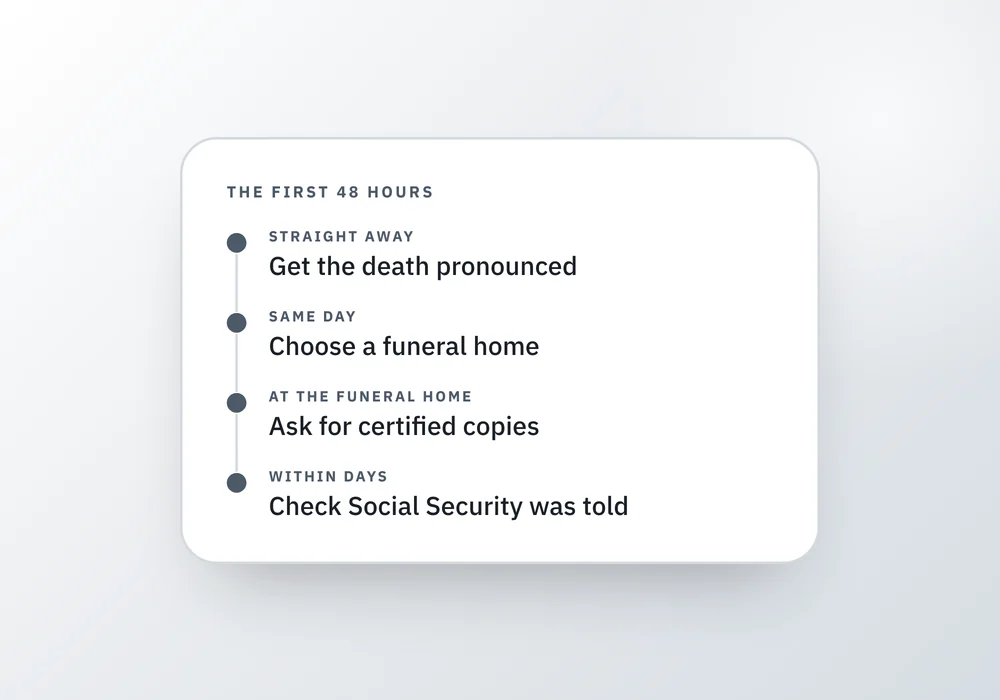
In the first two days, three things cannot wait: the death is pronounced, you choose a funeral home, and you ask for certified copies of the death certificate, more than seems reasonable. Then find out whether a will and a prepaid funeral plan exist. Almost everything else can wait weeks, and none of it has to be done today.
This is for a death in the United States, written for the adult child who is suddenly holding the paperwork. It is not legal advice and it cannot see your state's rules, so where it disagrees with your funeral director or the probate court clerk in your parent's county, go with them. If your parent died in the UK, use the UK version.
An example: what a first week can look like
Say your mother dies at home on a Tuesday night, under hospice care. (This is an illustration, not a case.) You call the hospice line, not 911, and the hospice nurse handles the pronouncement. You call the funeral home when you are ready, not before.
On Wednesday the funeral director sits down with you. You ask for the price list, you choose, and you ask how many certified copies of the death certificate to order. By Friday the copies are ordered, you know whether the funeral home reported the death to Social Security, and you have looked in the desk for a will. That is the whole week. The bank, the phone plan and the house can wait until the week after.
The first 48 hours
Straight away
Get the death pronounced. In a hospital, hospice or nursing facility, staff handle it. At home with hospice involved, call the hospice line, not 911. At home and unexpected, call 911.
Same day, when you can
Choose a funeral home. You can call more than one and ask for prices. In most states the funeral home files the death certificate with the state or county for you.
When you sit down with them
Ask for the General Price List and choose only what you want. Then ask for certified copies of the death certificate.
Before you arrange anything
Ask the family whether a prepaid funeral plan or burial policy already exists. Many people have one and never mention it.
Within a few days
Ask the funeral home whether it reported the death to Social Security. If it did not, you have to.
How many certified copies to order
Certified copies come from the vital records office in the state where the death happened, usually through the funeral home. Fees and turnaround vary by state. Some organizations will take a photocopy after a first look, so ask each one what it wants before you pay for extras. Here is an example count for a father with a modest set of accounts.
8 of 8 rows shown
Bank or credit union, two accounts
- Copies
- 2
Pension administrator
- Copies
- 1
Life insurance company
- Copies
- 1
Brokerage account
- Copies
- 1
DMV, for a vehicle title
- Copies
- 1
Mortgage servicer
- Copies
- 1
Spares for what turns up later
- Copies
- 2
Total (an example, not a rule)
- Copies
- 9
| Who will ask | Copies |
|---|---|
| Bank or credit union, two accounts | 2 |
| Pension administrator | 1 |
| Life insurance company | 1 |
| Brokerage account | 1 |
| DMV, for a vehicle title | 1 |
| Mortgage servicer | 1 |
| Spares for what turns up later | 2 |
| Total (an example, not a rule) | 9 |
Who to tell in the first two weeks
Not everybody. The full order is in who to notify when someone dies. These are the calls where delay costs money or invites trouble.
7 things to do
Ticks are for this visit only. Nothing here is saved anywhere.
Find the will, and read one clause first
Look where people keep them: a desk, a filing box, a safe, or the attorney who drafted it. Where to look for a will gives the whole search order. When you find one, read who is named executor before you read who inherits. The executor is the person with legal authority to act for the estate, and a child who is arranging the funeral does not automatically have it.
If it names you, what you agreed to as executor explains the job. If you hold an original will that names someone else, some states, California among them, expect it to be delivered to the probate court, so ask the clerk. Do not hide or discard one.
What you can leave alone for now
Rushing these is where most of the avoidable trouble starts.
- Your parent's phone number and email. Two-step codes and password resets often go to them, and closing them early can lock you out of the accounts you need. Digital accounts after a death covers what providers release.
- Closing accounts. Ask each institution to note the death and tell you what it needs.
- Paying your parent's bills from your own money. Debts are generally paid from the estate, not by family members, unless you cosigned. Collectors may only discuss a debt with the estate's representative, a spouse or a few others.
- Clearing the house. You may still need papers that look like junk mail, and the year of statements is the best map you will get.
- Signing anything under pressure, at the funeral home or anywhere else.
What the funeral home has to give you
Under the FTC's Funeral Rule, a funeral home must quote prices by phone, hand you an itemized General Price List when you visit, let you buy separate items instead of a package, and give you a written statement of everything you chose, with prices, before you pay. No state law requires routine embalming for every death, so you can ask about refrigeration, direct cremation or immediate burial. The rule covers funeral homes, not third-party casket sellers or cemeteries without a funeral home on site.
Call two homes and compare price lists. It is a normal thing to do, and it will not offend anybody.
What can go wrong
The death happened in another state. The certificates come from the state where your parent died, not where they lived, and the probate court is in the county where they lived. Two offices, two sets of forms.
No will turns up. Then the probate court in that county decides who acts for the estate, and the clerk can tell you how. The search for accounts is the slow part in every case, and how to find someone's accounts after they die gives the order to do it in. You are rebuilding somebody's paperwork from the outside, and it is normal for it to take months.
Questions people ask
Do I call 911 when a parent dies at home?
It depends on the situation. If your parent was under hospice care and the death was expected, call the hospice line first and let the nurse take it from there. If the death was unexpected and no hospice is involved, call 911. Hospital and nursing facility staff handle the pronouncement themselves.
How many death certificates do I need?
There is no fixed number. Count the organizations that will each want a certified copy, such as banks, a pension, insurers and the DMV, then add a couple of spares. Some accept a photocopy after a first look, so ask each one before you order more.
Do I have to tell Social Security myself?
Usually not, because the funeral home typically reports the death. Confirm that it did. If it did not, you have to report it, and any Social Security payment received for the month of death has to be returned.
Do I have to pay my parent's debts?
Generally no. Debts are paid from the estate, not by family, unless you cosigned or you are the executor and skipped the legal steps. Do not pay a collector from your own money. Ask the probate court clerk or an attorney what applies in your state.
Who pays for the funeral?
The funeral home will look to the person who signs the contract. Whether you are repaid from the estate depends on the will and your state, so ask the funeral director and the probate clerk before you sign, and keep every receipt.
For your own affairs, later
Going through this is often when people decide their own paperwork should be easy to find. Personal Life Affairs Companion is the Draftpace product for that, and it is for you, not for the two weeks in front of you. It asks one question at a time: who should be called first, where the will is kept, which bank, which pension, who has a spare key. It records where things are, not the documents themselves, it never asks for account numbers or passwords, and it prints a book somebody could follow. It has no list of who to notify and it sends nothing to anyone. See the Companion.
Sources and how we checked
- USAGov: Agencies to notify when someone dies: Who to notify, Social Security payment for the month of death, VA, credit bureausChecked 26 September 2026.
- USAGov: How to get a certified copy of a death certificate: Certificates come from the state where the death occurred; fees vary; photocopies sometimes sufficeChecked 26 September 2026.
- FTC: The Funeral Rule: Price list, phone quotes, itemized statement, embalmingChecked 26 September 2026.
- FTC: Debts and deceased relatives: Debts paid from the estate, collector contact rulesChecked 26 September 2026.
- California Courts Self-Help: Probate: An original will found must be delivered to the court (California example)Checked 26 September 2026.
Where to go next
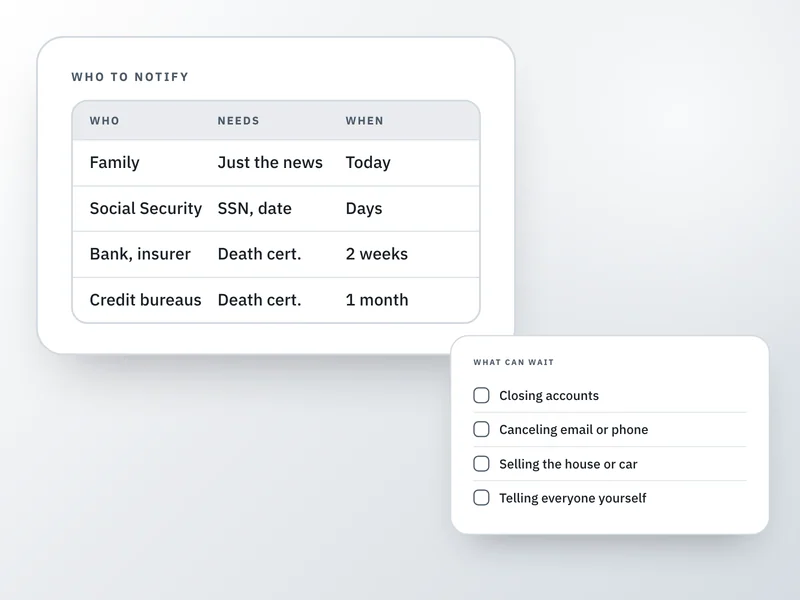 If this is where you areWho to notify when someone dies, in orderOnce the first days are handled, this gives the full order of who to notify and how to keep track as you go.
- What to do when a parent dies: the first fortnight (UK)
If the death happened in England, Wales, Scotland or Northern Ireland, this is the UK version with registration and Tell Us Once.
- How to find someone's accounts after they die
When nothing was written down, this is the search order for finding bank accounts, pensions and policies.
- How to find a will after someone dies
To find out whether a will exists and where it is kept, this covers the usual places and the order to check them.