If you have been named executor of someone's will, you are now legally responsible for finding everything they owned, paying what they owed out of the estate, and handing out what is left the way the will says. It is real legal work, mostly in a fixed order, and most estates take many months from start to finish, not weeks.
This is for someone named executor of a will in the United States, doing it for the first time. It cannot tell you your state's exact rules, your county probate court's deadlines, or whether you need to hire an attorney, so where this disagrees with the clerk's office or a lawyer, go with them.
An example: a fairly ordinary estate
Say your father named you executor. (This is an example, not a case.) He left a house with a small mortgage, two bank accounts, an old 401(k) from a job he left years ago, and a life insurance policy the family knew almost nothing about. The will is in his filing cabinet, and it names your sister as the backup if you cannot do it.
In the first week you order more certified death certificates than feels necessary, take the will to the probate court in the county where he lived, and go through twelve months of his bank statements looking for accounts and policies nobody mentioned. Nothing gets paid out yet. That comes later, once the estate has its own bank account and its own tax ID.
What the job involves, in order
Six stages, and you cannot skip ahead to the last one.
Find
Locate and secure everything: the house, accounts, pensions, policies, and anything else of value.
Value
Value the estate as of the date of death, which often needs a professional valuation for property or a business.
Apply
Petition the probate court in the county where they lived for authority to act. What it issues is usually called letters testamentary, the document banks ask to see.
Settle
Pay debts and taxes before anyone inherits anything, including the estate's own income tax return if it earns income.
Distribute
Distribute what remains according to the will, once the creditor claim window has closed.
Account
Keep records of all of it. Beneficiaries are entitled to see the accounting.
Your first week, if you decide to act
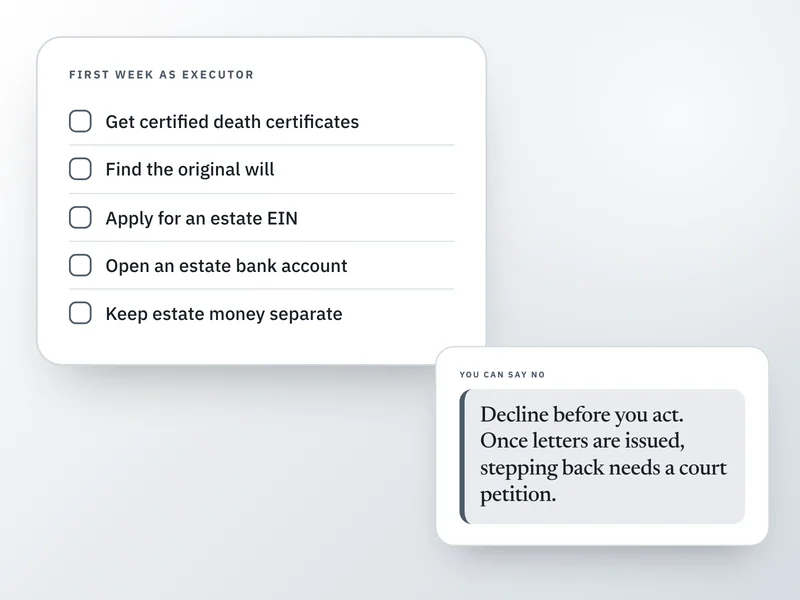
Do these before anything else, and in roughly this order.
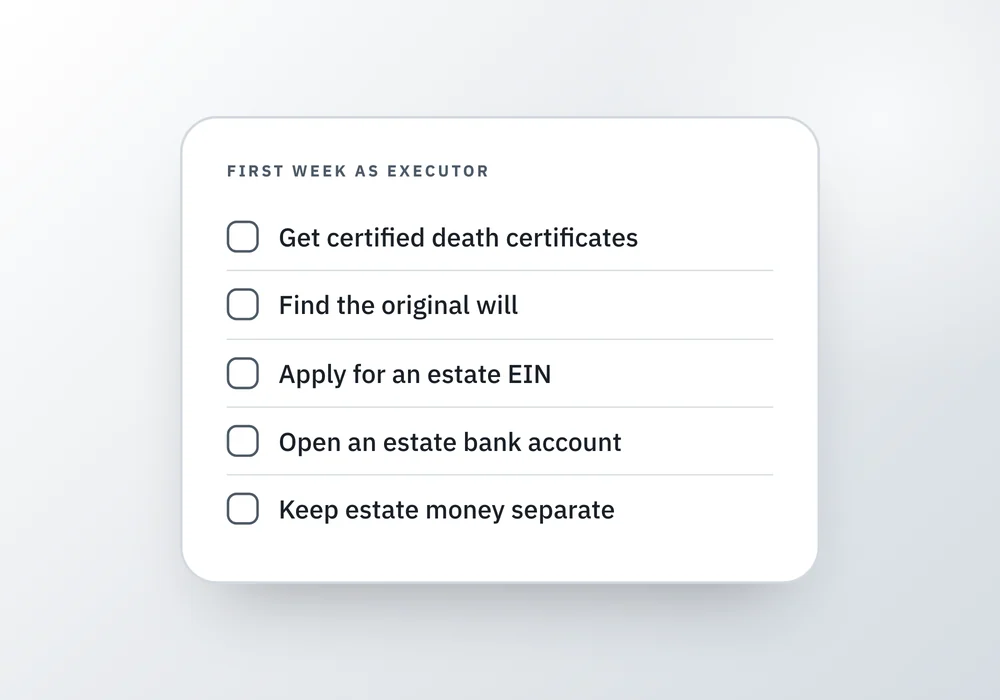
- Get certified copies of the death certificate, more than seems necessary. Banks, the pension administrator, and the DMV will each want their own.
- Find the original will, not a photocopy, and take it to the probate court in the county where they lived.
- Apply for an estate EIN from the IRS. The online application is free and takes minutes, and most banks will not open an estate account without one.
- Once you have letters testamentary and the EIN, open a bank account in the estate's name. Every estate expense and every estate payment runs through it, and nothing else does.
- Keep estate money and your own money separate from day one. Paying an estate bill from your own account, or the reverse, is the fastest way to create a mess an accountant has to untangle later.
- Ask the probate court clerk how long creditors have to file a claim against the estate where you are. That window has to close before you distribute anything.
How long it really takes
A simple estate, one house, a couple of accounts, one beneficiary, still takes many months. Add real property that needs to sell, a business, assets in another state, or beneficiaries who disagree, and two years is not unusual.
The slow parts are not the tasks themselves. Waiting for the court to issue letters, waiting for a property to sell, and waiting out the creditor window take far longer than anything you actually do.
Where you could be personally liable
Executors can be held personally responsible for mistakes. Distributing the estate before debts are settled is the classic one: if a creditor turns up after the money is gone, the shortfall can land on you rather than on the beneficiaries who already spent it.
Mixing estate money with your own is the second one, even without any intent to misuse it. And if the estate earns $600 or more in income during the year, such as interest or rent, it owes its own income tax return, separate from the person's final one. Missing that is a liability too. Anything complicated is worth a probate attorney, paid from the estate rather than out of your own pocket.
You can be paid for this
Executors are generally entitled to compensation for the work, either a flat amount the will sets or a fee state law sets, often a percentage of the estate. It is optional, and plenty of family members waive it.
If you take it, it counts as taxable income to you, reported on your own return, unlike an inheritance, which generally is not. Ask the probate court clerk what your state's default fee looks like if the will is silent on it.
Executor, administrator, and being a beneficiary too
If there is a will, you are the executor. If there is no will, or the named executor cannot serve, the court appoints someone instead, usually called the administrator, and the duties are the same either way.
Being named executor and being a beneficiary are not in conflict. Most executors inherit something too. The thing to hold onto is that you account for every decision the same way regardless, in writing, because the other beneficiaries are entitled to see it. If one of them disputes an appointment or a decision, that gets settled through the probate court, not informally.
You can say no
Being named does not require you to serve. You can decline, formally, as long as you have not already started acting, such as paying a bill from the estate or telling a bank you are the executor. Once the court has issued letters to you, stepping back takes a petition instead of a simple filing.
To decline, you file a written declination, sometimes called a renunciation, with the probate court before you act. Some states, California among them, let you file it alongside the initial petition for probate; the exact form and process differ by state, so ask the clerk's office in the county where they lived.
Declining is not a betrayal. Someone may have named you years ago, before they had a business or a property out of state, and before your own life got complicated. If you cannot give it the time, saying so at the start beats stalling for a year.
What to ask for immediately if you are acting
6 things to do
Ticks are for this visit only. Nothing here is saved anywhere.
Questions people ask
What does an executor actually do?
An executor finds everything the person owned, gets court authority to act, values the estate, pays debts and taxes, then distributes what is left the way the will says. It is mostly paperwork in a fixed order, and it usually takes many months. You keep records the whole way through, since beneficiaries can ask to see them.
Do I have to accept if I am named executor?
No. You can decline, as long as you have not started acting, by filing a written declination with the probate court. Once the court has issued you letters testamentary, stepping back takes a court petition instead. Ask the clerk in the county where the person lived what your state requires.
What is the difference between an executor and an administrator?
An executor is named in a will. An administrator is appointed by the court when there is no will, or when the named executor cannot or will not serve. The job and the personal liability are the same either way, and both processes run through the probate court in the county where the person lived.
Can an executor also be a beneficiary?
Yes, and it is common. Being named to inherit something does not conflict with serving as executor. What it does mean is that you should keep the accounting especially careful and in writing, since other beneficiaries are entitled to see exactly what happened to the estate's money.
Am I personally liable for the estate's debts?
Not out of your own pocket for debts that exceed the estate. You can become liable for your own mistakes though, such as paying out inheritances before creditors have had their window to file a claim, or mixing estate money with your own. Careful order and separate accounts protect you.
For your own affairs, later
Being handed someone else's estate with nothing written down is often what makes people decide their own should not work that way. Personal Life Affairs Companion is built for that side of it: it records who you would name as executor, whether you have a will and where it is kept, and one status question about how far along proving your executor's authority already is. It never asks for an account number or a password, and it prints a book someone could actually follow. See Personal Life Affairs Companion.
Sources and how we checked
- IRS: Are the fees I receive as an executor or administrator of an estate taxable?: Executor compensation is taxable income to the executor, reported on their own return, unlike an inheritanceChecked 26 September 2026.
- IRS: Apply for an Employer Identification Number (EIN) Online: The online EIN application is free and issues an EIN immediately; never pay a site to get oneChecked 26 September 2026.
- IRS: Instructions for Form 1041 (2025): An estate must file its own income tax return once gross income reaches $600 in a yearChecked 26 September 2026.
- IRS: Deceased Taxpayers: Probate, Filing Estate and Individual Returns, Paying Taxes Due: General executor/administrator responsibility to file final and estate returns and pay taxes dueChecked 26 September 2026.
- California Courts Self-Help: Probate: Example of one state's process for declining to serve as executor before probate beginsChecked 26 September 2026.
Where to go next
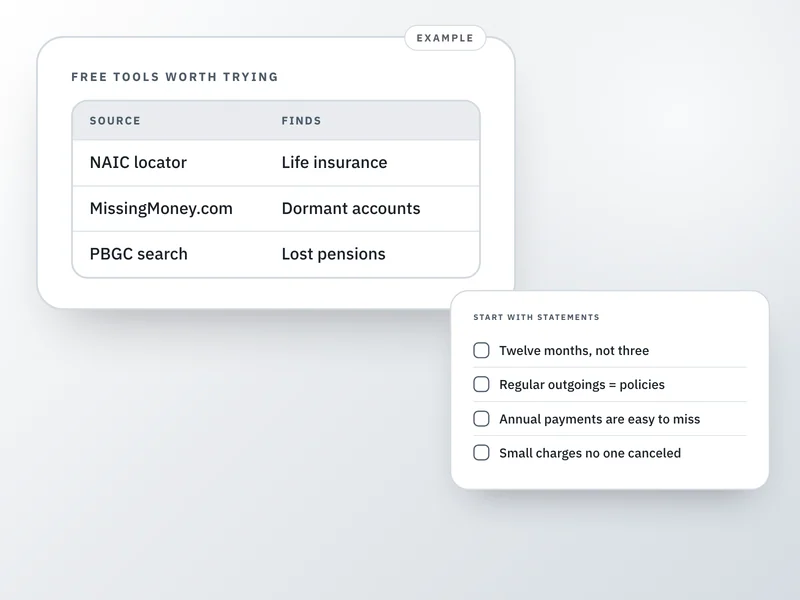 If this is where you areHow to find someone's accounts after they dieServing as executor means finding every asset, and this shows the order to search for accounts and policies.
- Named as an executor: what you agreed to (UK)
In England, Wales, Scotland or Northern Ireland the role and the court process differ, and this is the UK version.
- How to find a will after someone dies
Before you can act, you need the original will, and this covers where it is usually kept.
- Who to notify when someone dies, in order
An executor has to notify banks, agencies and providers, and this lists who to tell and when.