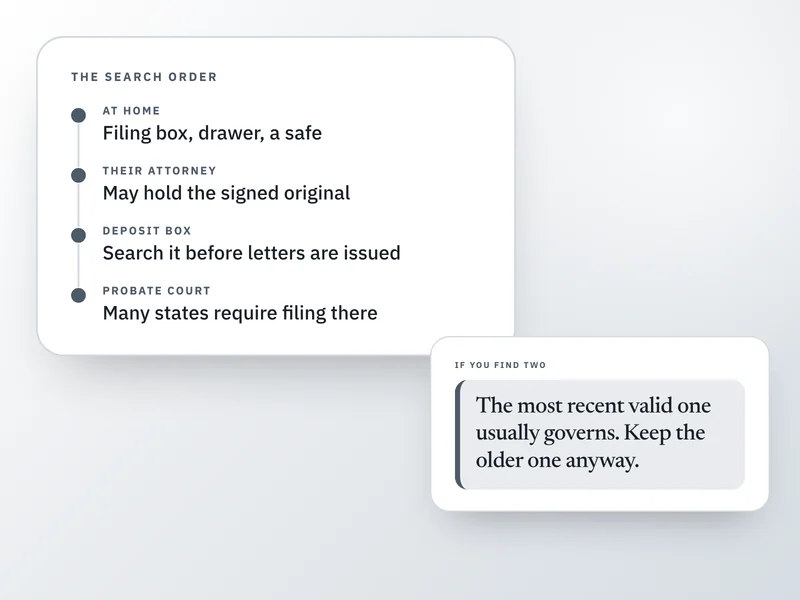
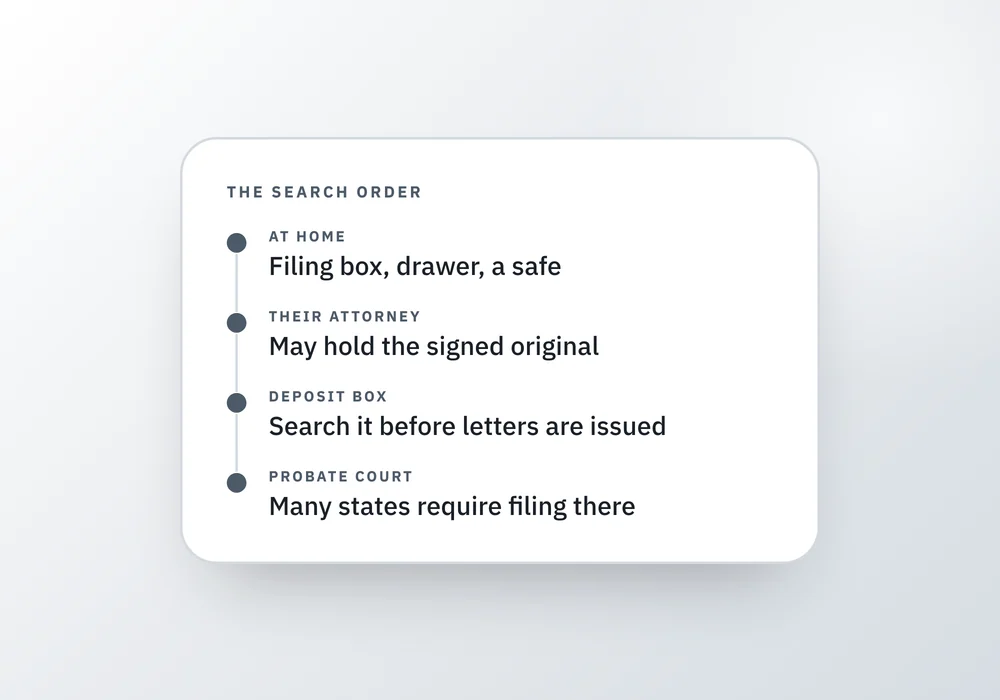
Start with the dull places: a home filing box, a bedside drawer, a safe, or the attorney who drew it up. If none of those turn up anything, move to a safe deposit box, then the county probate clerk's office, since many states expect a found original to be filed there quickly.
This is written for a search in the United States, where the exact rules are set by each state, not the federal government. It can't tell you your state's deadline or process, so where it disagrees with the probate clerk's office in the county where the person lived, go with the clerk.
An example: a will that surfaces twice
Say your uncle mentioned years ago that his will was 'with the lawyer.' (This is an example, not a case.) You call three firms in his town before one confirms it holds a will under his name, but the attorney who wrote it has since retired, and the file only holds a copy.
Two weeks later, going through his safe deposit box with the bank's help, you find the original, signed and witnessed, dated eight months after the copy. The original is the one that counts, and you deliver it to the probate clerk's office, as the state where he lived requires.
The search order
Work down the list. Each step costs more effort than the one before it.
At home
The obvious places: filing box, desk, bedside drawer, a home safe, or a folder marked important or similar.
Their attorney
Many firms keep the signed original and give the client only a copy, so a copy at home can mean the original is elsewhere.
A safe deposit box
Most states let a key holder open a deceased person's box to search for a will alone, before any court authority is granted, under supervision.
The county probate office
Many states require whoever has custody of an original will to file it with the court soon after learning of the death, so it may already be on record.
The named executor
If someone else was named, they may already hold it and not have said so yet.
Their accountant or adviser
Often knows a will exists even without holding it themselves.
What a found original legally has to do next
In California, whoever has custody of a will must deliver it to the clerk of the superior court in the county where the estate would be handled within 30 days of learning of the death, and mail a copy to the named executor or a beneficiary if the executor can't be found. In Florida the window is 10 days. Both states can hold a custodian who ignores this liable for damages, and neither charges a fee to file it. Check your own state's deadline, since it isn't the same everywhere.
Read who's named executor before you read who inherits. That person has the legal authority to act, and a son or daughter who found the will in a drawer doesn't automatically have it. What being named executor involves covers the job.
If it's in a safe deposit box
California is one of several states with a specific rule for this: a person with a key can ask the bank for access before any court authority has been granted, using only a death certificate and proof of identity, for the single purpose of looking for a will or burial instructions. The bank photocopies anything removed, and the original will still has to go to the court clerk afterward. Ask your bank directly what your state requires, since the details differ.
If more than one turns up
The most recent valid one usually governs, and a later will typically revokes earlier ones by saying so directly. Don't destroy the older versions. They can become evidence if the newest one is challenged, undated, unsigned or unwitnessed, and that's a point to get advice rather than decide yourself which one is valid.
If there really is no will
Then the estate passes under your state's intestacy rules, a fixed order of who inherits that doesn't ask what anyone actually wanted. It often surprises families, especially where an unmarried partner or a stepchild is involved, since neither is automatically included.
This is usually also the moment a family realizes how much else was never written down anywhere. How to find someone's accounts after they die covers tracing the rest of it.
Questions people ask
Where do people usually keep their will?
Most commonly at home, in a filing box, a desk drawer or a home safe, or with the attorney who prepared it. A smaller number use a bank safe deposit box or a state will registry where one exists. If none of those turn up anything, the county probate office is worth checking, since some wills are filed there directly after a death.
Is a handwritten will valid?
Sometimes. Many states recognize a handwritten (holographic) will if it's signed and, depending on the state, written entirely in the person's own hand, even without witnesses. Other states don't recognize them at all. Whether one you've found is valid is exactly the kind of question to bring to the probate clerk's office or an attorney rather than decide yourself.
What happens if I hide or destroy a will?
Don't. Several states treat concealing, destroying or altering someone's will as a crime, separate from any civil liability to the people it would have benefited. If you're holding an original, deliver it to the county probate office, whatever it says.
Do I need a lawyer to find or file a will?
Not to search for one. Finding it is something you can do yourself by checking the places in this guide. Filing an original with the court, and opening probate afterward, is also something many people handle themselves for a simple estate, though an attorney is worth considering if the estate is large or a will is being disputed.
Can a will be filed with any court, or does it have to be a specific one?
It goes to the probate office, sometimes called the surrogate's or orphans' court, in the county where the person lived when they died, not where they died if that's different. If you're not sure which court that is, the clerk's office in that county can tell you.
For your own affairs, later
Searching for someone else's will is usually what convinces people theirs should be easy to find. Personal Life Affairs Companion records whether you have a will, where it's kept, who else knows, and who you'd name to sort things out, so this search never has to happen to the people who'd do it for you. It has no upload for the document itself, only a place to say where it is, and it prints a book someone could actually follow. See Personal Life Affairs Companion.
Sources and how we checked
- California Probate Code section 8200: 30-day deadline for a will's custodian to deliver it to the county court, and liability for failing toChecked 26 September 2026.
- California Probate Code section 331: Limited pre-letters safe deposit box access to search for a will, what it takes and what can be removedChecked 26 September 2026.
- Florida Statutes section 732.901: Florida's 10-day deadline for a will's custodian to deposit it with the court, as a second state exampleChecked 26 September 2026.
- California Courts Self-Help: Probate: General overview of what probate requires once a will is locatedChecked 26 September 2026.
Where to go next
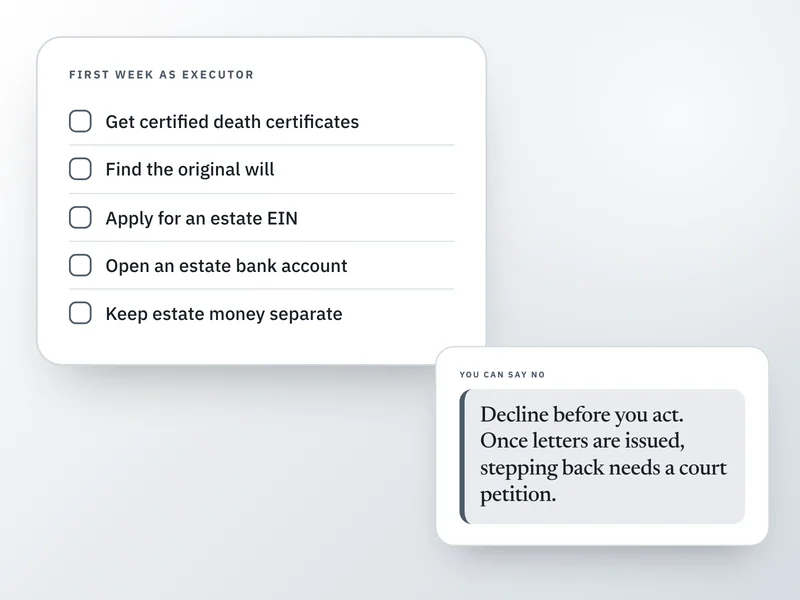 If this is where you areNamed executor of a will: what you agreed to (US)If the will names you, this explains what an executor does and where you could be personally liable.
- How to find someone's accounts after they die
A will rarely lists every account, so this gives the search order for tracing money and policies.
- What to do when a parent dies: the first two weeks (US)
For the wider order of tasks after a parent dies, this puts the search for a will in context.
- Who can open a safe deposit box or safe when you die?
If the original may be in a deposit box or home safe, this covers who can open one and how.