A joint renter can usually open a safe deposit box the same day, with a death certificate and ID. A box rented in one name alone is typically sealed until someone shows the bank proof of legal authority over the estate, court paperwork naming them executor or administrator, and the process depends on your state.
This is for people in the United States: writing down what you have now, or figuring out what to expect if you need to get into someone else's box after a death. It can't tell you your state's rule or your bank's own policy, so where this disagrees with the branch, follow the branch.
An example: two ways this goes
Say your father rented a box in his name alone at a local branch. (This is an example, not a case.) The bank often learns of a death from an obituary or a family phone call, not automatically, and once it knows, it restricts the box. If his name was the only one on the rental agreement, the branch will ask for a certified death certificate and either the court paperwork naming you executor, or documers of administration if there was no will. Until you have that paperwork, the box waits.
Now say your parents rented the box jointly, both names on the agreement. In most cases the surviving renter can walk in with a death certificate and ID and open it that day. The difference isn't what's inside the box. It's whose name is on the rental agreement.
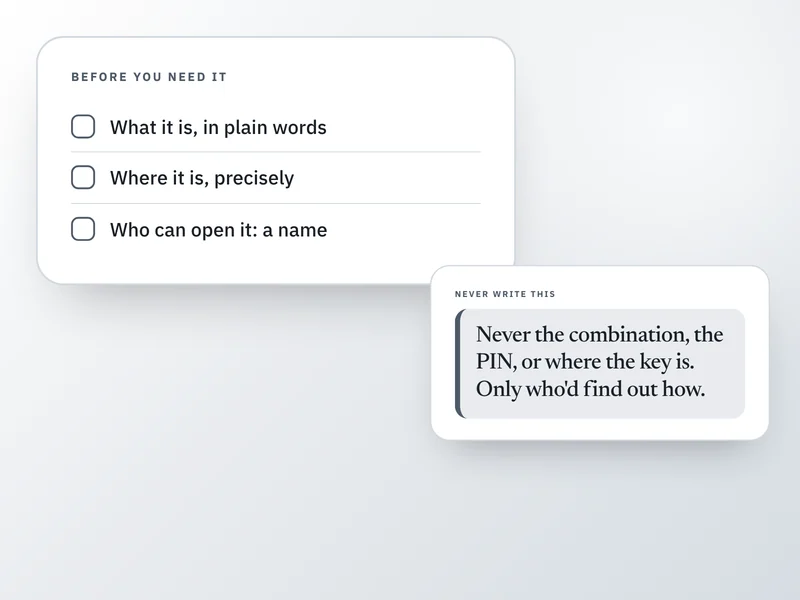
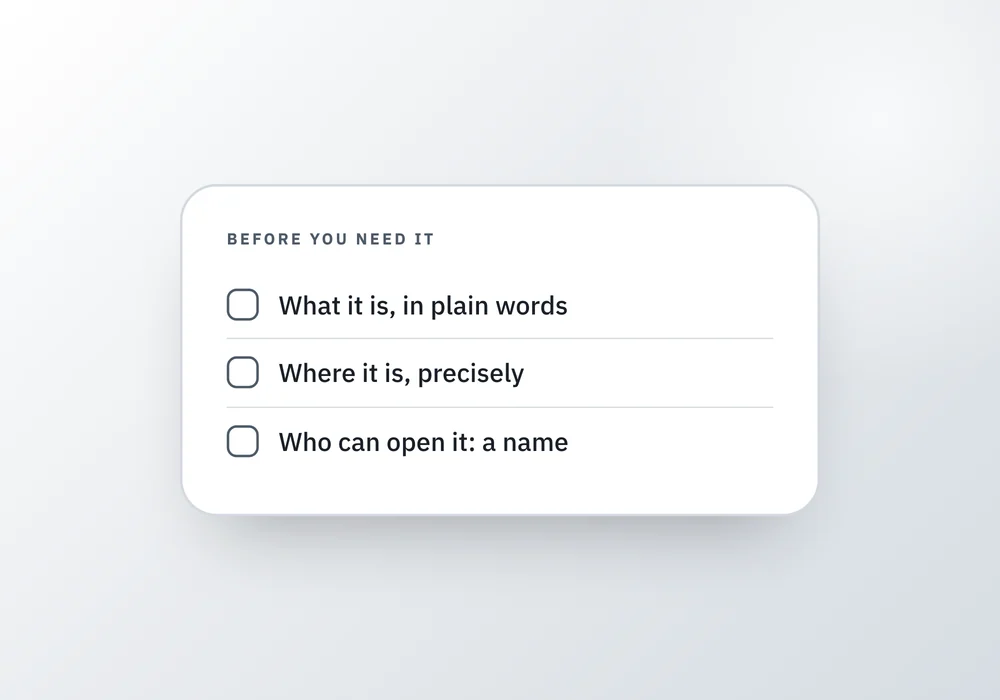
Three things to write down
3 things to do
Ticks are for this visit only. Nothing here is saved anywhere.
Never write the combination
Do not record the combination, the PIN, or the location of the key on the same page as the location of the safe. Write where someone would find out how to open it, such as who holds the key or where the instructions are kept, not the instructions themselves.
That's the same rule as the rest of a life admin file: say where, not what. See what goes in a life admin binder.
Spare keys
Note who has a spare key to your home, and who could get one quickly. A neighbor with a key is often the fastest route into a house in an emergency, faster than anyone waiting on a locksmith. Tell that person they're on the list, and ask them to check, once, that the key still works.
If you're the one trying to get in later
Every bank runs its own process inside what your state allows, so treat this as what to expect, not a guarantee.
You're a joint renter
- What usually happens
- You can typically open the box once the bank knows about the death, without waiting for probate.
- What you'll likely need
- A certified death certificate and your ID
You're the executor, box in one name
- What usually happens
- The bank waits for proof you have legal authority over the estate before it lets anyone in.
- What you'll likely need
- the executor's or administrator's court paperwork, plus a death certificate
No executor yet, but the will might be inside
- What usually happens
- Some states allow one supervised visit, with a bank officer present, to search only for a will and burial instructions.
- What you'll likely need
- A formal request to the bank, and in some states a court order
The key is lost
- What usually happens
- The bank drills the box instead of forcing it open, and bills the cost to the renter or the estate.
- What you'll likely need
- Whatever proof of authority your situation above already requires
| Your situation | What usually happens | What you'll likely need |
|---|---|---|
| You're a joint renter | You can typically open the box once the bank knows about the death, without waiting for probate. | A certified death certificate and your ID |
| You're the executor, box in one name | The bank waits for proof you have legal authority over the estate before it lets anyone in. | the executor's or administrator's court paperwork, plus a death certificate |
| No executor yet, but the will might be inside | Some states allow one supervised visit, with a bank officer present, to search only for a will and burial instructions. | A formal request to the bank, and in some states a court order |
| The key is lost | The bank drills the box instead of forcing it open, and bills the cost to the renter or the estate. | Whatever proof of authority your situation above already requires |
Why the box is a bad place for the one thing everyone needs first
A safe deposit box is a poor home for the only copy of a will, a funeral wish or a medical directive, because it can be the one thing sealed shut exactly when someone needs it fastest. Banks are cautious about opening a box before the family has legal authority, even when everyone agrees a will is what's inside. Keep an original will with an attorney or at home as well, and treat the box as backup, not the only copy.
The other common snag is a key that's gone missing by the time anyone needs the box. The bank will drill it instead of forcing the lock, and the renter or the estate pays for the drilling and the new lock afterward. If you're not sure where your key is, find it now, while that's a five-minute search instead of a fee.
Questions people ask
Does a will override who can access a safe deposit box?
No. A will names who inherits the contents, but it doesn't by itself get anyone into the box. The bank looks at whose name is on the rental agreement and, for a sole renter, at court paperwork proving legal authority over the estate. Being named in the will is a separate question from being able to open the box.
Can I add someone to my safe deposit box so they can access it after I die?
Yes. Most banks let you add a co-renter or an authorized signer while you're alive, and that person can usually open the box the same day you die with a death certificate and ID. Ask your branch what it calls the arrangement and what it needs from both of you to set it up.
What if I don't know which bank has the box, or whether there is one?
Check old bank statements and tax returns for a rental fee, and watch the mail for an annual renewal notice. Then ask each bank where the person did business whether a box is on the account. There's no single national registry of safe deposit boxes to search.
Can a bank keep a family out even with a death certificate?
Yes, if you're not the renter and don't yet have court paperwork proving you have authority over the estate. A death certificate alone is usually enough for a joint renter, but for a sole rental the bank is following its own policy and state law, not being difficult on purpose.
What the Companion does with this
Personal Life Affairs Companion has one step for any safe, lockbox or deposit box: what it is, where it is, who is able to open it, and where someone would find out how, with a hint that says never to record a combination there. A separate step covers who has a spare key to your home. It doesn't check your answers against a bank or a court, and it can't confirm that the person you named can actually get in, so testing that once is still on you. See Personal Life Affairs Companion.
Sources and how we checked
- FDIC: Five Things to Know About Safe Deposit Boxes, Home Safes and Your Valuables: Access after a renter's death depends on state law, and a bank does not police what a joint renter removesChecked 26 September 2026.
- FineMark Bank & Trust: Dear FineMark, who can access a safe deposit box after death?: A key alone doesn't grant access; an executor needs the court paperwork naming them executor or administrator; Florida allows a judge to permit a supervised search for a willChecked 26 September 2026.
Where to go next
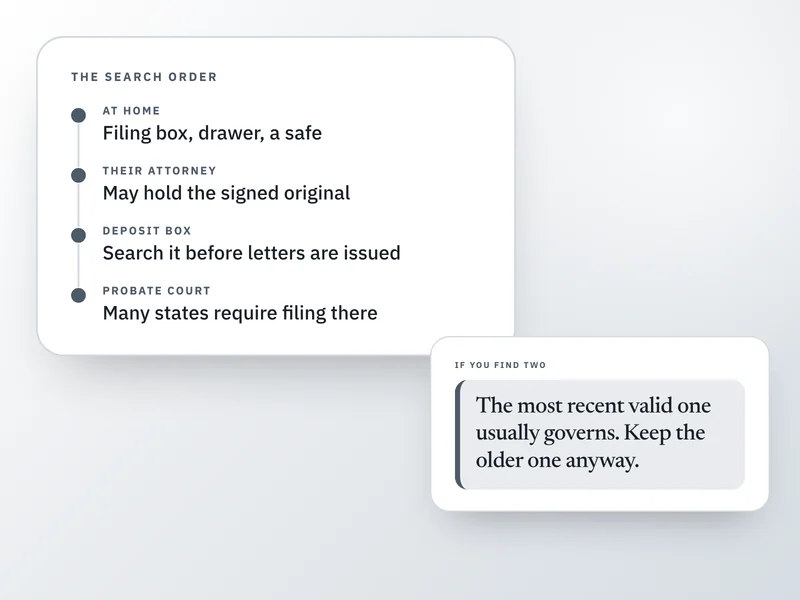 If this is where you areHow to find a will after someone diesIf a will may be in a box or safe, this covers where wills are kept and how to search.
- Life admin binder: what to include, in 8 sections
For papers kept at home, this shows how to organize them into a binder someone could open.
- The if-something-happens-to-me file: what goes in it
To record who can open the box and where the keys are, this file gives you a place to note it.
- Which documents to keep, shred or store, and for how long
Deciding what deserves a box versus a shredder starts with this retention guide.