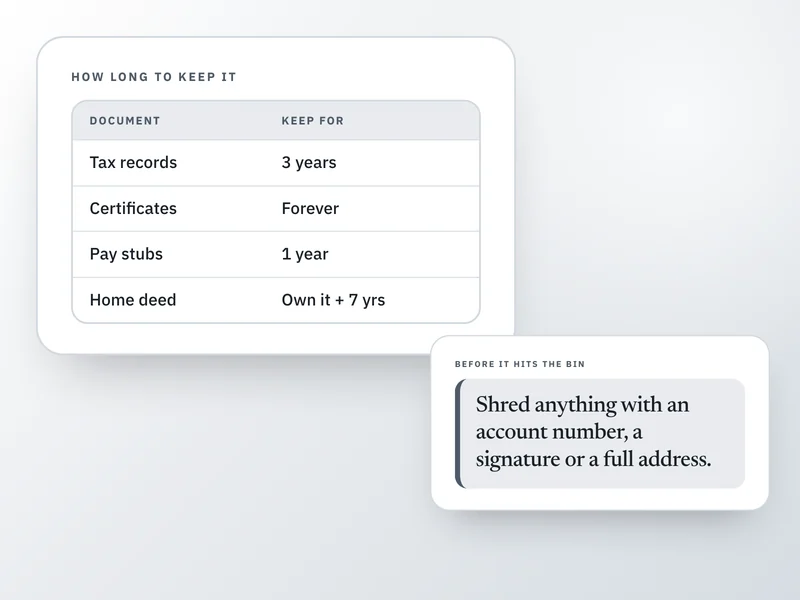
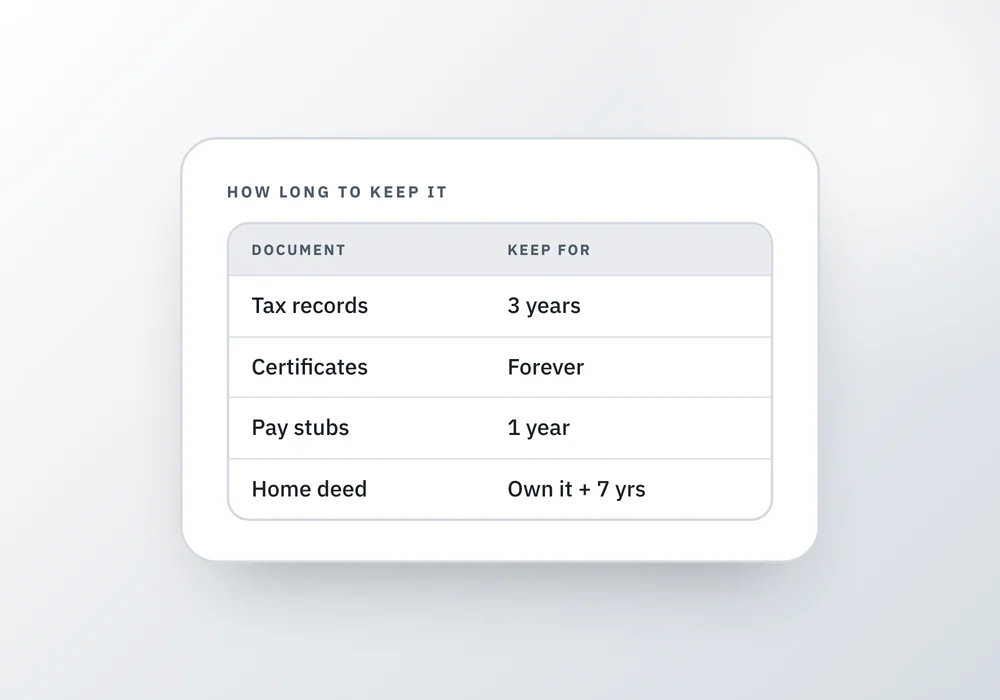
Keep tax returns and their backup for three years after you file, six if you left off more than a quarter of your income, and forever if you never filed. Birth certificates, a current will, and your deed last permanently. Pay stubs and utility bills get about a year, then the shredder.
This is for US households sorting ordinary paperwork, not a business or an estate. It can't tell you your own state's specific rules, or whether a document already tied to an open dispute is safe to toss, so treat anything contested as its own question for a professional.
Example: sorting a drawer no one has opened in years
A made-up batch, not a real one, sorted using the rule below.
A 2019 tax return and its receipts
- What to do with it
- Past the three-year window with no sign of unreported income: shred it.
The deed from a house sold in 2016
- What to do with it
- Well past the seven-year cost-basis window: shred it.
A kitchen remodel receipt from last spring
- What to do with it
- Keep it. You still own the house, and it raises what you paid when you sell.
A canceled cable bill from March
- What to do with it
- Shred it. This month's bill already replaced it.
A life insurance policy from a job left in 2014
- What to do with it
- Don't shred yet. Call the provider first and confirm the policy is actually gone.
| What was inside | What to do with it |
|---|---|
| A 2019 tax return and its receipts | Past the three-year window with no sign of unreported income: shred it. |
| The deed from a house sold in 2016 | Well past the seven-year cost-basis window: shred it. |
| A kitchen remodel receipt from last spring | Keep it. You still own the house, and it raises what you paid when you sell. |
| A canceled cable bill from March | Shred it. This month's bill already replaced it. |
| A life insurance policy from a job left in 2014 | Don't shred yet. Call the provider first and confirm the policy is actually gone. |
How long to actually keep things
Rules of thumb for a US household. Where your state or your own situation differs, follow that instead.
9 of 9 rows shown
Tax returns and the records behind them
- Keep for
- 3 years after filing, 6 if you may have left off more than 25% of your income, forever if you never filed
- Why
- That's roughly how long the IRS has to come back and ask
Birth, marriage and death certificates
- Keep for
- Permanently
- Why
- Originals are slow and expensive to replace
A current will and any power of attorney
- Keep for
- Permanently, and destroy the old version only once the new one is signed
- Why
- An earlier will can still matter if the current one is contested
Deed, mortgage payoff and closing papers
- Keep for
- As long as you own the home, plus about 7 years after you sell
- Why
- They set what you paid, which lowers the taxable gain later
Home improvement receipts
- Keep for
- As long as you own the home
- Why
- Each one raises your cost basis the same way the deed does
Retirement and investment statements
- Keep for
- The annual summary, permanently; monthly statements, about a year
- Why
- Old accounts from a long-gone job are the ones people lose
Insurance policies
- Keep for
- As long as the policy is active, plus about 3 years after it ends
- Why
- A claim can still surface after a policy has lapsed
Pay stubs
- Keep for
- Until they match your W-2, then shred
- Why
- A year of stubs rarely tells you more than the W-2 does
Bank and credit card statements
- Keep for
- About a year, unless one ties to a deduction or a home improvement
- Why
- Most banks hold years of history online if you need one again
| Document | Keep for | Why |
|---|---|---|
| Tax returns and the records behind them | 3 years after filing, 6 if you may have left off more than 25% of your income, forever if you never filed | That's roughly how long the IRS has to come back and ask |
| Birth, marriage and death certificates | Permanently | Originals are slow and expensive to replace |
| A current will and any power of attorney | Permanently, and destroy the old version only once the new one is signed | An earlier will can still matter if the current one is contested |
| Deed, mortgage payoff and closing papers | As long as you own the home, plus about 7 years after you sell | They set what you paid, which lowers the taxable gain later |
| Home improvement receipts | As long as you own the home | Each one raises your cost basis the same way the deed does |
| Retirement and investment statements | The annual summary, permanently; monthly statements, about a year | Old accounts from a long-gone job are the ones people lose |
| Insurance policies | As long as the policy is active, plus about 3 years after it ends | A claim can still surface after a policy has lapsed |
| Pay stubs | Until they match your W-2, then shred | A year of stubs rarely tells you more than the W-2 does |
| Bank and credit card statements | About a year, unless one ties to a deduction or a home improvement | Most banks hold years of history online if you need one again |
Sort by how urgently you'd need it
Filing by category is how filing systems die. A given document usually fits two categories, and choosing between them costs a moment every single time you touch it.
Sorting by urgency works better: one thin folder for anything someone might need in an emergency, one for active paperwork, one box for archive. Three destinations, no real decision to make, so things actually get filed instead of stacked.
What actually needs to stay on paper
Certificates, deeds, a signed will, and anything with a raised seal or a signature that has to be an original. For nearly everything else, a clear scan holds up: under IRS Revenue Procedure 97-22, a properly stored digital image counts as the record, and you're allowed to shred the paper once your storage meets its requirements.
If you don't actually know where the current will is kept, that's worth fixing before anything else on this page. Where to look for a will covers the usual places it turns up.
Shred it, don't just bin it
Anything with an account number, a signature, a date of birth or a full address belongs in the shredder, not the recycling bin. That covers most of what a household actually throws away.
A basic cross-cut shredder handles the ordinary volume. For a backlog, most towns and several banks run free shredding events a few times a year, which is worth checking before you pay for a bulk service.
Where this goes wrong
The failure isn't usually keeping too much. It's shredding something the same week a dispute starts: a warranty claim, an insurance question, a line on a tax return the IRS wants explained. None of those announce themselves in advance.
If that happens, ask before you assume the record is gone. Banks, employers and the IRS itself can typically reissue years of statements, W-2s and past returns, sometimes for a small fee. It's slower than opening a folder, but it's rarely a dead end.
Questions people ask
How long should I keep bank statements?
About a year covers most households, since your bank can usually reissue older statements if you ever need one again. Keep a statement longer only if it backs up a tax deduction, a home improvement, or a dispute that's still open. Statements tied to a mortgage or a business account are worth holding for around seven years.
Do I need to keep pay stubs after I get my W-2?
No. Once a full year of stubs adds up to the numbers on your W-2, they've done their job and can go in the shredder. Keep the W-2 itself with that year's tax return instead, since it's the document that actually gets referenced later.
Is a scanned copy good enough for the IRS?
For most records, yes. IRS Revenue Procedure 97-22 treats a properly stored digital image the same as the paper original, and allows you to destroy the paper once your storage setup meets its requirements. The exception is anything that needs a wet signature to be valid at all, like a will or a deed, which stays paper regardless of how well you scan it.
What should never go straight in the trash?
Anything carrying an account number, a signature, a date of birth or a full address. That covers most bank and utility statements, old tax returns, expired insurance cards, and pre-approved credit offers. A home shredder handles the everyday volume; for a larger backlog, a local shredding event is usually free.
What if I get audited and I've already shredded something?
Ask the source before assuming it's unrecoverable. Banks, employers, brokers and the IRS itself can typically reissue several years of statements, W-2s and past returns, sometimes for a small fee. It's slower than pulling a folder from a drawer, but losing the backup this way is rarer than it feels in the moment.
What the Companion records
Personal Life Affairs Companion doesn't decide what you should keep or for how long. It records where the things worth keeping already are: your birth certificate and passport, your tax records, the current will, and any safe or deposit box, each as a short note of location rather than a scan or an upload. There's no upload field in the product at all, so the record itself is a much smaller thing to lose than the documents it points to. See Personal Life Affairs Companion.
Sources and how we checked
- IRS Topic no. 305, Recordkeeping: Backs the 3-year, 6-year and no-limit tax-record retention periods.Checked 26 September 2026.
- Better Money Habits (Bank of America): How Long to Keep Your Tax, Financial and Legal Documents: Backs the deed, mortgage, home-improvement and insurance retention guidance in the table.Checked 26 September 2026.
- IRS Revenue Procedure 97-22: Backs the FAQ answer that a properly stored scanned record satisfies IRS recordkeeping rules.Checked 26 September 2026.
Where to go next
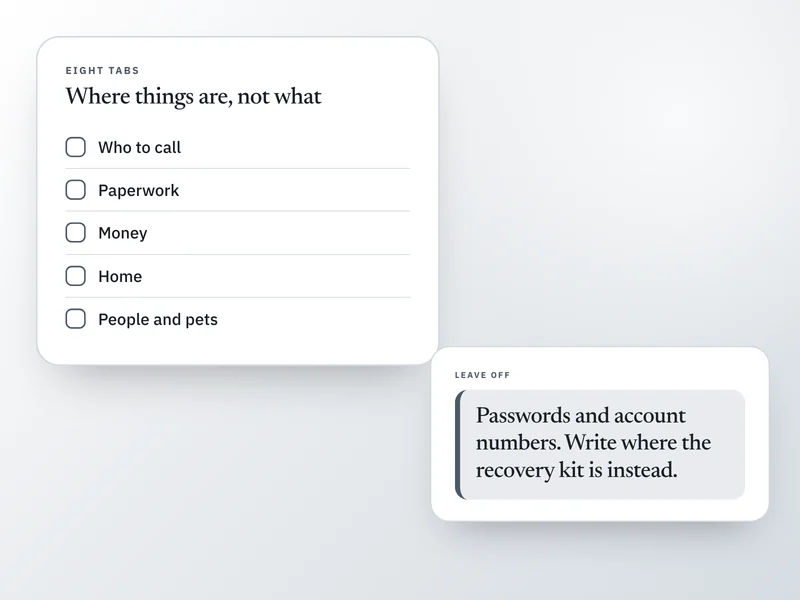 If this is where you areLife admin binder: what to include, in 8 sectionsOnce you know what to keep, this shows how to lay it out in eight sections.
- The if-something-happens-to-me file: what goes in it
To record where each kept document lives, this file gives someone else a way to find it.
- Who can open a safe deposit box or safe when you die?
For the originals worth keeping outside the house, this covers deposit boxes, safes and spare keys.
- What to update after marriage, divorce, a move or a baby
After a move, marriage or new baby, some papers are out of date, and this lists where to look again.