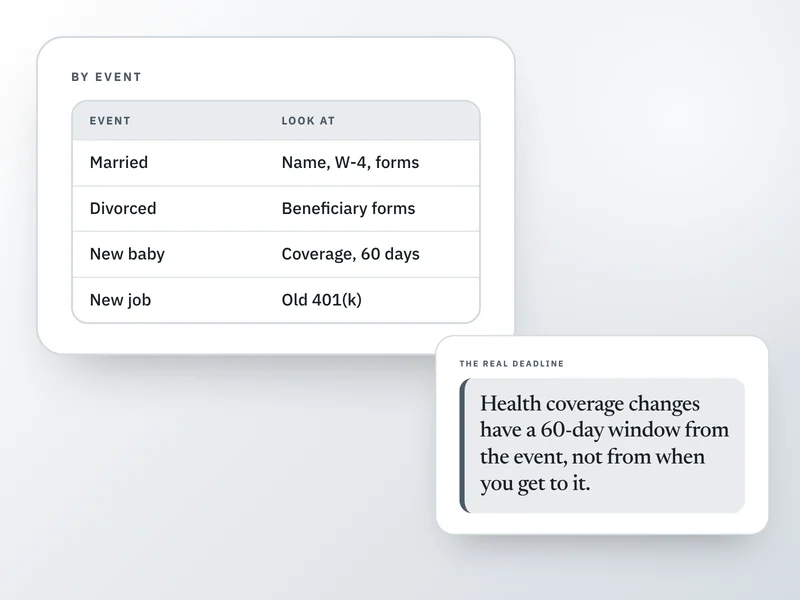
Paperwork does not go out of date gradually. Marriage, divorce, a move, a new baby or a new job changes several forms at once, in the same week, and none of them sends a reminder. Start with the names on your forms, then the one item with a real clock attached, then everything else as you get to it.
This is a list of where to look again in the United States, not advice about what a specific change means for you. For what a change does to your taxes, your will or a plan's rules, ask an attorney or the provider named on the form.
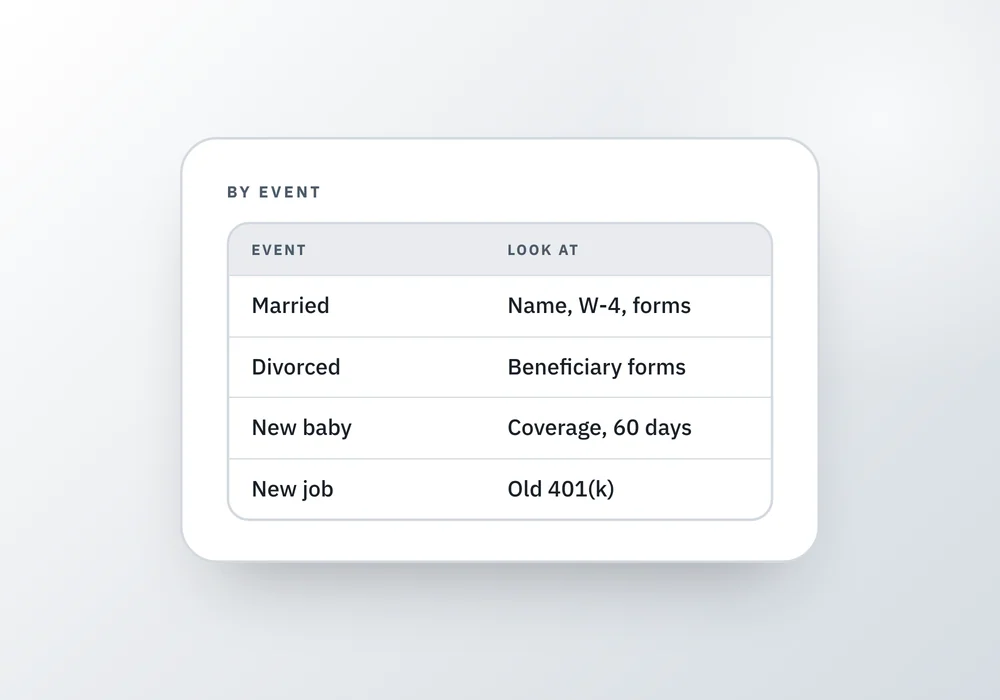
A marriage, as an example
Say you get married in June. Your withholding at work, the W-4 on file with payroll, is now probably wrong, so it needs a new one. The health plan you are on, or your new spouse is on, gives you a 60-day window from the wedding date to add or switch coverage, and that window closes whether you use it or not. The 401(k) from the job before this one still names whoever it named before you married, and it will pay that person, not your spouse, unless you sit down and change the form by hand. None of it has to happen in June. All of it has to happen before it is forgotten.
Where to look again, by event
You married
- Where to look again
- Your name on forms if you changed it, starting with Social Security; your W-4 withholding; who is named on retirement and life insurance; who speaks for you medically; a 60-day window to add health coverage
You divorced or separated
- Where to look again
- Who is named on retirement, life insurance and beneficiary forms (a decree does not remove an ex-spouse from these by itself); who would speak for you medically; health coverage if you shared a plan
You had or adopted a child
- Where to look again
- Who would raise them if you could not; who is named on life insurance; a 60-day window to add them to health coverage from the day they arrived
You moved
- Where to look again
- Your address with banks, insurers and the motor vehicles office; your voter registration; whether your homeowners or renters policy still covers the new address
You changed jobs
- Where to look again
- The retirement plan and life insurance from the job you left, which do not follow you automatically; who is named on the new job's forms
Someone you had named has died
- Where to look again
- Every form or plan where that person was the named contact, beneficiary or decision maker
| What changed | Where to look again |
|---|---|
| You married | Your name on forms if you changed it, starting with Social Security; your W-4 withholding; who is named on retirement and life insurance; who speaks for you medically; a 60-day window to add health coverage |
| You divorced or separated | Who is named on retirement, life insurance and beneficiary forms (a decree does not remove an ex-spouse from these by itself); who would speak for you medically; health coverage if you shared a plan |
| You had or adopted a child | Who would raise them if you could not; who is named on life insurance; a 60-day window to add them to health coverage from the day they arrived |
| You moved | Your address with banks, insurers and the motor vehicles office; your voter registration; whether your homeowners or renters policy still covers the new address |
| You changed jobs | The retirement plan and life insurance from the job you left, which do not follow you automatically; who is named on the new job's forms |
| Someone you had named has died | Every form or plan where that person was the named contact, beneficiary or decision maker |
Start with the names, then the clock
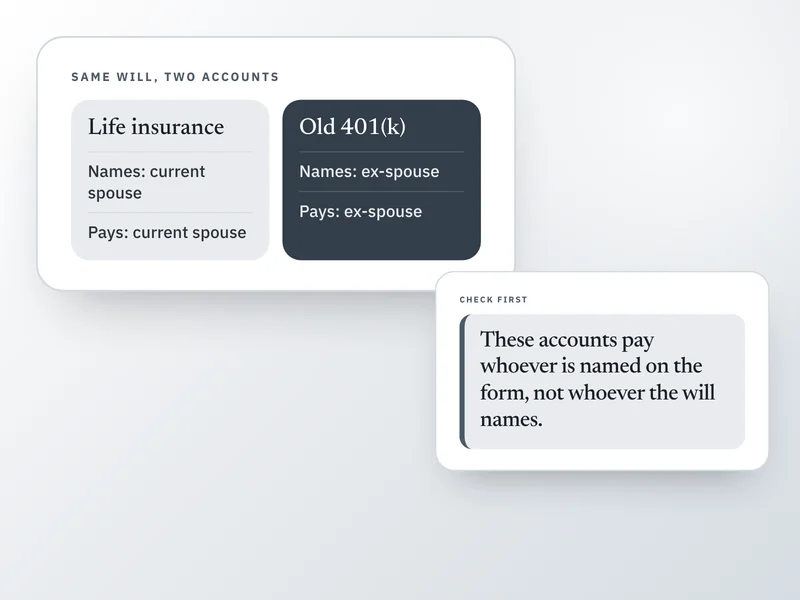
The most consequential items are the names on forms, because a retirement account or life insurance policy usually pays whoever is named on the form, regardless of what a will or a divorce decree says. A form filled in years ago at a previous job can still be the one that counts. See your beneficiary forms quietly override your will.
Health coverage is the one with a real deadline. Adding a spouse, a new child, or switching plans after a qualifying life event generally has a 60-day window from the event itself, not from whenever you get around to it. Miss it, and the next chance may be the next open enrollment period, months away.
What gets missed
A name change trips people up in both directions. Marrying or divorcing does not update your Social Security card by itself, and several other offices check your name against what Social Security has on file, so changing it there first, with form SS-5 and your marriage certificate or divorce decree, avoids a second round of paperwork later.
Going the other way, more than twenty states automatically remove an ex-spouse as a beneficiary on some accounts once a divorce is final, but 401(k)s, pensions and other plans governed by federal law are not covered by those state rules. They keep paying whoever the form names, ex-spouse included, until the form itself is changed by hand.
Questions people ask
Should I change my name with Social Security before my driver's license?
Generally yes. Several other offices check your name against Social Security's records, so updating your Social Security card first, using form SS-5 and your marriage certificate or divorce decree, avoids a mismatch that can slow down everything you try to change after it.
Does a divorce automatically remove my ex-spouse as a beneficiary?
It depends on the account and your state. Over twenty states automatically revoke an ex-spouse's beneficiary status on some accounts, but 401(k)s, pensions and other federally governed retirement plans are not covered by those state laws and keep paying whoever the form names. Check each account directly.
How long do I have to add a new baby to my health insurance?
Generally 60 days from the birth or adoption date, and coverage can start on the day of the event even if you enroll near the end of that window. After 60 days without acting, you may have to wait for the next open enrollment period.
What if I cannot remember every account that might need updating?
Start with what is in the table: your employer, your bank, your retirement plan, and anyone you named somewhere as a contact or a beneficiary. What to write down in case something happens to you is a shorter starting list if this feels like too much at once.
Do I need a lawyer to update any of this?
Not for most of it. Checking who is named on a form is usually a phone call or a login. An attorney is worth involving for anything that touches a will, a trust, or a disagreement about what a document is supposed to mean.
One card for all nine events
Personal Life Affairs Companion has a card in Settings called Has something changed, with nine life events, such as I moved, I got married or I changed jobs. Choose the one that applies and it goes back through what you already recorded, works out which parts a change like that could affect, and brings them back one at a time as questions rather than as a single long list. Nothing you already recorded is deleted or marked wrong while it waits for a second look.
Sources and how we checked
- HealthCare.gov: Special Enrollment Period: The 60-day window to add or change health coverage after marriage, birth, adoption or divorce with loss of coverageChecked 26 September 2026.
- Social Security Administration: How to change or correct your name on your Social Security card: Using form SS-5 with a marriage certificate or divorce decree to update a nameChecked 26 September 2026.
- CBIZ: Automatic Revocation Upon Divorce: Which states automatically revoke an ex-spouse as beneficiary, and the ERISA exception for 401(k)s and pensionsChecked 26 September 2026.
Where to go next
 If this is where you areBeneficiary vs will: which one decides who gets it?After a life change, the first form to check is your beneficiary designation, and this explains which one wins.
- Who would raise your children? A guardian checklist
A new baby means naming a guardian, and this checklist covers choosing and asking someone.
- How to choose a health care proxy, and record it
Marriage or divorce can change who should speak for your medical care, and this explains the choice.
- The if-something-happens-to-me file: what goes in it
To keep the updated details in one place, this file records what exists and where it is kept.