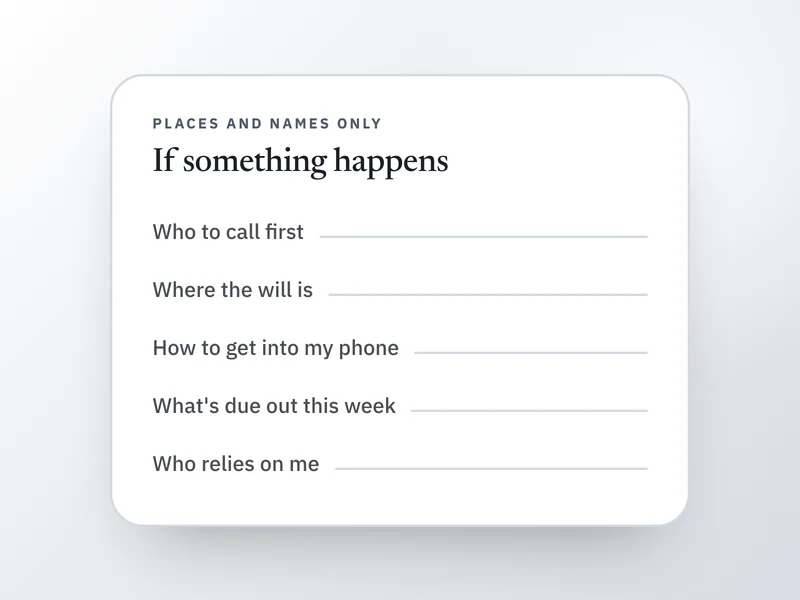
Write down where things are and who to call, not the things themselves: who someone should phone first, which bank and pension you use, where the will and key papers are, how they'd get into your phone and email, and who depends on you. One page, written in an evening, kept where somebody can find it.
This is for anyone who wants a short list they'll actually finish, rather than a full estate plan. It isn't legal advice, it can't make a will or a power of attorney valid, and it only helps if at least one person knows where it is.
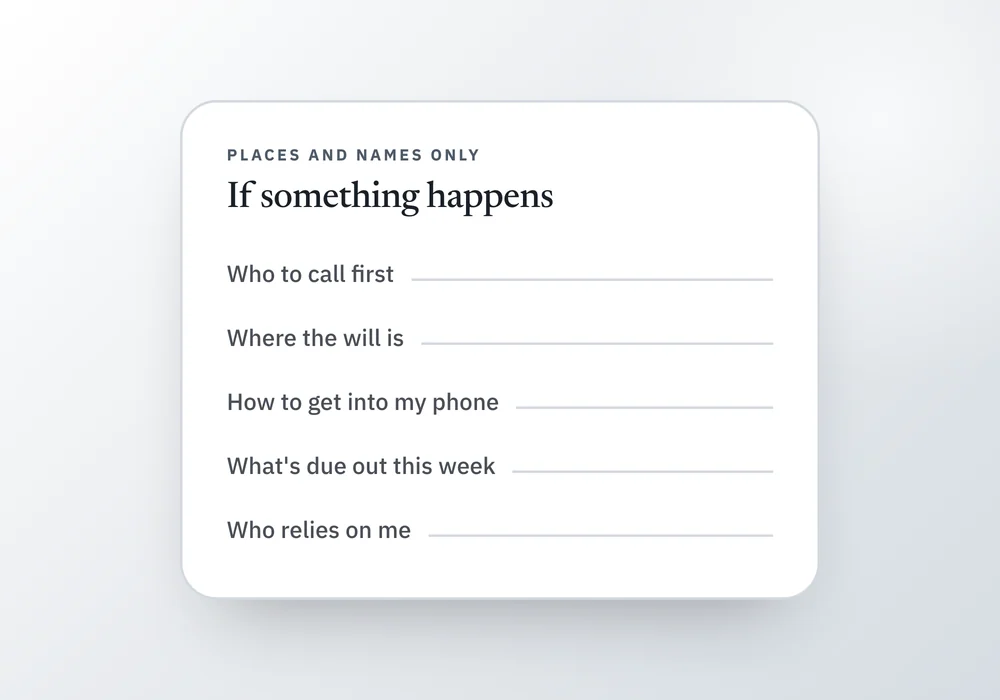
The two-week test
Say you're in the hospital for two weeks. You're fine, or will be, but you can't answer texts. Your sister has a key and good intentions. By day two she has three questions: is anything due out of the account this week, who does she call at your work, and what does the cat eat? Every answer is in your head. None of it is secret, and none of it is written anywhere.
Two weeks is the frame we'd use, because it's the likelier version: an illness, a surgery, an accident, a trip where you can't be reached. The same page also covers the harder scenarios, without you having to sit and think about them.
Example: one page, filled in
An invented example, to show the level of detail. Notice that every answer is a place or a name. There isn't a single password or account number on it.
8 of 8 rows shown
Who to call first
- How it's written
- My sister Dana, 555-0147. She has a key and knows about this page.
Who to call at work
- How it's written
- My manager, Priya, 555-0119. Tell her I'm out; no need to say why.
Household account
- How it's written
- Main account is at First Union. Rent goes out by automatic transfer on the 1st.
Bills due soon
- How it's written
- Car insurance renews on the 14th, from the same account. Nothing else is close.
Phone and email
- How it's written
- Dana knows how to open my phone. My email is the address on the fridge magnet card.
Passwords
- How it's written
- Password manager. Recovery kit is in the desk, top left drawer.
Papers
- How it's written
- Will and passport in the grey folder, bedroom closet. Spare house key with the neighbor at number 14.
Who relies on me
- How it's written
- Feed Miso twice a day, half a can. Vet is Lakeside Animal Clinic.
| Question | How it's written |
|---|---|
| Who to call first | My sister Dana, 555-0147. She has a key and knows about this page. |
| Who to call at work | My manager, Priya, 555-0119. Tell her I'm out; no need to say why. |
| Household account | Main account is at First Union. Rent goes out by automatic transfer on the 1st. |
| Bills due soon | Car insurance renews on the 14th, from the same account. Nothing else is close. |
| Phone and email | Dana knows how to open my phone. My email is the address on the fridge magnet card. |
| Passwords | Password manager. Recovery kit is in the desk, top left drawer. |
| Papers | Will and passport in the grey folder, bedroom closet. Spare house key with the neighbor at number 14. |
| Who relies on me | Feed Miso twice a day, half a can. Vet is Lakeside Animal Clinic. |
How to write it in one evening
Take them in this order. Each is a line or two, and any of them can say 'I'm not sure'.
- Write the one person to call first, and how to reach them. A name and a number is enough.
- Write what's going out of your account this month: rent or mortgage, insurance, any automatic payments. Names of things, not numbers.
- Write which email address everything is registered to, and how somebody would get into your phone. If you can't answer the second one, that's your first real task.
- Write who or what relies on you: children's pickup, a person you care for, pets, a work commitment.
- Write where the papers are: will, passport, birth certificate, insurance policies, any safe or deposit box, and who can open it.
- Tell one person the page exists and where it is. Then put a date in your calendar, six months out, to reread it.
Check the door your accounts sit behind
Almost every household has one door no one has tried to open from the outside: the password manager, guarding the recovery email, guarded by a master password that lives in one head.
You don't have to write the master password on the page, and we'd advise against it. You need a way in that doesn't depend on you: a recovery kit or emergency-access feature, if your password manager offers one, and one person who knows where the kit is. Check what yours actually provides. Then the page says, in one line, where that recovery route lives.
What to leave off
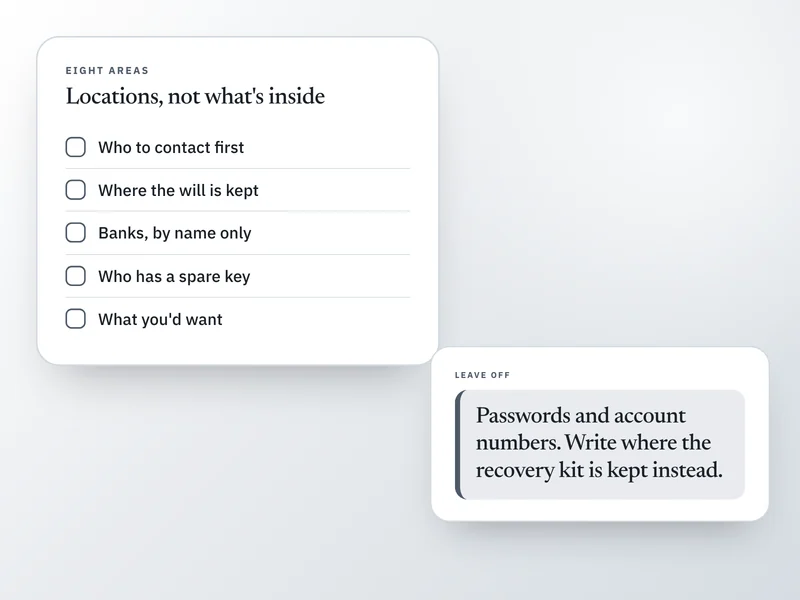
Passwords, PINs, account and card numbers, alarm codes and safe combinations stay off it. The page should be safe to leave in a drawer, which means it tells somebody where to look and who to ask, and no more.
A page that's too sensitive to leave anywhere gets left nowhere, or ends up in a spot only you know, which brings you back to the start.
When it doesn't work
The usual failure is the page that exists and can't be found. Tell someone, and say where it is. The second is that it goes stale: a new bank, a new job, a person named who has since moved away. A date six months out fixes most of that. The third is doing it all at once, getting to the password manager question, and stopping. Skip that line, mark it 'not sure', and finish the page. A short finished page is worth more than a long half-filled one.
If your situation is complicated, with children, a business, a person who depends on your care, or property in more than one state, a page won't be enough on its own. An attorney can tell you what to put in legal documents for your state. For the fuller version of what to record, see the if something happens to me file, and to test your page, try what someone would need to find if you were in the hospital.
Common questions
What should I write down in case something happens to me?
Who to call first, the bank and pension names, what's due out this week, where the will and key papers are, how someone gets into your phone and email, and who or what depends on you. Locations and names, not passwords or account numbers. One page is enough to begin.
Is this the same as a will?
No. A will is a legal document with rules about how it's signed, and it usually takes effect only after a death. This page is a practical list for the days someone has to keep your life running, whether you're ill, away or worse. It doesn't replace a will, and it isn't legal advice.
Should I write my passwords down?
We'd say no. Write where the recovery route is instead, such as where a password manager's recovery kit is kept and who knows about it. A page full of passwords is dangerous to leave in a drawer, and a page that's too sensitive to leave anywhere is one no one finds.
Who should I tell where the list is?
One person you trust to act, and ideally a second as a backup: a partner, sibling, adult child or close friend. Tell them in person, show them where it is, and check they're willing. A list that stays a secret helps no one.
How often should I update it?
Every six months is a sensible rhythm, plus any time something big changes: a move, a new job, a new bank, a marriage or separation, a new pet. Put a date in your calendar when you write it, and reread it on that date.
Doing this one step at a time
The Personal Life Affairs Companion turns this page into a sequence. It asks eight yes or no questions first, so it skips what doesn't apply to you, then gives you one step at a time: who to contact first, who would sort things out, the main email address, whether you have a will and where it is, where the password manager's recovery instructions are kept, banks by name, spare keys and safes, and who would take the pets. Each answer is a place or a name in your own words. It never asks for a password or an account number.
When you're ready, it prints a book you can hand to someone. It doesn't send anything to anyone, and it isn't a will or legal advice. See what's in the Personal Life Affairs Companion.
Where to go next
 If this is where you areThe if-something-happens-to-me file: what goes in itOnce you have the short list, this shows the full file and where each item is kept.
- If you were hospitalized, what would someone need to find?
To check the list holds up, imagine two weeks in the hospital and see what someone could actually find.
- Life admin binder: what to include, in 8 sections
If you prefer paper, this shows how to gather the same information into a binder with eight sections.
- Digital accounts after a death: what can be recovered
Passwords, photos and email are the items most often forgotten, and this covers what can be recovered.