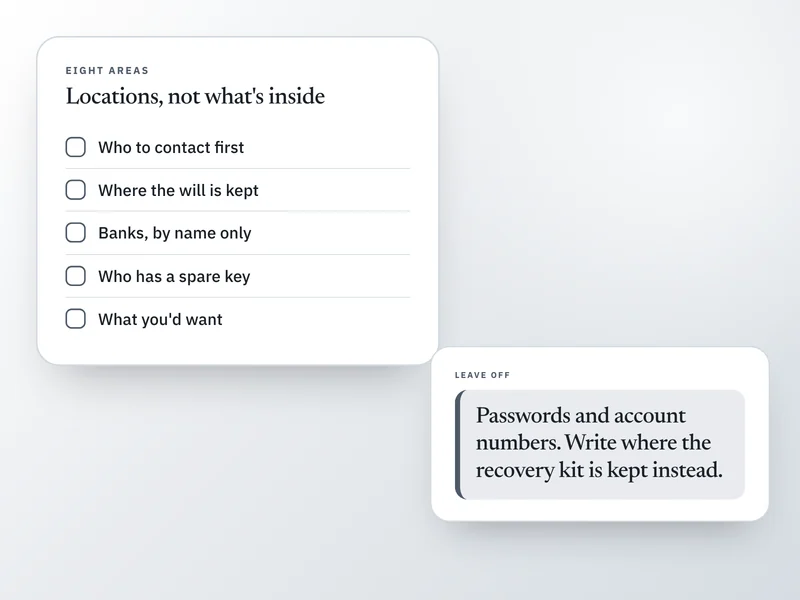
If you were in the hospital for two weeks, someone would need six things: who to call, where your important papers are, which bills fall due, how to get into your phone and accounts, who covers children or pets, and who tells your employer. Write down where each answer is, not the answer itself.
This is for a partner, parent or friend who would step in, and for you, if you're the one who'd be away. It can't tell you what a bank will allow or what your state's forms say. It isn't legal or medical advice.
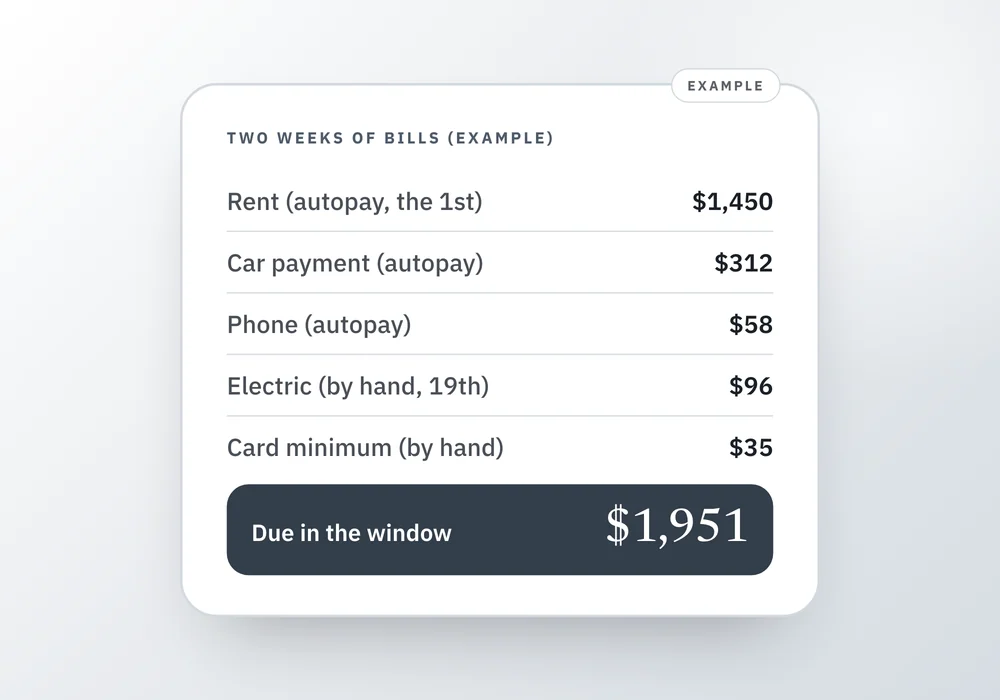
The bills in a two-week stay (example)
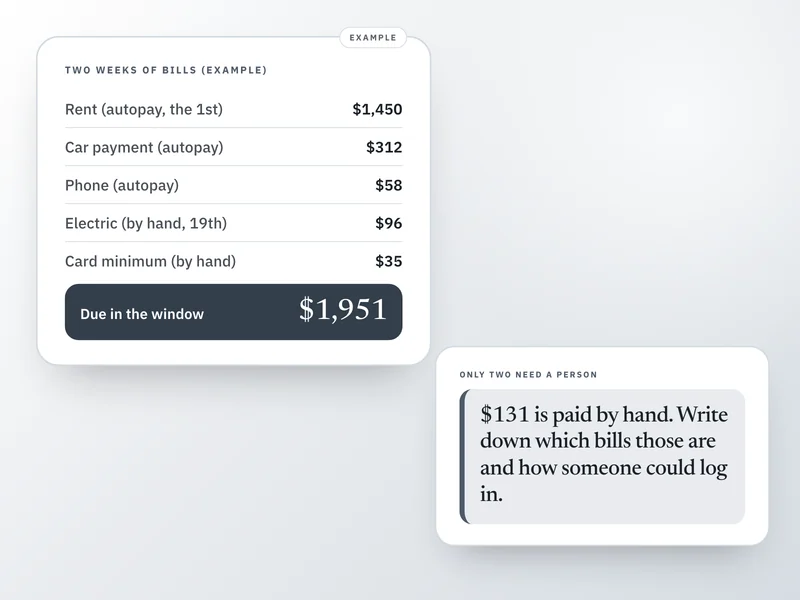
An invented month, to show why the question is less dramatic than it sounds. Most of it pays itself. The trouble is the few items that don't.
Rent
- Amount
- $1,450
- Pays itself?
- Yes, autopay
- Due
- The 1st
Car payment
- Amount
- $312
- Pays itself?
- Yes, autopay
- Due
- The 8th
Phone
- Amount
- $58
- Pays itself?
- Yes, autopay
- Due
- The 12th
Electric
- Amount
- $96
- Pays itself?
- No, paid by hand
- Due
- The 19th
Credit card minimum
- Amount
- $35
- Pays itself?
- No, paid by hand
- Due
- The 22nd
Total in the window
- Amount
- $1,951
- Pays itself?
- $1,820 pays itself
- Due
- $131 needs a person
| Bill | Amount | Pays itself? | Due |
|---|---|---|---|
| Rent | $1,450 | Yes, autopay | The 1st |
| Car payment | $312 | Yes, autopay | The 8th |
| Phone | $58 | Yes, autopay | The 12th |
| Electric | $96 | No, paid by hand | The 19th |
| Credit card minimum | $35 | No, paid by hand | The 22nd |
| Total in the window | $1,951 | $1,820 pays itself | $131 needs a person |
Read that table the way a sister would. Nothing bad happens to the $1,820 as long as the account has money in it. The $131 is the problem, and only if she can't log in. A late electric bill in week two is small. Not knowing which bills are which is what makes it feel like a crisis.
What someone runs into, in order
Roughly the sequence for a sudden admission. A planned one gives you time to prepare, which is what the rest of this guide is for.
Day 1
Someone is called, or should be. They need a name and a number for family, your employer, and whoever is looking after a child or pet.
Day 1 to 2
The hospital asks who speaks for you. That is a separate person and a separate form from your emergency contact. See the guide on choosing a health care proxy.
By day 3
Your employer or school needs telling, and your phone needs to be reachable. If it's locked and no one has the code, both stall.
Week 1
The first manual bills approach. Someone needs to know which ones, and what the way in to the account is.
Week 2
Mail piles up, pets and plants need care, and whoever has been managing everything needs a page to work from.
Answer the six questions, one sentence each
Take ten minutes with a notebook. Write where the answer is or who has it. A sample answer follows each question, and it's a full answer.
- Who should be called first, and how would they be reached? "Dana, 555-0142. If she doesn't pick up, Marcus."
- Where is the important paperwork, and who knows that? "Fireproof box, hall closet. Marcus knows."
- How would someone get help getting into your accounts and phone? "Recovery kit is in the fireproof box. Dana has my phone passcode."
- Which bills fall due, and are they automatic? "Rent, car and phone are automatic. Electric and the credit card are by hand, the 19th and 22nd."
- Who looks after children, dependents or pets, and what's a normal week? "Marcus takes the dog. Feeding is twice a day, the vet is Lakeview."
- Who speaks to your employer or your business? "My manager is Priya, her email is on my work profile. Dana will write to her."
What this list can't do
A page saying where things are helps someone find them. It doesn't give them the right to act. In the United States, a bank generally deals with the account holder, or with someone the account holder has formally named. The Consumer Financial Protection Bureau lists the usual options: a convenience or joint account, a power of attorney, or a trusted contact who is only notified about suspected fraud and has no access to money. Each has a cost. A person who can deposit can also withdraw, and a power of attorney is a serious grant of authority.
Which of those fits you, and what your state's forms require, is a question for an attorney in your state. Write down who you've named and where the paper is. For the medical side, choosing a health care proxy covers that decision, and the if something happens to me file covers the longer list.
Where the test goes wrong
Answers that live only in your head fail the test. So do answers written on a device that's locked, or in a binder no one knows about. The fix is the same each time: a person who knows where the page is.
Two-week tests also tend to skip the awkward ones. Ask yourself who would be embarrassed to be asked, and write that answer first. If you'd like a place to keep the pages, a life admin binder does the job on paper, and what to write down in case something happens to you is the short list.
Questions people ask
If I'm in the hospital, who pays my bills?
Automatic payments continue while the account has money in it. Anything you pay by hand waits until someone can log in or you're back. A family member usually can't act on your account without formal authority, so note which bills are manual and who could be named to help, and ask an attorney in your state about a power of attorney.
Can my spouse or partner access my bank account while I'm hospitalized?
It depends on how the account is set up. A joint owner can, and a spouse who isn't on the account generally can't without authority. The CFPB describes joint and convenience accounts, powers of attorney and trusted contacts as different arrangements with different risks. An attorney or your bank can tell you what applies.
What should someone know if I have a planned surgery?
The same six things, written down before the date: who to call, where the papers are, how to get into your phone and accounts, which bills are manual, who covers children or pets, and who tells your employer. Also name the person who speaks for your medical care and tell them where any forms are.
How do I let someone into my phone and accounts without sharing passwords?
Write where the recovery instructions are kept, not the instructions themselves, and tell one person the location. If you use a password manager, its recovery kit can live in a fireproof box. Some services offer a legacy or emergency contact, and those settings differ by provider, so check each one.
Is an emergency contact the same as a health care proxy?
No. An emergency contact is who the hospital calls. A health care proxy, also called an agent, is the person you legally name on a state form to speak for your care if you can't. They can be the same person, but they don't have to be, and the forms differ by state.
Checking it the way a stranger would
Personal Life Affairs Companion includes a Handoff Check. Once you've recorded a few things, it reads your answers by what someone would be trying to do, such as find the paperwork, reach accounts and devices, or look after the people who rely on you, and shows how many may still be unclear. It never shows a percentage. It's a private self-check over your own answers. It doesn't send anything to anyone, and it doesn't give anyone access to your accounts.
Sources and how we checked
- Consumer Financial Protection Bureau: Can a family member or friend help me with bill paying and banking?: Options for help with banking (convenience account, trusted contact, power of attorney) and their risks.Checked 26 September 2026.
- CaringInfo: Advance directives: An agent is named on a state advance directive form; states vary in witness and notary requirements.Checked 26 September 2026.
Where to go next
 If this is where you areThe if-something-happens-to-me file: what goes in itOnce you have seen the gaps, the full file shows what to record and in what order.
- What to write down in case something happens to me
For the short list of items that exist only in your head, use this writing prompt.
- How to choose a health care proxy, and record it
If a hospital needs someone to decide for you, this covers how to choose and record a health care proxy.
- Who will take care of your pets if something happens to you
If animals would need feeding while you were away, this covers naming someone and writing down what each needs.