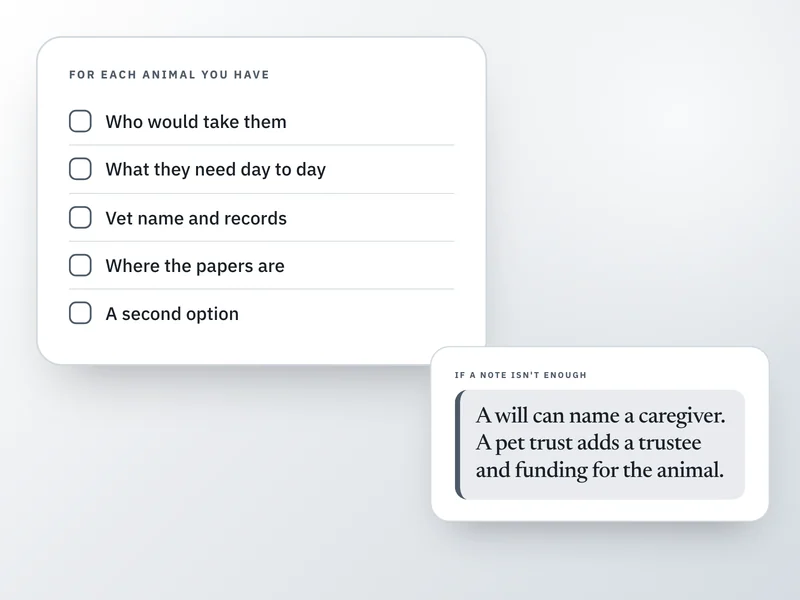
If you were suddenly hospitalized or died, someone would need to feed, walk and medicate your pets with no notice. Write down who would take each animal, what it needs day to day, and where the vet and its records are. A note won't fund the care; for that, you need a pet trust or a clause in your will.
This is for anyone with a pet in the United States who wants a plan in place before an emergency, not after one. It can't draft a pet trust or tell you what your state allows; for that, talk to an attorney who handles them.
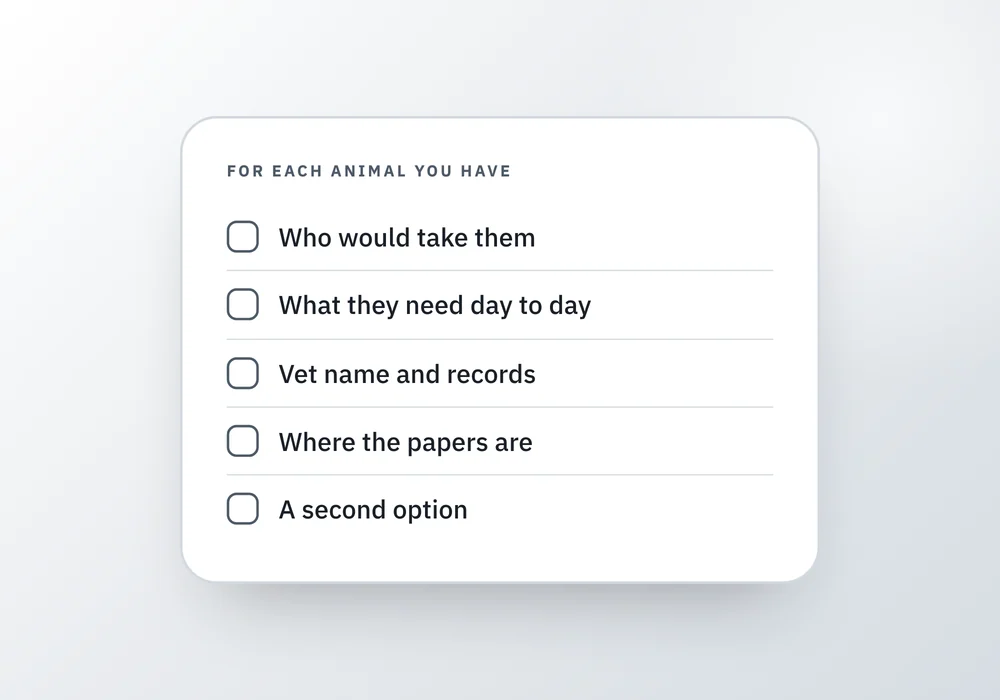
An example: what two people wrote down
An illustration with two invented animals, not a real household.
Milo, dog, 6
- Who would take them
- Neighbor Dana, asked and agreed
- What they need
- Two meals a day, a joint that needs a daily pill
- Vet and records
- Riverside Vet, records on their app
Nora, cat, 3
- Who would take them
- Sister Priya, second choice if Dana can't
- What they need
- Indoor only, skittish around strangers
- Vet and records
- Same clinic as Milo, chip number on file
| Animal | Who would take them | What they need | Vet and records |
|---|---|---|---|
| Milo, dog, 6 | Neighbor Dana, asked and agreed | Two meals a day, a joint that needs a daily pill | Riverside Vet, records on their app |
| Nora, cat, 3 | Sister Priya, second choice if Dana can't | Indoor only, skittish around strangers | Same clinic as Milo, chip number on file |
What to write for each animal
5 things to do
Ticks are for this visit only. Nothing here is saved anywhere.
Ask first
As with any arrangement that depends on another person, ask before you write their name down. A person who has agreed, and knows what's involved, is a plan. A name on a page is only a hope.
A trust or a clause in your will, if a note needs more backing
Pets are legally property, so a will can say who gets to keep them, but it can't leave money directly to an animal, and naming a caregiver in a will doesn't obligate that person to actually provide care. A pet trust is different: a trustee holds money set aside for the animal, an enforcer can hold the caregiver to it, and it can even take effect while you're alive but unable to look after the animal yourself, not only after death. Every state now has some form of pet trust law.
This is worth more than a note for a pet with ongoing medical costs, an exotic animal that's harder to place, or more than one or two animals. An estate attorney who has set one up before can tell you what your state requires to fund and enforce it. For most healthy pets with a willing family member nearby, the written note is enough.
Two more things worth doing
2 things to do
Ticks are for this visit only. Nothing here is saved anywhere.
When the plan doesn't hold
The person you named can change their mind, move, or develop an allergy years after you asked, so check in every couple of years rather than trusting a yes from a decade ago. If no one can be found in time, animals default to a shelter, and an exotic or less common pet can wait far longer there for a new home than a dog or cat would.
A boarding contact isn't the same as a caregiver. Boarding buys a few days for a short absence. It isn't a plan for a death or a long hospital stay, and most kennels won't keep an animal indefinitely without someone paying and making decisions for it.
Questions people ask
Can I leave money to my pet in my will?
Not directly. Pets are legally property, so a will can say who gets to keep them, but it can't leave money to an animal the way it can to a person. A pet trust does what a will can't: it sets aside funds and names a trustee to manage them for the animal's care.
Do I need a lawyer to set up a pet trust?
You don't have to, but the trust has to be funded and worded correctly to hold up and actually pay out, which is why an estate attorney usually drafts it. That attorney can also tell you what your state's pet trust law requires to enforce it.
What happens to my pet if no one is named at all?
Whoever handles your affairs decides, often a family member acting quickly under pressure, or the animal goes to a shelter until someone claims it. Naming even one person, and telling them, is usually enough to avoid that outcome.
Is a pet trust worth it for a healthy dog or cat?
Often not. If a family member or friend has agreed to take the animal and can cover routine costs, a written note naming them is usually enough. A trust earns its cost for pets with ongoing medical needs, exotic animals that are harder to place, or when you want the money, not just the goodwill, to be there.
What the Companion does with this
If you say yes to having pets, Personal Life Affairs Companion asks who would take each one and what they need, and lets you add more than one animal. Your own words print in the book someone would actually be handed, not a form filled in and never looked at again. It doesn't draft a pet trust, choose a caregiver for you, or arrange care if something happens; it records the plan you've already made. See Personal Life Affairs Companion.
Sources and how we checked
- ASPCA: Pet Trust Laws: All 50 states and DC now have a pet trust law; a trustee and a caregiver are named, and some states cap how much can be fundedChecked 26 September 2026.
- FindLaw: Pet Trusts: Pets are legal property and a will can't leave money directly to one; a pet trust adds a trustee and an enforcement mechanism a will bequest doesn't have, and can take effect at incapacity, not only deathChecked 26 September 2026.
Where to go next
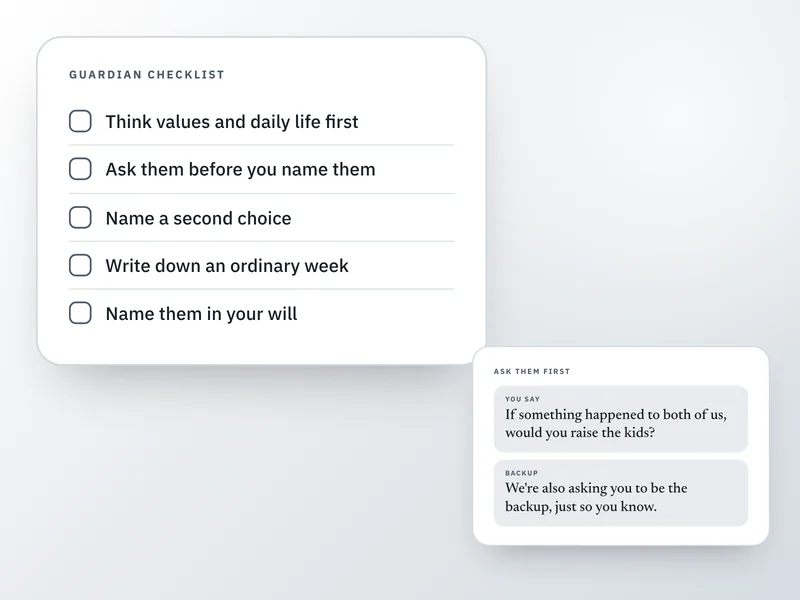 If this is where you areWho would raise your children? A guardian checklistIf you also have children, this checklist covers choosing someone who would say yes.
- The if-something-happens-to-me file: what goes in it
To store the note about your animals where someone will look, use this file.
- What to write down in case something happens to me
For the short list of everything else that lives only in your head, use this prompt.
- If you were hospitalized, what would someone need to find?
A hospital stay is the most likely reason someone needs to step in, and this test shows what they would need.