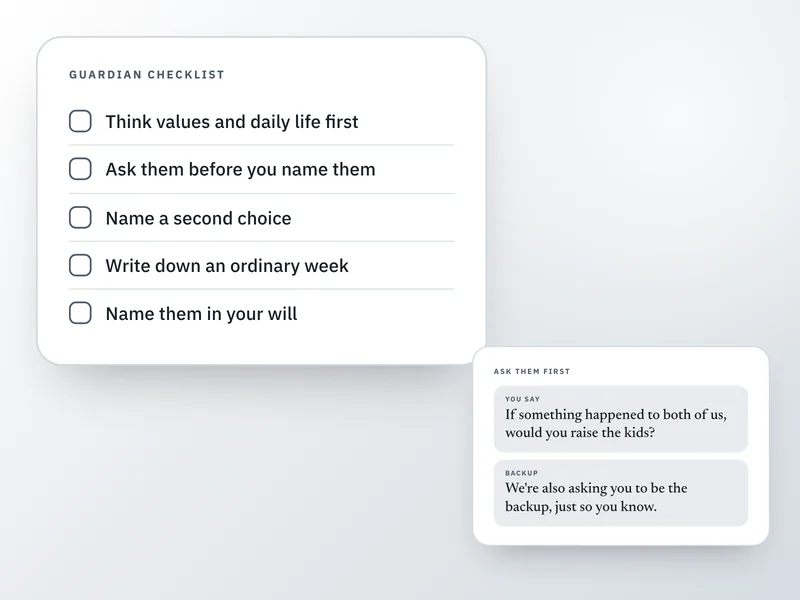
If both parents were gone, a court in your state would decide who raises your kids, unless you'd already named someone. To do that: pick one person or couple, ask them before you name them, name a second choice in case the first can't do it, and write down the details of an ordinary week so whoever steps in isn't guessing.
This is the human side of naming a guardian for a minor child in the United States: who and how to ask, not how to draft the legal document. How a court weighs your nomination, and what happens if you haven't named anyone, differs by state, so confirm the specifics with an attorney or your state court's self-help resources.
An example: what changes once you've decided
Say you and your partner agree your sister and her husband would raise your two kids. (This is an example, not a case.) You name them in your wills, name your brother as the backup, and write one page: which school, who the pediatrician is, that the younger one has a peanut allergy, and who picks the kids up on Wednesdays when practice runs late. None of that page is legally binding by itself. All of it is what your sister would actually need in the first week.
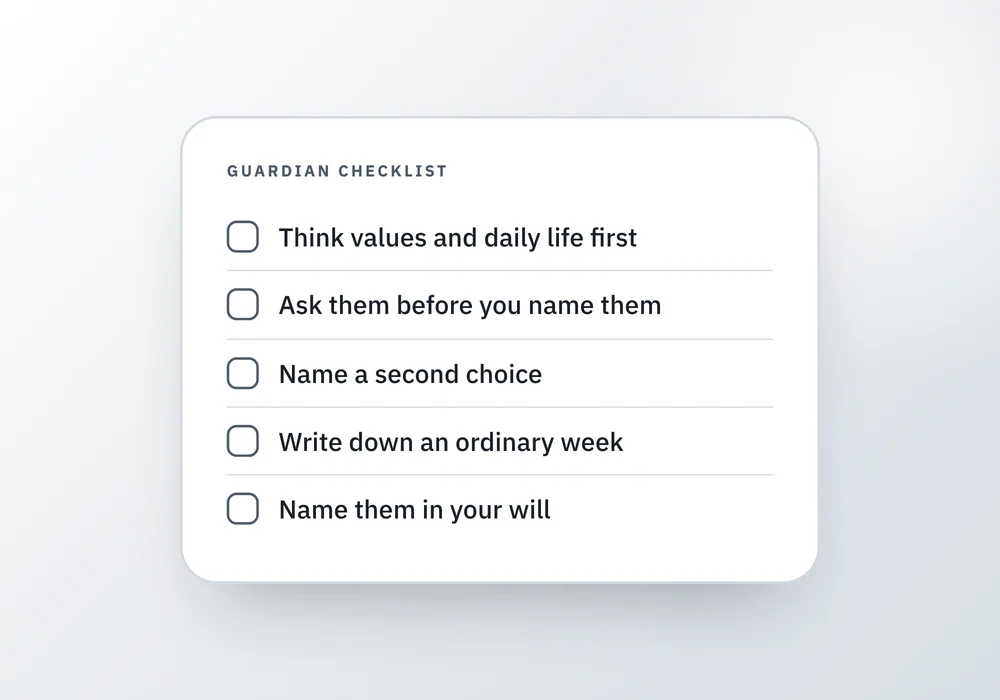
The checklist
6 things to do
Ticks are for this visit only. Nothing here is saved anywhere.
A will names your choice. It doesn't appoint them on its own
A will is where you formally nominate a guardian, and it's the single most useful document for this, but naming someone there doesn't hand them custody by itself. If it's ever needed, a court in your state still opens a guardianship case and approves the nomination, and it generally does, unless the nominee is clearly unfit or someone objects. Skip the will and rely only on a note or a spoken understanding, and there's nothing for a court to work from at all.
If you haven't named anyone
If neither parent can care for the child and no guardian was named, custody doesn't default to a court's best guess of who you'd have wanted. A surviving parent is usually considered first. Past that, courts generally ask relatives to come forward and choose based on the child's best interests, weighing relationships, stability, and the child's own wishes if they're old enough. If no relative is found or willing, the outcome can be foster care, which is the strongest reason to name someone yourself rather than leave the question open. Exactly how a court runs this process, and how much weight it gives a parent's nomination, differs by state.
Two different jobs: raising the kids, and managing the money
Who raises your children and who manages any money or property they inherit don't have to be the same person. A guardian of the person handles daily life. A guardian of the estate, called a conservator in some states, handles finances until the child is an adult. Many parents name the same person for both, but if your first choice as a parent wouldn't be your first choice with money, a will can send that half of the job to someone else, or to a trust, instead.
Covering a shorter absence
None of this is the right tool for a two-week hospital stay or a work trip, since opening a guardianship case takes time even when everyone agrees. For a short absence, some states offer a simpler document that lets someone you choose enroll your child in school and consent to routine medical care without going to court. California's version, the Caregiver's Authorization Affidavit, lets a relative caregiver consent to school enrollment and to medical and dental care under California law; a non-relative caregiver gets narrower authority, limited to school-related care. Ask your state court's self-help site or a family law attorney what the equivalent is called where you live, since the name, the powers it grants, and who qualifies all vary.
Questions worth sitting with before you choose
There's no perfect answer to any of these. There's a best one for your situation.
- Do their values about raising kids look enough like yours, on the things you actually care about?
- Where do they live, and would your kids have to change schools or leave their friends?
- Are they healthy enough, and young enough, to realistically take this on for years, not months?
- Can they afford it, or would money need to come from what you leave behind?
- How would this affect your other children's relationships with siblings or cousins, if the group would get split up?
Asking them, in your own words
Pick the one you are facing
“If something happened to both of us, would you be willing to raise the kids? No pressure to answer right now.”
“We're also asking you to be the backup, in case Sam isn't able to do it. Just so you know where you stand.”
When you and a co-parent don't agree
If you and the other parent can't agree on who should raise the kids, write down your own choice and your reasoning anyway. A recorded preference, even a disputed one, gives a court more to work with than silence from both of you. If you can't resolve it between you, a family law attorney can explain how your state weighs each parent's nomination when they conflict.
A letter alongside the will
A short letter explaining why you chose this person, and what you'd want for how the kids are raised, isn't a legal document, but it's the part a guardian, and a court, actually reads to understand your reasoning. Keep it with your will, not instead of it. It can say things a will's legal language can't: what you'd want to stay the same for the kids, what worries you, what you'd want them to know about you. See what to write down in case something happens to you for the wider list this fits into.
Questions people ask
Is naming a guardian in my will legally binding?
It's the nomination a court will almost always follow, but it doesn't hand over custody automatically. If it's ever needed, a court in your state still opens a guardianship case and approves it, generally unless your nominee is clearly unfit or someone objects. Skipping the will leaves the court with nothing to work from.
What happens to my kids if I don't name a guardian?
A surviving parent takes over first. If neither parent is available and no guardian was named, courts generally ask relatives to come forward and choose based on the child's best interests. If no one is found or willing, the outcome can be foster care, which is why naming someone yourself is worth doing even informally.
Can I name different people for guardianship and for managing money?
Yes. The person who raises your kids day to day, the guardian of the person, doesn't have to be the same one who manages money they inherit, sometimes handled by a guardian of the estate or a trust instead. Many parents choose the same person for both, but you don't have to.
What if my child's other parent and I disagree on a guardian?
Write down your own choice and your reasoning anyway. A recorded preference gives a court more to work with than no preference from either of you. If you can't reach agreement, a family law attorney can explain how your state weighs each parent's nomination when they conflict.
How do I arrange care for a short trip without a full guardianship?
Full guardianship takes too long to open for a short absence. Some states offer a simpler authorization that lets a chosen caregiver enroll your child in school and consent to routine medical care without a court case. California's version is called a Caregiver's Authorization Affidavit. Ask what your own state's equivalent is called.
Recording the choice, and the details that go with it
Personal Life Affairs Companion, if you have children under eighteen, has a step for deciding who would raise them, then asks you to talk to them first, then asks for a second choice and the practical details of an ordinary week: school, the doctor, who collects them, what happens on which day. It records your answers in your own words. It doesn't nominate a guardian in a legal document, doesn't file anything with a court, and doesn't contact the person you've named. See Personal Life Affairs Companion.
Sources and how we checked
- California Courts Self-Help Guide: Guardianships in California: Example of one state's process: a guardianship is opened and supervised by a court until the child turns 18 or the court ends itChecked 26 September 2026.
- FreeWill: What Is a Legal Guardian, and How to Choose One for Your Child: A court must approve all guardian nominees, and what happens if no guardian was named and no relative is found or willingChecked 26 September 2026.
- Alliance for Children's Rights: Caregiver's Authorization Affidavit: California's short-term caregiver authorization: what it lets a relative versus a non-relative caregiver consent toChecked 26 September 2026.
Where to go next
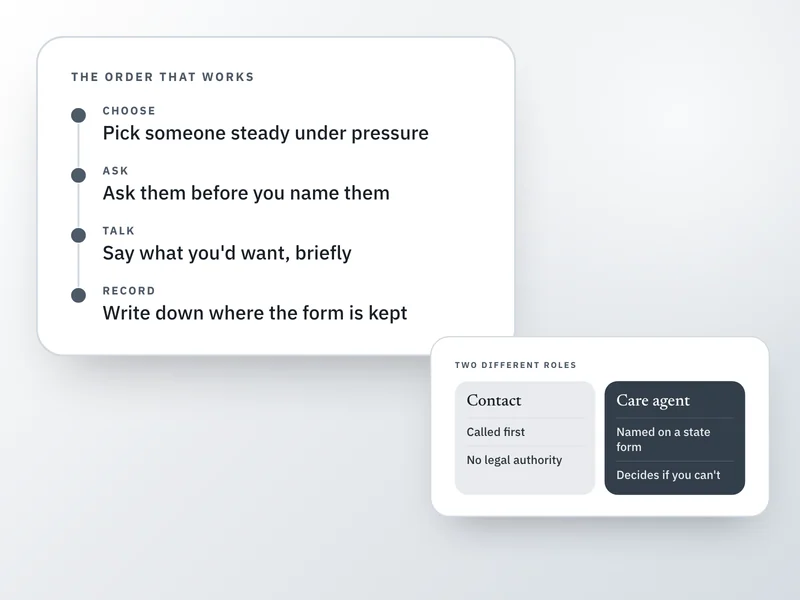 If this is where you areHow to choose a health care proxy, and record itAfter naming a guardian, this covers naming the person who would speak for your medical care.
- What to update after marriage, divorce, a move or a baby
A new child is a common reason to revisit your paperwork, and this lists what to look at again.
- Beneficiary vs will: which one decides who gets it?
To make sure money reaches the right people as well, this compares beneficiary forms and your will.
- Who will take care of your pets if something happens to you
If your household includes animals, this covers naming someone to take them in and what to write down.