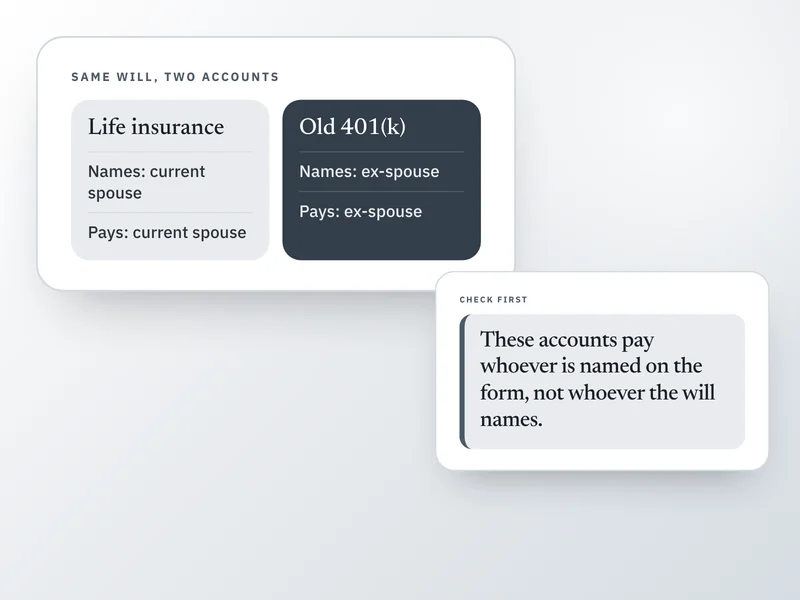
A will does not control everything you own. A retirement account, a life insurance policy, and a payable-on-death bank account go to whoever is named on that account's own form, regardless of what your will says or how recently you updated it. Checking who is named takes one login or one phone call per account.
This is written for the United States, for anyone with a 401(k), an IRA, a life insurance policy or a payable-on-death account who hasn't checked the named beneficiary in years. It can't tell you what to write on a form, or whether you need a trust; that's a question for an attorney, and the details vary by state and by plan.
Example: the account that outruns the will
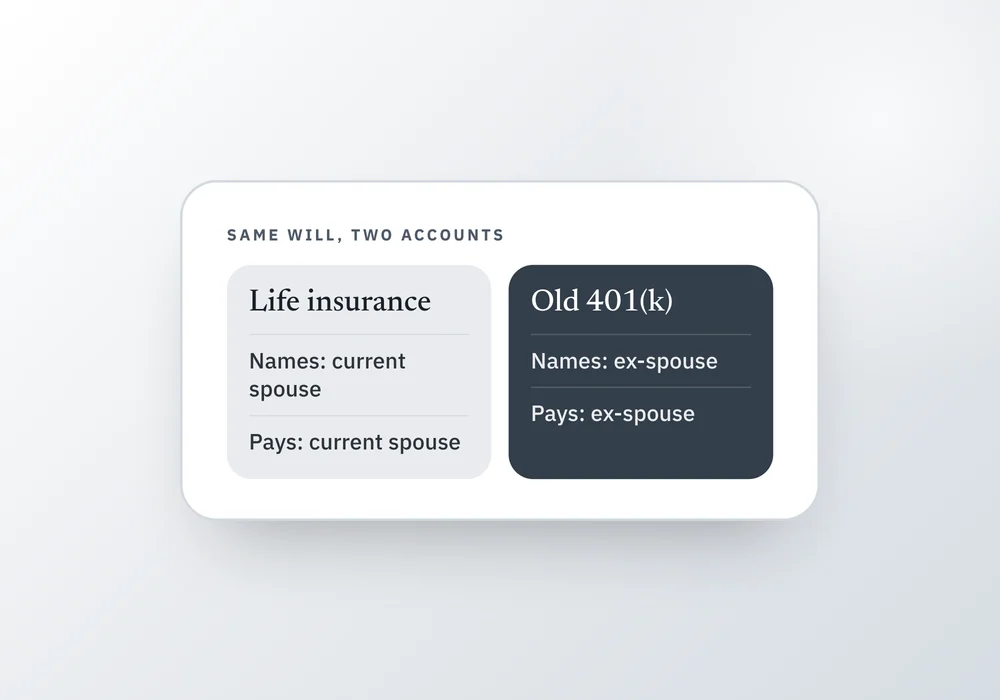
Say your will leaves everything to your children, and an old 401(k) from a job you left years ago still names your ex-spouse. The plan pays the person on the form. It does not read the will first, and in most cases divorce does not remove that name for you. (This is an example, not a case. Rules differ by plan and by state.)
What the form decided (example)
An invented set of accounts, to show how differently each one can pass even when the will says the same thing throughout.
Old 401(k)
- Named beneficiary
- Ex-spouse, never updated
- Will says
- Everything to my children
- Who actually gets it
- Ex-spouse
Life insurance policy
- Named beneficiary
- Current spouse
- Will says
- Everything to my children
- Who actually gets it
- Current spouse
Payable-on-death savings account
- Named beneficiary
- Sister
- Will says
- Everything to my children
- Who actually gets it
- Sister
Regular brokerage account, no beneficiary on file
- Named beneficiary
- None named
- Will says
- Everything to my children
- Who actually gets it
- Passes through the will
| Account | Named beneficiary | Will says | Who actually gets it |
|---|---|---|---|
| Old 401(k) | Ex-spouse, never updated | Everything to my children | Ex-spouse |
| Life insurance policy | Current spouse | Everything to my children | Current spouse |
| Payable-on-death savings account | Sister | Everything to my children | Sister |
| Regular brokerage account, no beneficiary on file | None named | Everything to my children | Passes through the will |
What passes by form, and what the will controls
General shape for the United States. Confirm the details with each plan or provider, since rules vary.
8 of 8 rows shown
401(k) or other workplace plan
- Usually passes by
- Beneficiary form on file with the plan
- Does the will control it
- No
IRA (traditional or Roth)
- Usually passes by
- Beneficiary form on file with the custodian
- Does the will control it
- No
Life insurance policy
- Usually passes by
- Named beneficiary on the policy
- Does the will control it
- No
Payable-on-death (POD) bank account
- Usually passes by
- POD beneficiary named at the bank
- Does the will control it
- No
Transfer-on-death (TOD) brokerage account
- Usually passes by
- TOD beneficiary on file
- Does the will control it
- No
Jointly owned property with survivorship
- Usually passes by
- Passes to the surviving owner
- Does the will control it
- No
Anything held in a living trust
- Usually passes by
- The trust's own terms
- Does the will control it
- No
Accounts and property with no beneficiary named
- Usually passes by
- The estate, through probate
- Does the will control it
- Yes
| Asset | Usually passes by | Does the will control it |
|---|---|---|
| 401(k) or other workplace plan | Beneficiary form on file with the plan | No |
| IRA (traditional or Roth) | Beneficiary form on file with the custodian | No |
| Life insurance policy | Named beneficiary on the policy | No |
| Payable-on-death (POD) bank account | POD beneficiary named at the bank | No |
| Transfer-on-death (TOD) brokerage account | TOD beneficiary on file | No |
| Jointly owned property with survivorship | Passes to the surviving owner | No |
| Anything held in a living trust | The trust's own terms | No |
| Accounts and property with no beneficiary named | The estate, through probate | Yes |
Check your own forms, in this order
A short afternoon of logins and phone calls. Write down what you find as you go.
6 things to do
Ticks are for this visit only. Nothing here is saved anywhere.
Why this goes wrong so often
Beneficiary forms are usually filled in once, during onboarding at a new job or when a policy is first bought, and then never looked at again. People marry, divorce, have children and change jobs, and the form stays exactly as it was.
The result is predictable and still surprises people: a 401(k) from a job left fifteen years ago still names an ex-spouse, or a parent who has since died, or no one at all.
What can go wrong, and the rules behind it
- If you're married and want to name someone other than your spouse on a 401(k) or similar workplace plan, federal law generally requires your spouse's written, notarized or plan-witnessed consent first. Without it, the spouse is the default beneficiary. An IRA usually doesn't carry that same federal requirement, though it can in a community-property state.
- Divorce doesn't automatically remove an ex-spouse from a 401(k), pension or other workplace retirement plan. Federal law generally overrides state laws that try to erase an ex-spouse's name automatically, so the pre-divorce form stays in force until you personally change it.
- Many states do have a law that automatically removes an ex-spouse from things like life insurance and payable-on-death accounts after a divorce, but it doesn't apply everywhere or to every asset, so check the form yourself instead of assuming a divorce decree already handled it.
- A blank beneficiary usually means the plan's own default order decides, which can push the money into your estate, where it moves slower and is reachable by creditors in ways a direct beneficiary payout is not.
- Naming a minor directly on a form can mean a court has to appoint someone to manage the money until they turn 18, rather than the person you had in mind. Ask the plan or an attorney about naming a custodian or a trust instead.
Where to keep what you find
Once you've confirmed who's named on each account, write down where each confirmation is kept, not the account numbers themselves. The if-something-happens-to-me file is one place to put that.
A beneficiary form is exactly the kind of paperwork that goes stale after a marriage, a divorce, a new job or a new child. What to update after a life change covers the rest of what's worth checking at the same time.
Questions people ask
Does a beneficiary designation override a will?
Yes, for accounts that carry their own beneficiary form: retirement accounts, life insurance, and payable-on-death or transfer-on-death accounts. These pass directly to the named person and are not controlled by the will, even if the will says something different. Only property with no named beneficiary passes through the will.
Does divorce automatically remove my ex-spouse from my 401(k)?
Generally, no. Federal law usually overrides state rules that try to erase an ex-spouse from a workplace retirement plan automatically after a divorce, so the old form can stay in force. Update the beneficiary form yourself as soon as the divorce is final, and don't assume the decree already did it.
Do I need my spouse's permission to name someone else as my 401(k) beneficiary?
In most cases, yes. Federal rules generally require a married participant's spouse to consent in writing, with a notary or plan representative as witness, before someone other than the spouse can be named on a workplace retirement plan. An IRA usually doesn't carry this same requirement outside community-property states.
What happens if a beneficiary form is left blank?
The plan or provider's own default rules decide, which often means the money goes to your estate rather than directly to a person. That can mean probate, a slower payout, and exposure to creditors that a named beneficiary wouldn't have faced. Check every account rather than assume it's handled.
Can I name a minor child as a beneficiary?
You can name a minor, but a court may need to appoint someone to manage the money until they turn 18, which may not be who you had in mind. Ask the plan about naming a custodian under your state's transfer-to-minors law, or ask an attorney about a trust instead.
Where a Companion helps
Personal Life Affairs Companion has two steps built around exactly this. One has you check who's currently named on your pension or workplace retirement plan and your life cover; the other prompts you to update it once your situation has changed. It records the provider, where the paperwork is kept, and, if you choose to add it, who's currently named. It doesn't give advice on what to write on the form, and it can't check the form for you; that call still has to be made to the provider.
Sources and how we checked
- U.S. Department of Labor, EBSA: FAQs About Retirement Plans and ERISA: A surviving spouse's automatic right to a 401(k)-type plan and the notarized spousal consent needed to name someone else.Checked 26 September 2026.
- CBIZ: Automatic Revocation Upon Divorce: ERISA preempts state revocation-on-divorce statutes for 401(k)s and pensions; roughly 26 states have such a statute for non-ERISA assets like life insurance.Checked 26 September 2026.
- Bank of America: Beneficiaries FAQs: How a payable-on-death (POD) beneficiary designation on a bank account works and passes outside the will.Checked 26 September 2026.
Where to go next
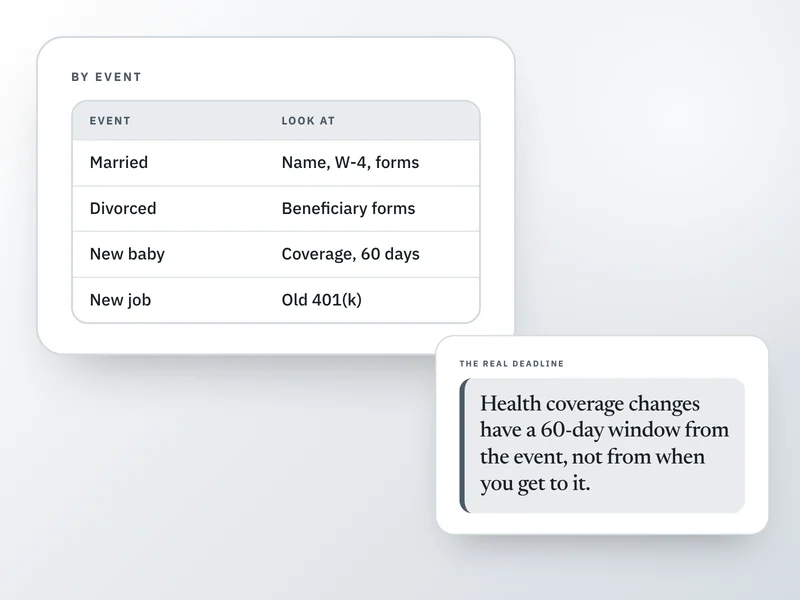 If this is where you areWhat to update after marriage, divorce, a move or a babyBeneficiary forms go stale after a divorce, marriage or birth, and this lists what to review by event.
- The if-something-happens-to-me file: what goes in it
To record which accounts have named beneficiaries and where the forms are, use this file.
- Who would raise your children? A guardian checklist
If you have children, a guardian named in your will is another choice worth checking against your forms.
- How to talk to your parents about their will and finances
If a parent's forms are a mystery, this offers scripts for asking about their will and finances without it going badly.