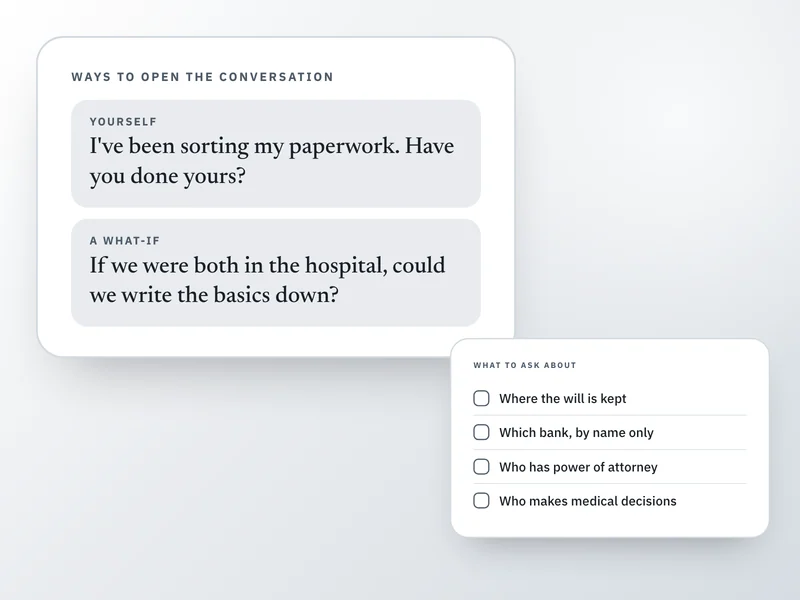
The conversation works when it sounds like logistics, not mortality: where the will is kept, which bank, who the lawyer is. Skip the contents entirely, the values, the balances, who inherits what. Open by mentioning your own paperwork first, ask for locations only, and expect it to take more than one sitting.
This is for adult children in the US who want to start this conversation with a parent who is still able to have it. It has nothing to say about guardianship or undue influence, and if either is already a concern, an elder law attorney is the next call, not this page.
Example: what a reassuring answer doesn't tell you
A typical exchange, not a real one.
"It's all taken care of."
- What you still don't know
- Whether there's a current will, or one from decades ago
"Your uncle has a copy."
- What you still don't know
- Which uncle, and where he actually keeps it
"We'll deal with that later."
- What you still don't know
- Whether later means next month or never
| What they say | What you still don't know |
|---|---|
| "It's all taken care of." | Whether there's a current will, or one from decades ago |
| "Your uncle has a copy." | Which uncle, and where he actually keeps it |
| "We'll deal with that later." | Whether later means next month or never |
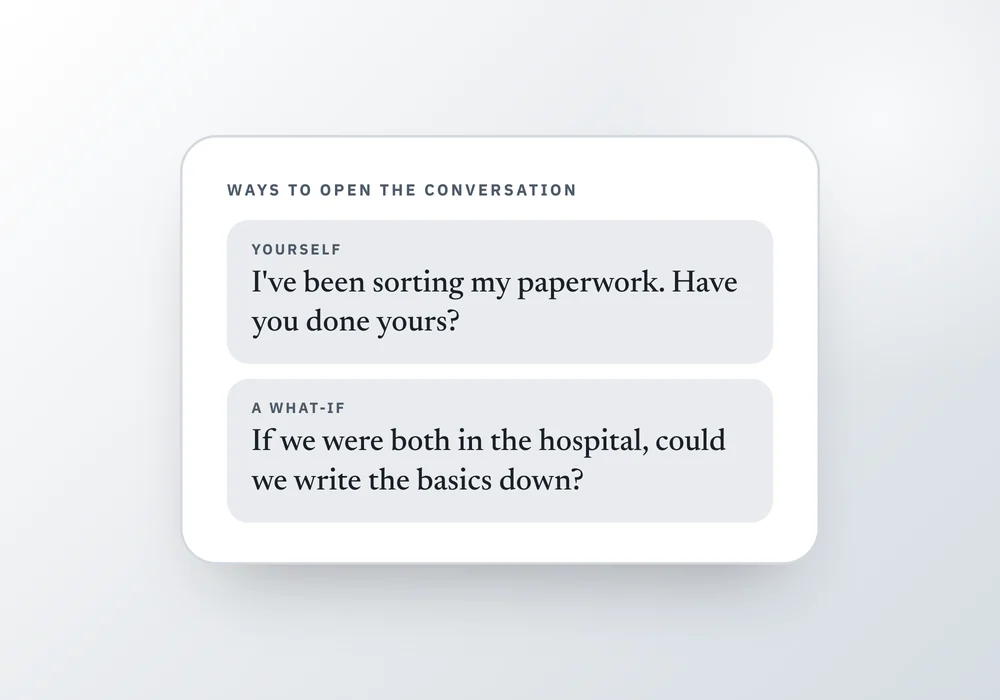
Ways to open the conversation
Each one makes the conversation about logistics rather than about them, which is most of the difference between a conversation and an argument.
Pick the one you are facing
“I've been sorting out my own paperwork, and I realized no one would know where any of it is. Have you done yours?”
“If you two were both in the hospital for two weeks, I wouldn't know how to keep things running. Can we write down the basics?”
“That scared me more than I expected. Can we make sure I'd know where to look for things, just in case?”
“Since we're already talking about the house, where do you keep the deed and the will?”
What to ask about, once they're willing
Locations and names, never balances or contents.
7 things to do
Ticks are for this visit only. Nothing here is saved anywhere.
Start with your own first
Doing your own paperwork first and mentioning it removes any suggestion that this is about their age or their health. It gives you something concrete to point to instead of an abstract request.
It also changes what you're asking. You're inviting them to join something you're already doing, not submitting them to a task you invented for them.
Ask for locations, not contents
Where the will is, not what it says. Which bank, not the balance. Who the lawyer is, not what was discussed.
Most people are far more comfortable naming a location than sharing a figure, and a location is what actually prevents months of searching later. Content can wait, or never come up at all.
If they say no, or change the subject
A parent who changes the subject, or says 'we'll get to it,' isn't necessarily refusing. Try a different opening later, or let it come from someone else; a parent will sometimes tell a sibling something they won't tell you, for no reason either of you could explain.
If the answer stays a flat no more than once, stop pushing and offer the version that doesn't run through you at all: 'Would you rather go through this with a lawyer instead of me? I can help you find one.' That removes you as the reason it feels uncomfortable, which is sometimes the actual problem.
Write it down when you hear it
The most common failure isn't a conversation that goes badly. It's one that goes fine, gets no follow-up, and evaporates. Six months later you remember there was a lawyer involved, and not which one.
Write down what you learn the same day, while the details are still exact. What to capture is in the if something happens to me file.
Where this doesn't work
If a parent's memory or judgment has started to slip, or a family member appears to be steering their decisions, this conversation is the wrong tool. Those situations call for an elder law attorney, not a well-meaning relative, and pushing ahead informally can make a real problem harder to prove later.
The other common failure is agreement without follow-through. If a parent says yes and nothing happens, set the next conversation before you leave the room: a specific week, not 'soon.'
Questions people ask
How do I bring this up without it sounding like I think they're dying?
Make it about logistics, not mortality. Ask where things are kept, not what's inside them, and mention that you're doing the same for your own paperwork first. A parent who hears 'I want to know where your will is' as 'you're about to die' usually relaxes once they realize it's a practical question, not a frightening one.
What if my parent refuses to talk about it?
Don't press it in one sitting. Try again later, from a different angle, or let another family member raise it instead. If the answer stays no, offer to step out of the conversation entirely and suggest a lawyer instead of you, which can remove the part that's actually bothering them.
Do I need power of attorney to help my parent with their finances?
Only if you'll actually act on their behalf, like paying bills or talking to their bank. A durable power of attorney names someone to do that if a parent can no longer manage it themselves, and it has to be set up by an attorney while they're still able to sign it. This isn't legal advice; an elder law attorney in their state can walk you through it.
What if my parent has already shown signs of memory loss?
This is where the informal version of this conversation stops being enough. Bring in an elder law attorney sooner rather than later. Whether someone can still legally sign documents, called capacity, is a real legal question, and it gets harder to answer the longer everyone waits.
Should I ask my parents for actual numbers, like account balances?
Not at this stage. Ask which bank, not the balance; who the lawyer is, not what was discussed. Balances and details are the parts that make people defensive, and you rarely need them just to know where to look if you ever have to find something.
What the Companion can and can't do
Personal Life Affairs Companion is built around a single account, so it can't be something you and a parent share or use together. What it can do is give you a blank copy to print, built from your own answers, so it leaves out whatever doesn't apply to you instead of listing every possible question. It won't be a perfect match for a parent's situation, but handing over a page of specific questions, in your own words, is often an easier opener than asking cold. See Personal Life Affairs Companion.
Sources and how we checked
- National Institute on Aging: Getting Your Affairs in Order Checklist: Backs the document list (will, durable power of attorney, health care proxy) and the advice to record locations rather than contents.Checked 26 September 2026.
- Fidelity: Talking About Estate Planning: Backs the advice on opening the conversation gradually and around specific moments rather than all at once.Checked 26 September 2026.
Where to go next
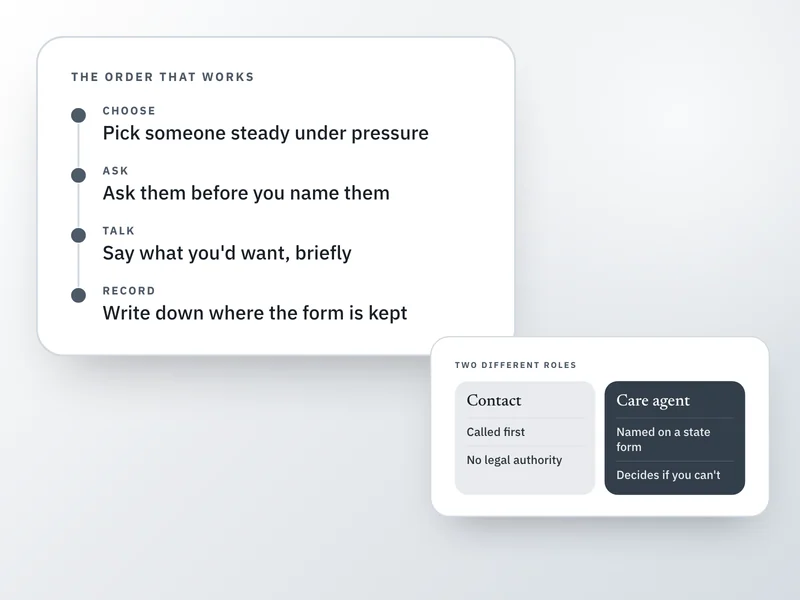 If this is where you areHow to choose a health care proxy, and record itA useful first question to raise is who would speak for a parent about their medical care.
- How to find a will after someone dies
Knowing where a parent keeps the will is one of the simplest things to ask, and this covers where wills usually are.
- Beneficiary vs will: which one decides who gets it?
Which form decides who gets a pension or policy is a good topic to raise, and this explains it.
- What to do when a parent dies: the first two weeks (US)
To see what happens if the conversation never occurs, this gives the order of tasks after a parent dies.