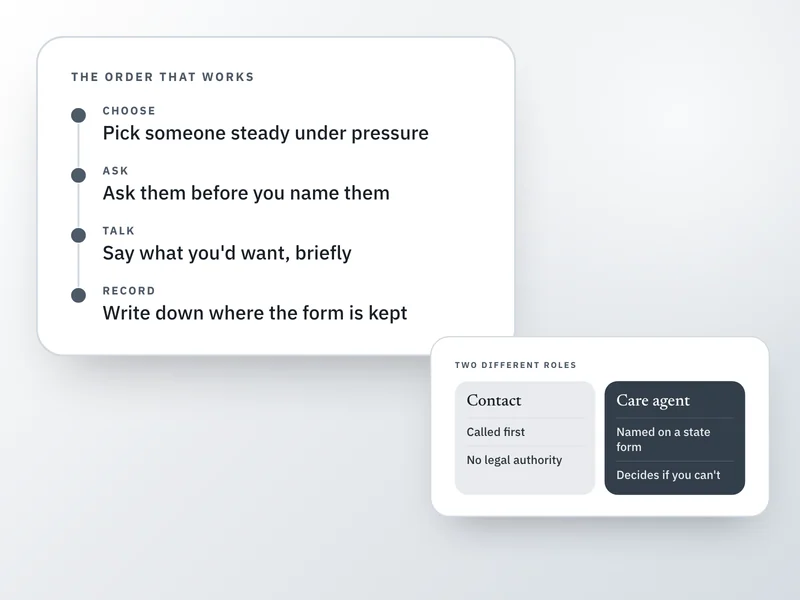
If you couldn't speak for yourself in a hospital, someone else would need to. To choose that person: pick one you trust to stay steady under pressure, ask them before you name them, tell them what you'd want, and write down where any signed form is kept.
This is for anyone naming a health care agent or medical decision maker for the first time in the United States. It's not legal or medical advice, and the forms, the witnessing rules, and who decides if you haven't chosen anyone all vary by state, so check your state's own form before you sign anything.
Three different things get called this
Health care proxy, agent, and medical power of attorney are three names for the same role: the person you name to make medical decisions for you when you can't. A living will is different. It isn't a person, it's a written statement of what treatment you would or wouldn't want, and advance directive is the umbrella term that can cover either or both. Most states let you name an agent and record treatment wishes on a single form.
What each one actually does
Emergency contact
- What it is
- The person a hospital or school calls first.
- What it does not do
- Carries no legal authority to decide anything.
Health care agent (proxy, or medical power of attorney)
- What it is
- The person you name on a state form to decide if you can't.
- What it does not do
- Doesn't take effect while you can still decide for yourself.
Living will
- What it is
- A written statement of the treatment you would or wouldn't want.
- What it does not do
- Doesn't name a person, and can't answer for a situation it doesn't cover.
| Term | What it is | What it does not do |
|---|---|---|
| Emergency contact | The person a hospital or school calls first. | Carries no legal authority to decide anything. |
| Health care agent (proxy, or medical power of attorney) | The person you name on a state form to decide if you can't. | Doesn't take effect while you can still decide for yourself. |
| Living will | A written statement of the treatment you would or wouldn't want. | Doesn't name a person, and can't answer for a situation it doesn't cover. |
An example: what the record actually looks like
Say you choose your sister. (This is an example, not a case.) The whole record is short: her name, how she's related to you, a phone number, and whether you've actually talked about what you'd want, not just that she agreed to be listed. If you'd want comfort-focused care rather than being kept on life support indefinitely, that's the kind of thing worth saying out loud once, not left for her to guess at in a hallway.
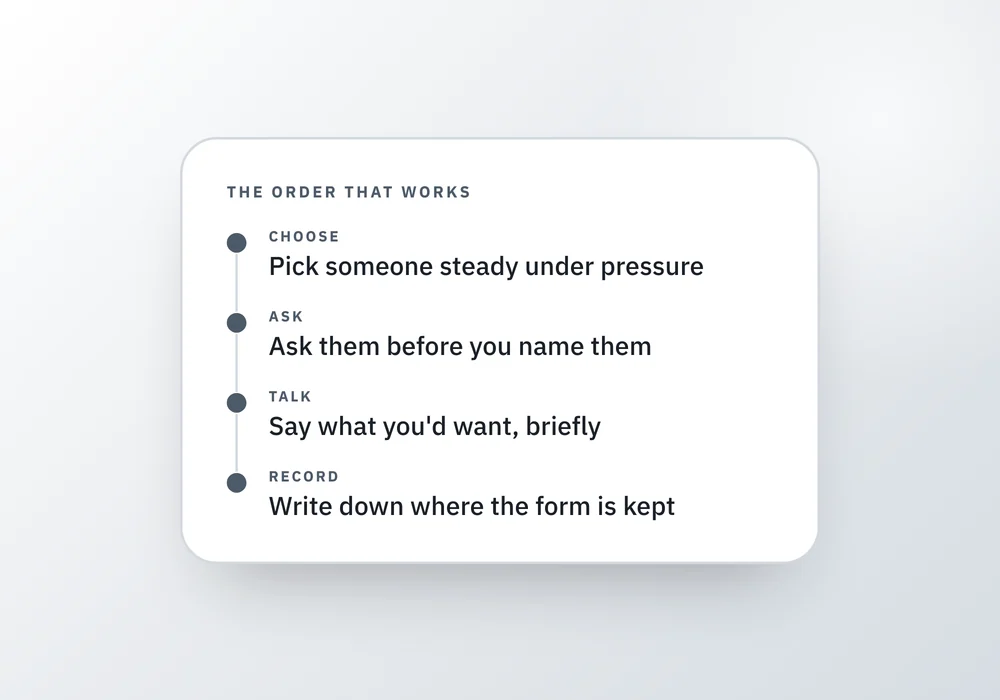
The order that works
Choose
Pick one person you trust who's likely to be reachable and able to stay steady under pressure. It doesn't have to be whoever is closest to you.
Ask
Ask them before you write their name down anywhere. Being named without being asked isn't fair to them, and it's not reliable for you.
Talk
Tell them what you'd want. It doesn't need to be a long conversation. What you'd want most, and what would be hardest for you, is enough to start with.
Record
Write down who they are, how to reach them, and where any signed form is kept. Give a copy to your doctor's office if you have one.
Name a second person
The person you choose might be traveling, sick, or unreachable on the exact day. A second name costs almost nothing and covers that gap. For the wider list of what to write down beyond this one decision, see what to write down in case something happens to you.
If you haven't chosen anyone
Every state has some default rule for who can decide if you haven't named an agent, and the rules aren't the same everywhere. In most states, the law hands that authority to a priority list, typically a spouse or domestic partner first, then an adult child, a parent, a sibling, and then other relatives, moving down until someone is reachable. A handful of states, including Massachusetts, Minnesota, Missouri, and Rhode Island, don't have a default list at all, which makes naming someone yourself the only way to be sure who decides. If more than one person shares the same priority, such as several adult children, hospitals generally look for agreement among them before acting on a majority.
Forms differ by state, and by what you sign
The document that makes an agent official differs by state in its name, its witnessing rules, and whether it needs notarizing, and a form written for one state doesn't automatically work in another, though some states will honor one from elsewhere. Free, state-specific forms are available through nonprofit directories such as CaringInfo, which lists a form for every state and territory. Use the one for the state where you live or are likely to receive care, not a generic template.
What can go wrong
The most common problem isn't the form, it's that no one who needs to see it knows it exists. Keep a copy somewhere your agent and your doctor's office can actually find, not only in a drawer at home. The second problem is a document that says who decides but not what they should decide: a name without a conversation leaves your agent guessing at the worst possible time. Naming one person with legal authority, rather than leaving it to whoever is in the room, is what this whole process is for.
Questions people ask
What is the difference between a health care proxy and a medical power of attorney?
Nothing meaningful. They're two names, along with health care agent, for the same role: the person you name on a state form to make medical decisions if you can't. Some states use one term in their statute and the other in everyday speech. What counts is which form your state actually issues, not which name you call it.
Is an emergency contact the same as a health care proxy?
No. An emergency contact is just who gets called first, with no legal authority. A health care proxy, or agent, is the person you name on a state form to make medical decisions if you can't. They can be the same person, but they don't have to be, and only one of the two roles carries legal weight.
What happens if I haven't named anyone?
Most states have a default priority list, usually starting with a spouse, then an adult child, a parent, then a sibling, that a hospital will turn to. A few states, including Massachusetts, Minnesota, Missouri, and Rhode Island, don't have one at all. Either way, naming someone yourself is the only way to control who that person is.
Does a health care proxy form from one state work in another?
Not always. Witnessing and notarizing rules differ by state, and while some states honor a form signed elsewhere, others don't. If you split time between states or moved recently, use the form for the state where you currently live or are likely to receive care, available free through sites such as CaringInfo.
Is a living will the same thing as a health care proxy?
No. A living will is a written statement of the treatment you would or wouldn't want. A health care proxy names a person to decide on your behalf. Many states let you complete both on one advance directive form, and having both covers more situations than either alone.
Recording the choice
Personal Life Affairs Companion has a step for deciding who should speak for you about medical care. It asks for their name, how they're related to you, how to reach them, and whether you've actually talked with them about what you'd want, tracked as yes, not yet, or not sure. It records the choice in your own words. It doesn't generate a state form, doesn't file anything, and doesn't contact anyone on your behalf. See Personal Life Affairs Companion.
Sources and how we checked
- National Institute on Aging: Choosing a Health Care Proxy: How to choose a health care agent, talk to them about your wishes, and why the choice differs from an emergency contactChecked 26 September 2026.
- CaringInfo: Advance Directive Forms for Each State and Territory: Free state-specific advance directive forms, and that witnessing and notarizing requirements differ by stateChecked 26 September 2026.
- Merck Manual (Consumer Version): Default Surrogate Decision Making: The typical state priority order (spouse, adult child, parent, sibling) used when no agent has been namedChecked 26 September 2026.
- American Bar Association Commission on Law and Aging: Recent Updates to Default Surrogate Statutes: Massachusetts, Minnesota, Missouri, and Rhode Island are the states without a default surrogate consent statuteChecked 26 September 2026.
Where to go next
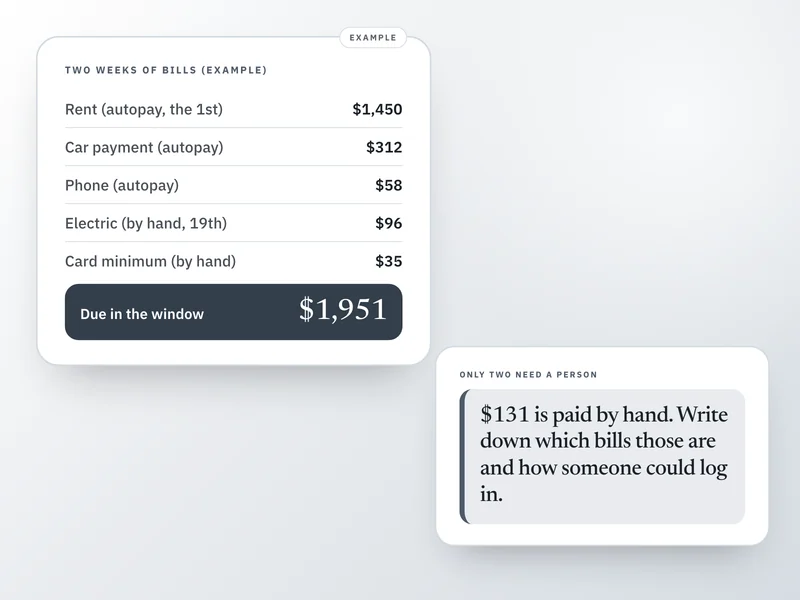 If this is where you areIf you were hospitalized, what would someone need to find?To see what someone would need to find in a hospital stay, this two-week test covers the rest of the paperwork.
- The if-something-happens-to-me file: what goes in it
To record the proxy's name and where the forms are kept, this file gives you a place for it.
- How to talk to your parents about their will and finances
Asking a parent who speaks for them is delicate, and this offers scripts for that conversation.
- Who would raise your children? A guardian checklist
If you have children, naming who would raise them is the companion decision, with a checklist.