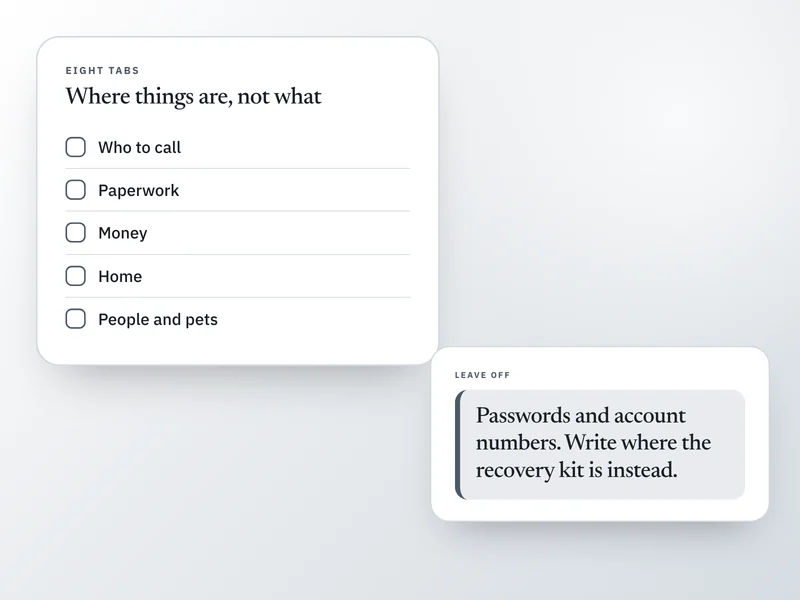
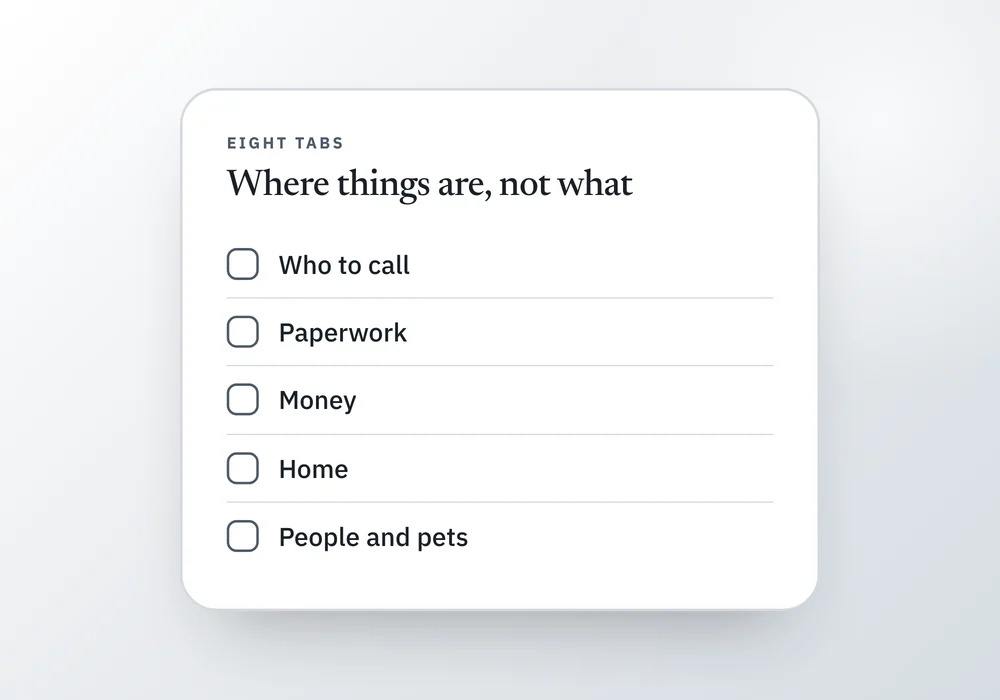
A life admin binder is one physical place, usually a three-ring binder with eight tabs, that tells someone where your important papers are and who to call. Each page holds locations and names, not copies of documents or passwords. Keep it short enough to finish in a few evenings.
This is the emergency version, the one a partner or sibling opens when you can't answer, not a chore or meal-plan binder for running the house. It is an organizing method, not legal advice, and the examples are written for the United States.
Two tabs, filled in (example)
An invented household, to show how short a good page is. Every line says where something is or who to ask.
1. Who to call
- What the page says
- First call: Dana Reyes (sister), 555-0142. Sorts things out: Marcus Reyes (brother), 555-0177, has a key. Speaks for my medical care: Dana. She knows what I'd want.
2. Paperwork
- What the page says
- Will: fireproof box in the hall closet, and Marcus knows the box is there. Passport and birth certificate: same box. Last three tax returns: blue folder, desk, bottom drawer.
3. Money
- What the page says
- Banks: Lakeside Credit Union (checking, savings), Harbor Bank (joint with Sam). Retirement plan: through work, statements come by email. Rent comes out on the 1st, automatic.
6. Accounts
- What the page says
- Everything is registered to my main email address. Password manager recovery kit: in the fireproof box. No passwords in this binder.
| Tab | What the page says |
|---|---|
| 1. Who to call | First call: Dana Reyes (sister), 555-0142. Sorts things out: Marcus Reyes (brother), 555-0177, has a key. Speaks for my medical care: Dana. She knows what I'd want. |
| 2. Paperwork | Will: fireproof box in the hall closet, and Marcus knows the box is there. Passport and birth certificate: same box. Last three tax returns: blue folder, desk, bottom drawer. |
| 3. Money | Banks: Lakeside Credit Union (checking, savings), Harbor Bank (joint with Sam). Retirement plan: through work, statements come by email. Rent comes out on the 1st, automatic. |
| 6. Accounts | Everything is registered to my main email address. Password manager recovery kit: in the fireproof box. No passwords in this binder. |
The eight tabs, and what to leave off each
Skip a tab that doesn't apply to you. A renter has no deed to find, and someone without children has nothing under tab 5 but pets.
8 of 8 rows shown
1. Who to call
- Put on the page
- First call, the person to sort things out, who speaks for your medical care, a backup for each
- Leave off
- Anyone you haven't asked
2. Paperwork
- Put on the page
- Where the will is, ID, tax records, any safe or deposit box, and who can open it
- Leave off
- Copies of the documents themselves
3. Money
- Put on the page
- Banks by name, retirement plans, life insurance, what leaves your account automatically
- Leave off
- Account numbers
4. Home
- Put on the page
- Own or rent, insurance company, utilities, who holds a spare key
- Leave off
- Alarm codes
5. People and pets
- Put on the page
- Who would look after children, dependents and animals, and what a normal week looks like
- Leave off
- Anything you'd only say to one person
6. Accounts and devices
- Put on the page
- Main email address, which phone opens what, where recovery instructions are kept
- Leave off
- Passwords and the master password
7. What you'd want
- Put on the page
- Preferences in your own words, and where any formal forms are
- Leave off
- Legal wording you're not sure of
8. Business
- Put on the page
- Who could keep it running or wind it down, where its papers are
- Leave off
- Client data
| Tab | Put on the page | Leave off |
|---|---|---|
| 1. Who to call | First call, the person to sort things out, who speaks for your medical care, a backup for each | Anyone you haven't asked |
| 2. Paperwork | Where the will is, ID, tax records, any safe or deposit box, and who can open it | Copies of the documents themselves |
| 3. Money | Banks by name, retirement plans, life insurance, what leaves your account automatically | Account numbers |
| 4. Home | Own or rent, insurance company, utilities, who holds a spare key | Alarm codes |
| 5. People and pets | Who would look after children, dependents and animals, and what a normal week looks like | Anything you'd only say to one person |
| 6. Accounts and devices | Main email address, which phone opens what, where recovery instructions are kept | Passwords and the master password |
| 7. What you'd want | Preferences in your own words, and where any formal forms are | Legal wording you're not sure of |
| 8. Business | Who could keep it running or wind it down, where its papers are | Client data |
Build it in this order
Three pages in one evening is a real start. The rest can wait for weekends.
- Get a one-and-a-half-inch three-ring binder and eight tab dividers. Label the tabs with the names above, and put clear sleeves behind the tabs you'll use for loose papers.
- Write tab 1 first: who to call first, who would sort things out, who would speak for your medical care. Names, relationship, phone. Ask each person before you write them down.
- Write the will line under tab 2: where it is and who knows. If you're not sure you have a current one, write that too. Where to look for a will covers why that line is worth the ink.
- Under tab 6, write the email address everything is registered to. It is usually the way into every other account.
- Fill in tabs 3 to 5 next, a page at a time, using the sample above as the length to aim for.
- Tell one person the binder exists and where it sits. A binder that only you know about is a private notebook.
- Put a date on page one, and a reminder to reread it once a year and after any big change.
What to leave out, and where it lives instead
Leave out passwords, the master password for a password manager, full account and Social Security numbers, and anything you wouldn't want a houseguest to read. A binder sits on a shelf in a house with visitors, cleaners and contractors in it.
Where something would be secret, write where the way in is kept: "recovery kit is in the safe, and Marcus knows the safe is there." That is a complete answer. For papers that live outside the house, the safe deposit box and spare keys guide covers who can open what. To decide what belongs in a binder and what to shred, see which documents to keep.
Where binders go wrong
The common failure is size. A binder that starts with 75 blank pages gets abandoned at tab 2. We'd keep each tab to one page until the whole thing exists, then add depth where you find gaps.
The second is staleness. A phone number that changed, a bank you closed, a sister who moved: an out-of-date binder is worse than a short one, because the person reading it trusts it. The third is the shelf problem: the binder is in a closet no one but you can find, or it's in a safe deposit box that can't be opened without you.
If you searched for a life admin binder to run the household, meaning chores, meal plans and maintenance, this isn't that. How to make a home binder is closer, and Home Base is the tool for the rest.
Questions people ask
What is a life admin binder?
It's a single binder that tells someone where your important papers are and who to call in an emergency. Some people call it an emergency binder or an in case of emergency binder. It records locations and names, not the papers themselves, so the person opening it knows where to look.
What should I put in an emergency binder?
Start with who to call first, who would sort things out, and who would speak for your medical care. Then add where the will and ID are, the banks you use, the email address your accounts are registered to, and who would look after children, dependents or pets. Add a page for a business if you have one.
Should I put passwords in a life admin binder?
No. Write where the recovery instructions for a password manager are kept, and who knows they're there. A binder gets read by visitors and lost in moves, so a password page is the wrong thing to leave on a shelf. A page of locations is useful to the right person and much less harmful in the wrong hands.
Where should I keep the binder?
Somewhere private but findable: a desk drawer or shelf, or a fireproof box if it holds original papers. Tell at least one person where it is. If some papers sit in a safe deposit box, keep a page at home saying so, since a box can be hard to open without you.
How often should I update it?
Once a year is a reasonable rhythm, plus after a move, a marriage or divorce, a new child, a new job, or a death in the family. Put the date on page one so a reader can tell how current it is. A quick reread usually takes under half an hour.
If a paper binder feels like too much
Personal Life Affairs Companion does the same job one step at a time. It starts with eight yes or no questions about your life, skips whatever doesn't apply, and shows one step on screen with no list of what remains. It never asks for a password or an account number, and it sends nothing to anyone. When you're ready, it prints a book called My Affairs that you hand over yourself. It records where things are. It doesn't create legal documents.
Sources and how we checked
- CaringInfo (National Alliance for Care at Home): Advance directives: Backs the point that health care forms vary by state and that an agent is named on a state form, which the binder only records.Checked 26 September 2026.
Where to go next
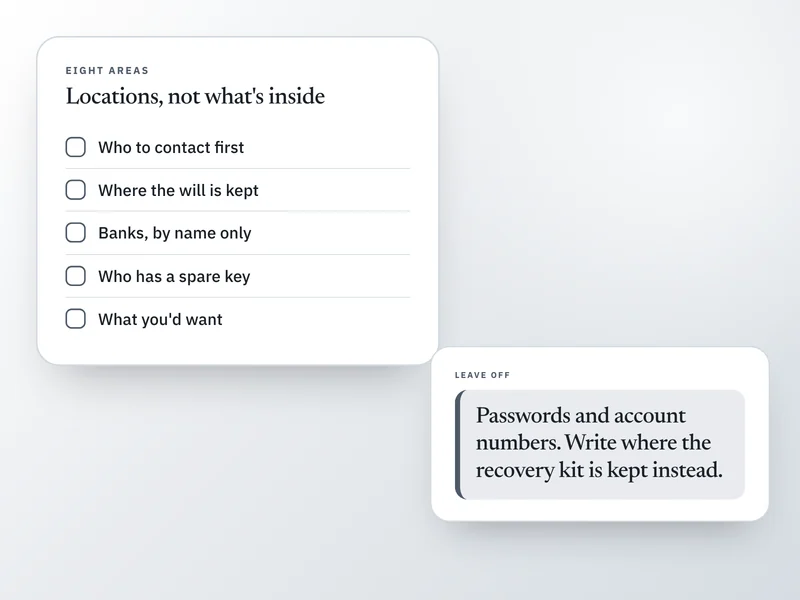 If this is where you areThe if-something-happens-to-me file: what goes in itFor what to actually record before you buy a binder, this gives the file and how to build it in passes.
- Which documents to keep, shred or store, and for how long
To decide what belongs in the binder and what to shred, use this retention guide.
- Who can open a safe deposit box or safe when you die?
Papers you cannot keep at home go in a box or safe, and this covers who can open them.
- What to write down in case something happens to me
For the details that are not on paper anywhere yet, this is the short list to write first.