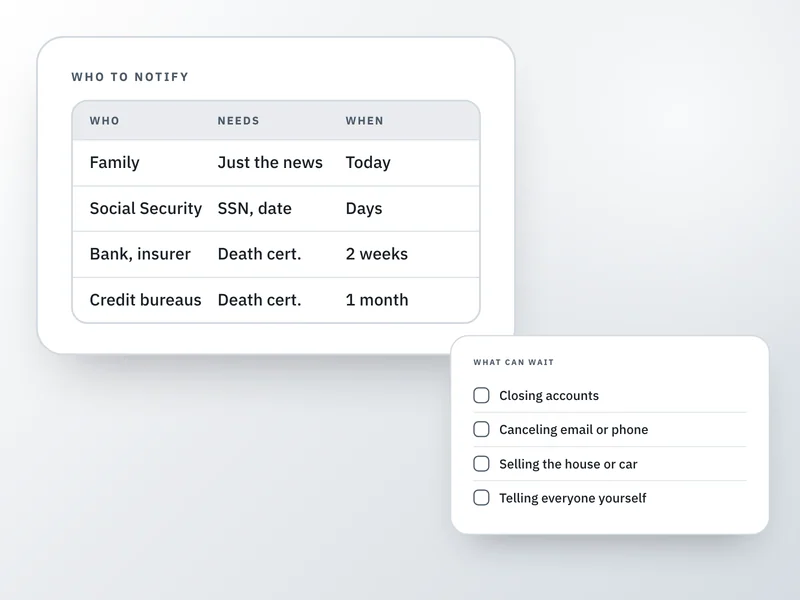
Tell close family and anyone who would want to hear it from you first, today. Notify Social Security within the first few days, since it decides what happens to a benefit payment already on its way. Everything else, from the bank to the gym membership, can wait a week or more without causing a problem.
This is a general order for the United States, built from what Social Security, the IRS and the three credit-reporting agencies actually ask for. It cannot tell you what your state or your family's situation specifically requires, and if there is an executor, a hospice team or a funeral director already involved, follow what they tell you first.
One week, as an example
Say someone dies on a Tuesday morning. That day and the next, the calls are short and personal: her sister, her closest friend, the people who would be hurt to hear it from someone else. By Thursday, the funeral home has usually already reported the death to Social Security using the certificate you gave them, which is the fastest route and needs no extra call from you. By the following Monday, whoever is handling things has called her employer, her bank and her insurer, in whatever order certified copies of the death certificate arrive in the mail. The credit bureau letter and the gym membership cancellation happen whenever there is time, sometime in the following month. This is an example only, and a real week will not line up this neatly.
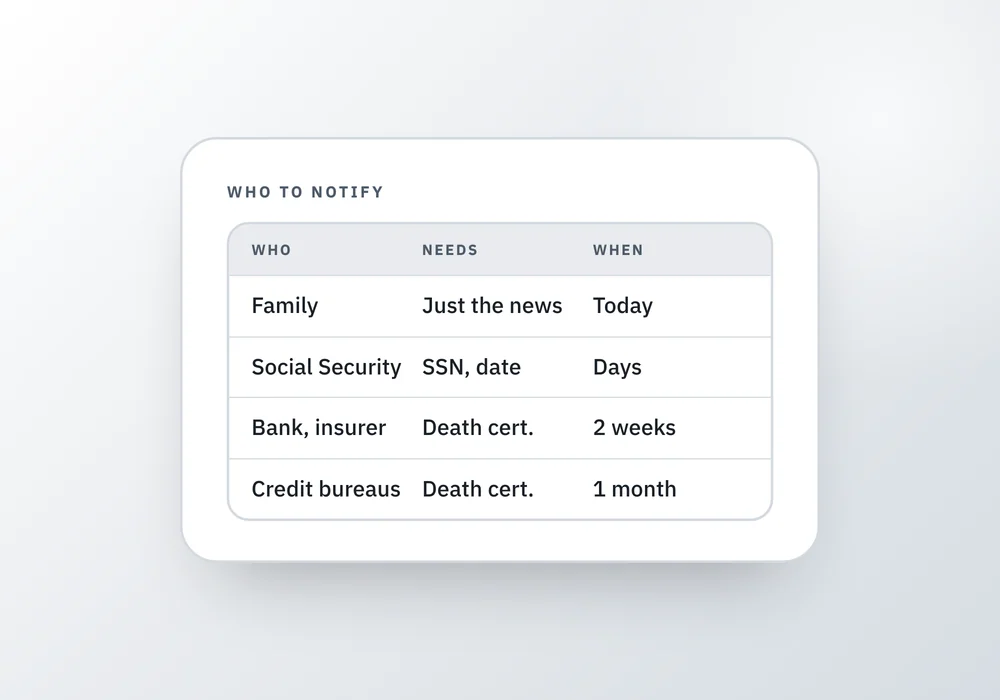
Who to notify, and what they will ask for
9 of 9 rows shown
Close family and friends
- What they will need from you
- Just the news, from you rather than someone else
- When
- Today
Social Security
- What they will need from you
- The Social Security number and date of death (the funeral home often reports this on Form SSA-721)
- When
- Within days
Employer
- What they will need from you
- A certified copy of the death certificate, for final pay and any benefits owed
- When
- Within the first week
Banks and credit card companies
- What they will need from you
- A certified copy of the death certificate; ask about joint accounts separately
- When
- Within two weeks
Life insurance and pension providers
- What they will need from you
- A certified copy of the death certificate, and a policy or plan number if you have one
- When
- Within two weeks
Equifax, Experian, TransUnion
- What they will need from you
- A certified copy of the death certificate; notifying one usually updates the other two
- When
- Within the first month
State motor vehicles office
- What they will need from you
- The driver's license or ID for cancellation, and the vehicle title for transfer
- When
- Within the first month
IRS
- What they will need from you
- Nothing sent separately; the final federal tax return is what tells them
- When
- At the normal filing deadline
Utilities, subscriptions, memberships
- What they will need from you
- An account number if you have one
- When
- Whenever there is time
| Who | What they will need from you | When |
|---|---|---|
| Close family and friends | Just the news, from you rather than someone else | Today |
| Social Security | The Social Security number and date of death (the funeral home often reports this on Form SSA-721) | Within days |
| Employer | A certified copy of the death certificate, for final pay and any benefits owed | Within the first week |
| Banks and credit card companies | A certified copy of the death certificate; ask about joint accounts separately | Within two weeks |
| Life insurance and pension providers | A certified copy of the death certificate, and a policy or plan number if you have one | Within two weeks |
| Equifax, Experian, TransUnion | A certified copy of the death certificate; notifying one usually updates the other two | Within the first month |
| State motor vehicles office | The driver's license or ID for cancellation, and the vehicle title for transfer | Within the first month |
| IRS | Nothing sent separately; the final federal tax return is what tells them | At the normal filing deadline |
| Utilities, subscriptions, memberships | An account number if you have one | Whenever there is time |
What can actually wait
- Closing accounts. Freezing or simply notifying is enough for now, and closing something too soon can cut off access someone still needs.
- Canceling the main email or phone. It is often the fastest way to find other accounts and contacts later, so leave it open until the search is further along.
- Signing anything offered quickly, especially by someone claiming to help settle a debt before you have checked it independently.
- Deciding what happens to the house, the car or anything of value. None of that has to be settled this month.
- Telling every single person yourself. Ask one or two people close to you to help pass the word once the closest circle already knows.
Watch for scams aimed at the bereaved
Obituaries and public death notices get read by people other than mourners. Some try to open credit or run up debt in a dead person's name before the bureaus catch up, which is part of why notifying them sooner rather than later closes that window. Be cautious of anyone who calls claiming money is owed by the person who died and asks for payment before you have verified anything through the bank or provider directly, not through the caller.
Questions people ask
How many certified copies of the death certificate do I need?
More than seems reasonable. Ask the funeral home for at least ten to start, since banks, insurers and the motor vehicles office each want their own certified copy and will not accept a photocopy. Ordering more later is possible but slower, so ordering extra at the start usually costs less time overall.
Can I access their bank account before probate is finished?
Usually not on your own signature alone. A joint account holder can typically keep using the account; a sole account is generally frozen until whoever has legal authority, such as an executor holding the court paperwork naming them, presents it to the bank. Ask the bank directly what it requires, since practice varies by institution.
Do I have to notify the IRS separately from everyone else?
Not with a phone call. The final federal income tax return, filed by the executor or surviving spouse, is what tells the IRS. It reports income up to the date of death and is generally due on the normal filing schedule for that tax year, not immediately.
Who pays for the funeral if no money was set aside?
Usually the estate once it can pay, or whoever agreed to pay and arranged it. This guide does not cover funeral costs. If money is a concern before the estate is settled, ask the funeral home about a payment plan before signing anything.
What if I do not know whether they had life insurance?
This list will not tell you that. How to find someone's accounts after they die covers the search itself, including the free lookup tool insurers use to check for policies nobody knew existed.
If this list is hard to build from nothing
Personal Life Affairs Companion is not built for this week. It is built for the version of this week that does not have to happen the same way to whoever comes after you: a place where you write down, in advance, who should be called first and what they would need to know to start. It records a name and a way to reach them, not a full notify list and not a script, and it sends nothing to anyone on its own. What it produces is a book someone could pick up and start from, which is the difference between the list you are piecing together this week and one that already existed.
Sources and how we checked
- USAGov: Agencies to notify when someone dies: List of government agencies and organizations to notify, and the note that funeral directors typically report to Social SecurityChecked 26 September 2026.
- Social Security Administration: What to do when someone dies: Reporting a death to Social Security, Form SSA-721, and the phone number for reportingChecked 26 September 2026.
- IRS: File the final income tax returns of a deceased person: Who is responsible for filing the final return and what it coversChecked 26 September 2026.
- Experian: How to report a relative's death to credit bureaus: What credit bureaus need, who can report, and that notifying one bureau updates the other twoChecked 26 September 2026.
Where to go next
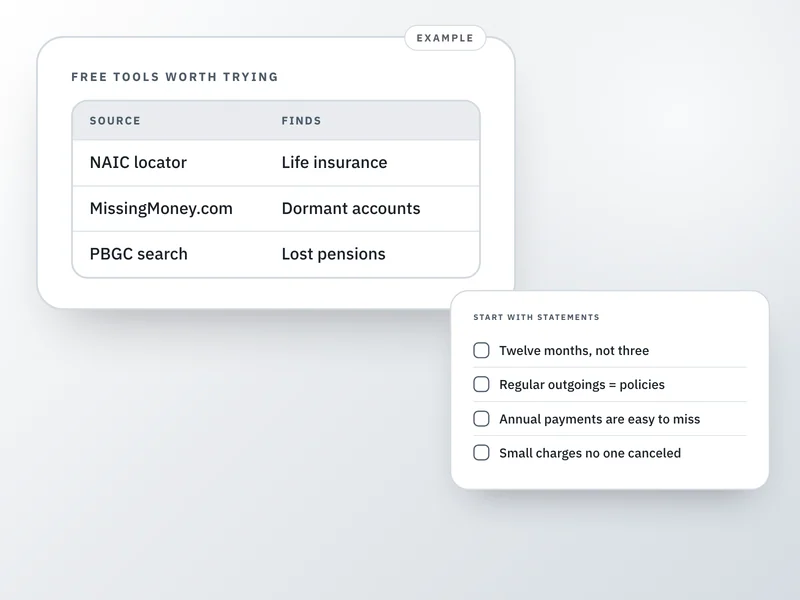 If this is where you areHow to find someone's accounts after they dieWhen a bank or policy turns up unexpectedly, this covers how to trace accounts, pensions and policies.
- What to do when a parent dies: the first two weeks (US)
For the whole first two weeks in order, including certificates and funeral choices, use this US guide.
- Digital accounts after a death: what can be recovered
Email, phone and social accounts also need handling, and this covers what providers will release.
- Named executor of a will: what you agreed to (US)
If you are the executor, this explains what the role includes and where you could be liable.