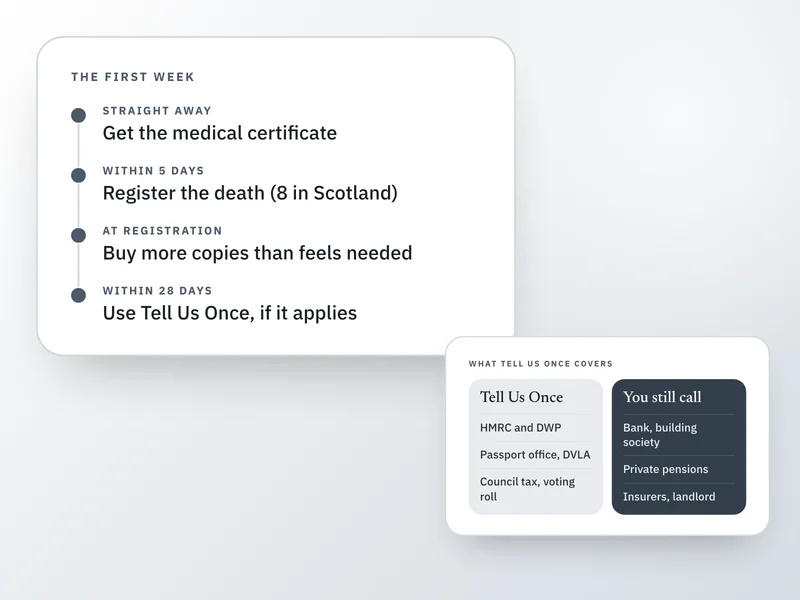
When a parent dies in the UK, two things cannot wait: get the medical certificate of cause of death, then register the death within 5 days in England, Wales and Northern Ireland, or 8 days in Scotland. Ask for several certified copies while you're there. Almost everything else, including probate and clearing the house, can wait weeks.
This is written for a death anywhere in the UK, though Scotland and Northern Ireland differ from England and Wales in places marked below. It isn't legal advice, and it can't see your family's exact situation, so where it disagrees with your registrar or a solicitor, go with them. If your parent died in the United States, use the US version instead.
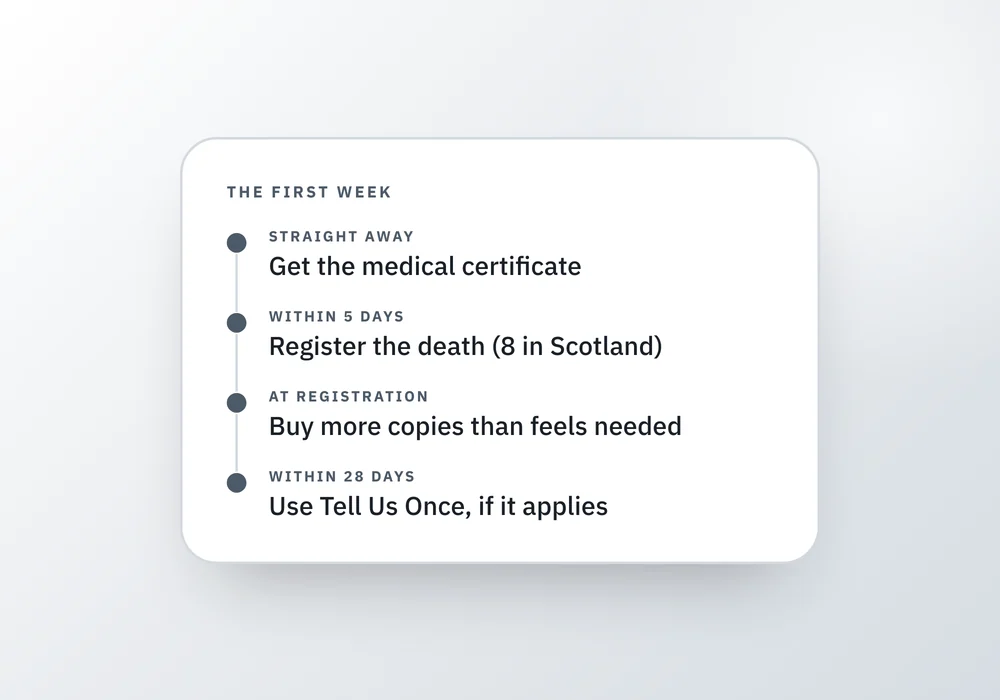
An example: what the first week can look like
Say your father dies in a hospital in Leeds on a Sunday morning. (This is an example, not a case.) Ward staff arrange the medical certificate of cause of death, and you collect it on Monday. You book an appointment at the register office for Wednesday, four days after he died, comfortably inside the 5 day limit.
At the register office you register the death, buy five certified copies (the bank, the pension provider, the mortgage lender, the car insurer, and one spare), and the registrar gives you a Tell Us Once reference number. That evening you use it online, and one form tells HMRC, the DWP, the passport office, the DVLA and the council together. The bank and the pension still need their own call. That's the whole week.
The first week
Straight away
Get the medical certificate of cause of death. Hospital or care home staff arrange it. If the death was at home and unexpected, call 999.
Within 5 days (8 in Scotland)
Register the death at a register office. A relative who was present or lives nearby usually does this; the registrar can confirm who qualifies.
At the register office
Buy certified copies of the certificate, more than feels necessary, and get the Tell Us Once reference number if the registrar can't set it up with you there.
Within 28 days of that
Use Tell Us Once online or by phone, if you're in England, Scotland or Wales. Northern Ireland doesn't have it, so contact each department yourself.
Once it's registered
Contact a funeral director, or check whether a plan was already paid for. Many people have one and never mention it.
What Tell Us Once covers, and what it doesn't
One notification, used within 28 days of getting the reference number, reaches most of government. It reaches none of the rest.
- HMRC, for tax and National Insurance
- DWP, for benefits and the State Pension
- The passport office and the DVLA
- Your council, for council tax and the electoral roll
- Public sector pensions, such as the NHS or the civil service
- Banks and building societies
- Private and workplace pensions
- Home, car and life insurers
- The landlord or mortgage lender
Tell Us Once notifies
- HMRC, for tax and National Insurance
- DWP, for benefits and the State Pension
- The passport office and the DVLA
- Your council, for council tax and the electoral roll
- Public sector pensions, such as the NHS or the civil service
You still tell yourself
- Banks and building societies
- Private and workplace pensions
- Home, car and life insurers
- The landlord or mortgage lender
Who to tell yourself, in the first two weeks
Tell Us Once handles government. This is the rest, roughly in the order it helps to do them.
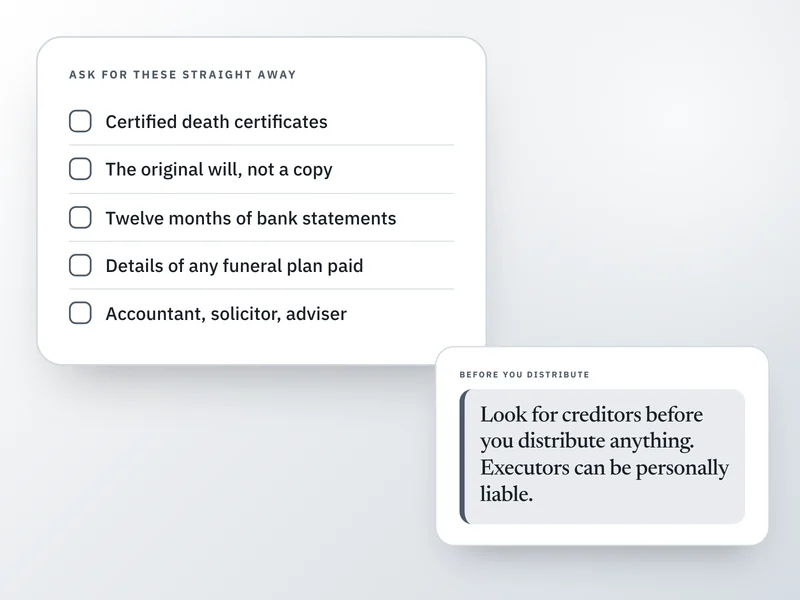
5 things to do
Ticks are for this visit only. Nothing here is saved anywhere.
Find the will, and read one clause first
Look where people actually keep them: a home safe, a filing box, a bedside drawer, or with the solicitor who drew it up. Where to look for a will covers the wider search, including what to do if several turn up or none does.
When you find it, read who's named as executor before you read who inherits. That person has the legal authority to act, called confirmation in Scotland and probate in England, Wales and Northern Ireland, and a son or daughter arranging the funeral doesn't automatically have it.
What can wait a while
Probate or confirmation takes months almost everywhere, and there's no version of this where you finish it inside a fortnight. Closing accounts, valuing the estate and paying anything out are all downstream of steps you haven't reached yet.
Clearing the house can wait too. It's fine if a wardrobe stays full until spring, and rushing it risks throwing away papers you still need.
Scotland and Northern Ireland: what's different
In Scotland you have 8 days to register instead of 5, and you can use any register office in the country rather than a local one. If the death is referred to the procurator fiscal, Scotland's version of a coroner, the registration clock can pause until that's resolved, and the registrar can talk you through an interim step if the funeral can't wait. Once you have the right to act, it's called confirmation rather than probate, and for a smaller estate, £36,000 or under, the local sheriff court can help you apply directly on form C1, without a solicitor.
Northern Ireland keeps the 5 day registration deadline but doesn't use Tell Us Once at all, so each government department has to be told separately. NI Direct's bereavement service can point you to the right forms for each one.
Questions people ask
How long do I have to register a death in the UK?
Five days in England, Wales and Northern Ireland, and eight days in Scotland, both counted from the death rather than from when you feel ready. If a death is referred to a coroner, or in Scotland the procurator fiscal, registration can be delayed until that's resolved, and the registrar will tell you what to do instead.
What does Tell Us Once actually cover?
One notification through Tell Us Once reaches HMRC, the DWP, the passport office, the DVLA, your council and public sector pension schemes. It doesn't reach banks, private or workplace pensions, or insurers, so you still contact those yourself. It's available in England, Scotland and Wales, and you have 28 days to use the reference number once you have it.
Is confirmation the same as probate?
They do the same job under different names. Confirmation is Scotland's court process for giving an executor the authority to deal with an estate, and probate is the equivalent in England, Wales and Northern Ireland. Neither is automatic, and a bank generally won't act on a will alone, whichever term applies where you are.
Do I have to register the death before the funeral can happen?
In most cases yes, because the funeral director needs the registrar's certificate before a burial or cremation can go ahead. If the death has been referred to a coroner or procurator fiscal, ask the registrar or funeral director about an interim certificate, which can let the funeral proceed while the fuller inquiry continues.
What if my parent died in Northern Ireland?
The registration deadline is the same 5 days as England and Wales, but Tell Us Once doesn't operate there. You'll need to contact HMRC, the DWP, the passport office and the DVLA separately, and NI Direct's bereavement service can point you to the right forms for each.
For your own affairs, later
Reconstructing which bank, which pension and where a will was kept is often what convinces people to organise their own paperwork before it's needed. Personal Life Affairs Companion is the Draftpace product for that. It isn't built around UK law specifically, but its dates print in the UK date format and its printed book can be sized to A4 as well as US Letter. It asks one question at a time: who to contact first, where the will is kept, which bank, which pension, who has a spare key. It records where things are, not the documents themselves, never asks for an account number or a password, and prints a book someone could follow. It has no notify list, and it sends nothing to anyone. See the Companion.
Sources and how we checked
- GOV.UK: What to do when someone dies: Overall order of steps; registration deadline of 5 days (8 in Scotland)Checked 26 September 2026.
- GOV.UK: Tell Us Once: What it covers, England/Scotland/Wales-only availability, 28-day window to use the reference numberChecked 26 September 2026.
- mygov.scot: Register a death: Scotland's 8-day deadline, any register office, procurator fiscal referrals delaying registrationChecked 26 September 2026.
- GOV.UK: Wills, probate and inheritance: Confirms Scotland and Northern Ireland run different probate rules to England and WalesChecked 26 September 2026.
- Scottish Courts and Tribunals Service: Small estates: £36,000 small-estate threshold and the C1 form for confirmation without a solicitorChecked 26 September 2026.
Where to go next
 If this is where you areNamed as an executor: what you agreed to (UK)If you have been named executor, this explains what the role involves, how long probate takes and how to step aside.
- What to do when a parent dies: the first two weeks (US)
Dealing with a death in the United States? This twin covers death certificates and the steps that apply there.
- Who to notify when someone dies, in order
For a tracked list of who needs to hear and in what order, this notification guide is written to be worked through.
- How to find someone's accounts after they die
If accounts, pensions or policies are missing from the paperwork, this sets out where to search and in what order.