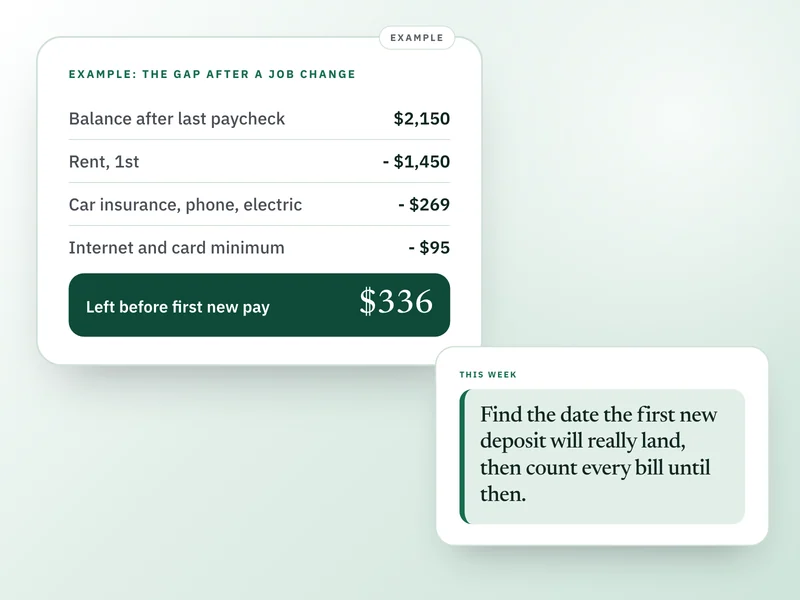
After a new job, a move or a separation, do six things in order: confirm when money will really arrive, list what leaves your accounts and from where, fix what points at the wrong place, deal with what the old situation left behind, update your tax withholding, and redo your safe-to-spend number.
This is written for the US and for one person or one household. It can't cover state law, and it isn't legal, tax or financial advice. Where a separation involves property, children or debts you share, a family lawyer is worth the fee.
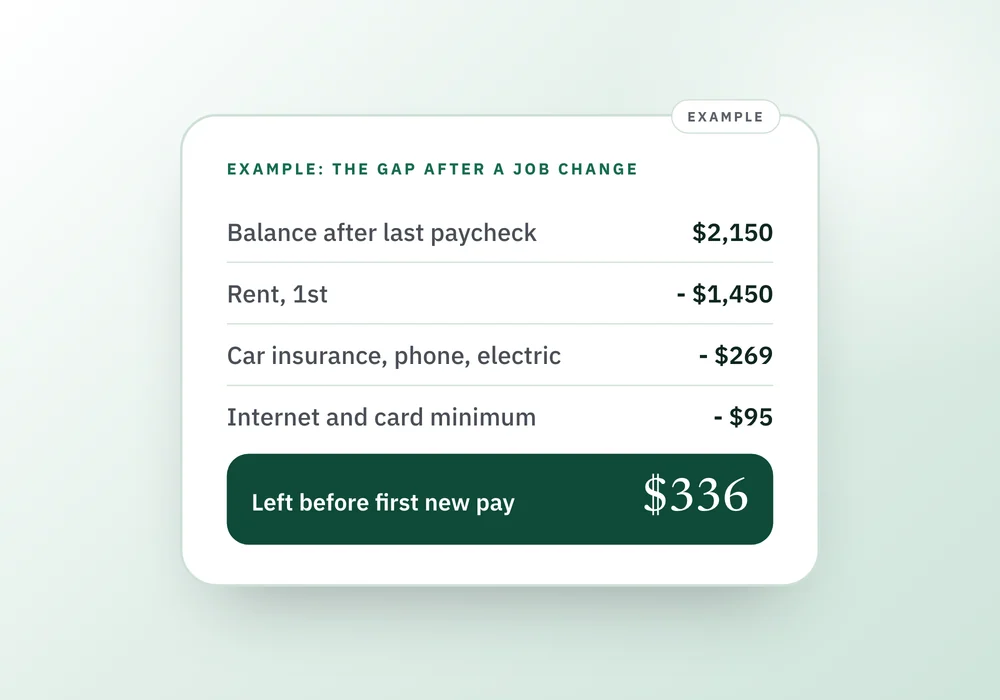
An example: the gap after a job change
Say your last paycheck lands on the 10th and the first one from your new employer lands on the 24th of the following month. That's about five weeks with no income. Your bank balance after the last paycheck is $2,150, and every autopay carries on as if nothing happened. This is an illustration, so swap in your own dates and amounts.
8 of 8 rows shown
Balance after your last paycheck, the 10th
- What leaves
- Amount
- $2,150
15th
- What leaves
- Car insurance
- Amount
- - $118
18th
- What leaves
- Phone
- Amount
- - $55
22nd
- What leaves
- Electric
- Amount
- - $96
1st, next month
- What leaves
- Rent
- Amount
- - $1,450
5th, next month
- What leaves
- Internet
- Amount
- - $60
12th, next month
- What leaves
- Card minimum
- Amount
- - $35
Left before the first new paycheck
- What leaves
- Before groceries, fuel or health coverage
- Amount
- $336
| Date | What leaves | Amount |
|---|---|---|
| Balance after your last paycheck, the 10th | $2,150 | |
| 15th | Car insurance | - $118 |
| 18th | Phone | - $55 |
| 22nd | Electric | - $96 |
| 1st, next month | Rent | - $1,450 |
| 5th, next month | Internet | - $60 |
| 12th, next month | Card minimum | - $35 |
| Left before the first new paycheck | Before groceries, fuel or health coverage | $336 |
The balance looked like plenty on the 10th. By the time the new pay arrives it's $336, and that has to cover five weeks of food and fuel. Nothing here is a mistake. It's a normal month with a longer gap in it, which is why you count the bills between now and the first real payday, not the bills due tomorrow.
The order, in six steps
- Confirm the real dates for income. Ask the new employer for the pay schedule and the date of your first check, because the first one can land later than a normal cycle. Write down each payday you can count on, and leave out any you can't yet.
- List what leaves your accounts and from which one. Use a monthly bills list, including the bills that are quarterly or annual. Mark every autopay with the account it pulls from.
- Fix whatever points at the wrong place. That means the direct deposit form for the new job, the autopay account on any bill tied to a closing account, and your address (see the table below). Keep the old account open until the last deposit and the last autopay have cleared.
- Deal with what the old situation left behind: the old employer's retirement plan and health coverage after a job change, the joint accounts after a separation, the old address after a move.
- Update your tax withholding. The IRS says to consider filling out a new Form W-4 when your personal or financial situation changes, and a new employer will ask for one anyway.
- Redo your safe-to-spend number. The old one was built on a shape of money that no longer exists. Here's how to work it out.
What each change usually touches
A starting list, not a full one. Your own accounts decide what belongs here.
New job
- Do this in the first week
- Give HR your direct deposit details. Ask for the first pay date. Look at the old plan's paperwork.
- Easy to miss
- A first check later than you expected, and health coverage that ends on a date you didn't note
Move
- Do this in the first week
- Send the address to your bank, card issuers, insurers, employer and the IRS. Update delivery addresses.
- Easy to miss
- Annual statements and renewals that still go to the old address
Separation
- Do this in the first week
- List every joint account, card and loan. Open an account in your name only for your own pay.
- Easy to miss
- A joint card that stays open, because both holders remain responsible for the whole balance
| Change | Do this in the first week | Easy to miss |
|---|---|---|
| New job | Give HR your direct deposit details. Ask for the first pay date. Look at the old plan's paperwork. | A first check later than you expected, and health coverage that ends on a date you didn't note |
| Move | Send the address to your bank, card issuers, insurers, employer and the IRS. Update delivery addresses. | Annual statements and renewals that still go to the old address |
| Separation | List every joint account, card and loan. Open an account in your name only for your own pay. | A joint card that stays open, because both holders remain responsible for the whole balance |
After a job change: the old retirement plan and your health coverage
Leaving a job usually leaves a retirement plan account behind. The IRS describes three ways to handle it: leave it where it is, roll it into another plan or an IRA, or take the money out. A direct rollover sends the money from the plan to the new account and doesn't trigger tax withholding. If the plan pays the money to you first, it must withhold 20 percent, and you have 60 days to deposit the payment in another plan or IRA to keep it a rollover. Which one is right depends on your fees, your taxes and your age, and a plan administrator or an adviser can answer that in a phone call.
Health coverage from the old employer normally ends. Under COBRA you can often keep it for a limited time, if the employer has 20 or more employees, but you can be charged up to 102 percent of the plan's cost. The Department of Labor says you have 60 days to enroll, counted from the later of when your coverage ends or when you receive the election notice. Put that date in your calendar the day you see it.
After a move: the address is on more accounts than you'd guess
Bank, card issuers, insurers, your employer's payroll, your retirement plan, subscriptions with a delivery address and anything that mails an annual statement. The statement is the risky one, because an account you've lost track of is easy to leave behind. The IRS has its own form for a change to your home mailing address, Form 8822, so don't assume a forwarding request at the post office has told them.
If you're renting and the lease has just started, what to document when moving into a rental is worth the same afternoon.
After a separation: untangle the joint things on purpose
On a joint credit card, each account holder is responsible for the full balance, according to the CFPB, and a divorce decree doesn't by itself remove your responsibility to the lender if your name is still on the account. The lender decides how a joint holder is removed, so call the issuer and ask for its policy. Paying the card off before closing it is the usual route, and where you can, closing it together avoids a dispute over who is spending on it.
For a joint bank account, the usual first step is to open one in your own name and move your pay to it before you close anything. Any agreement about who keeps what is a legal matter, so this is where a family lawyer earns the fee. Beneficiary forms on retirement accounts and life insurance are easy to leave as they were, and they override your will. Check them once the paperwork settles, using what to update after a life change.
When this goes wrong
- The first paycheck is late. Move your due dates, or call the biller about one, before the gap arrives. If one has already failed, here are the first 48 hours.
- An autopay pulls from an account you closed or emptied. Check each autopay's source before you close anything, and what to check before your bills come out is the two minute version.
- Two people disagree about a joint account. A guide can't settle that, and moving the money by yourself can create a bigger problem. Talk to a lawyer before you move anything you don't own alone.
- Your money is scattered across old and new accounts. Organize your finances from scratch gives a ten minute starting path.
Questions people ask
What should I do with my 401(k) when I change jobs?
The IRS lists three options: leave it in the old plan, roll it over to a new plan or an IRA, or cash it out. A direct rollover avoids withholding, and a check made out to you has 20 percent withheld with 60 days to redeposit. Cashing out usually has tax consequences. Call the plan administrator before you decide.
How long do I have to sign up for COBRA?
The Department of Labor says you have 60 days to enroll, counted from the later of when your job-based coverage ends or when you get the COBRA election notice. You may be charged up to 102 percent of the plan's cost. Ask your former employer or the plan administrator which date applies to you.
What do I need to change when I move?
Your address on your bank, card and loan accounts, insurance, payroll, retirement plan, and the IRS, which has Form 8822 for this. Also update delivery addresses on subscriptions, and check which accounts mail an annual statement. Keep mail forwarding on for a while, and check your bills list for anything you missed.
Should I close my joint account when I separate?
Often, yes, but not first. Open an account in your own name, move your pay there, and then decide about the joint one, ideally with the other person so nothing is spent that shouldn't be. Where you can't agree, or where the account holds shared savings, ask a lawyer. This isn't legal advice.
Do I need to fill out a new W-4 when I start a new job?
A new employer will ask for one so it can withhold the right federal income tax. The IRS also suggests a fresh W-4 each year and whenever your personal or financial situation changes, such as a move, a marriage or a separation. The IRS Tax Withholding Estimator can help you check the numbers.
Where the Companions fit
Personal Finance Companion keeps your accounts, income, bills, subscriptions and debts in one place, so after a change you are editing a picture, not rebuilding one. Its Coming up list shows what's due in the next 14 days, including pay days, and it flags income that hasn't arrived by its expected date and any bill with no due date. It's a month-level estimate of Available Money, not a count down to your first new paycheck, so use the example above for that. You type everything in, and it doesn't connect to your bank.
For the number you need this month, Monthly Money Reset is free and shows a single safe-to-spend figure with every line of the sum, and it lets you correct a starting balance as things move. Personal Life Affairs Companion records every pension you've paid into and who is named to receive it, which is the part of the old job people lose track of.
Sources and how we checked
- Rollovers of retirement plan and IRA distributions (IRS): Rollover within 60 days, direct rollover without withholding, mandatory 20 percent withholding when the plan pays you.Checked 26 September 2026.
- COBRA continuation coverage (U.S. Department of Labor): 60 days to enroll, counted from the later of coverage ending or receiving the election notice.Checked 26 September 2026.
- COBRA continuation coverage overview (U.S. Department of Labor): Applies to plans of employers with 20 or more employees; premium up to 102 percent of the plan's cost; covers job loss, divorce and other life events.Checked 26 September 2026.
- About Form W-4 (IRS): Consider a new W-4 each year and when your personal or financial situation changes.Checked 26 September 2026.
- About Form 8822, Change of Address (IRS): Form 8822 notifies the IRS of a change to your home mailing address.Checked 26 September 2026.
- Ask CFPB: divorce and credit questions: Each holder of a joint credit card is responsible for the full balance; a divorce alone does not remove your responsibility to the creditor; contact the issuer about removing a holder.Checked 26 September 2026.
Where to go next
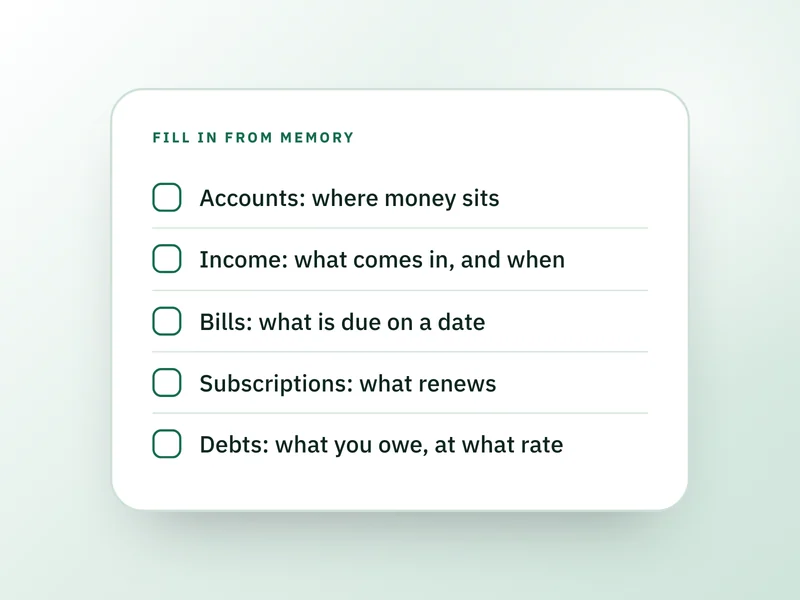 If this is where you areHow to organize your finances when everything is scatteredWhen accounts, cards and papers are scattered after the change, this gives a ten minute starting path.
- Financial binder: what to include and how often to update
Keep the new addresses, accounts and contacts together in one binder and update it on a schedule.
- How to split bills with a partner or roommate: 3 methods
Moved in with someone, or split up? See how to divide shared bills fairly and write the agreement down.
- Monthly bills list: include the bills that are not monthly
Rebuild your bill list from scratch after the move so nothing is still going to the old account.