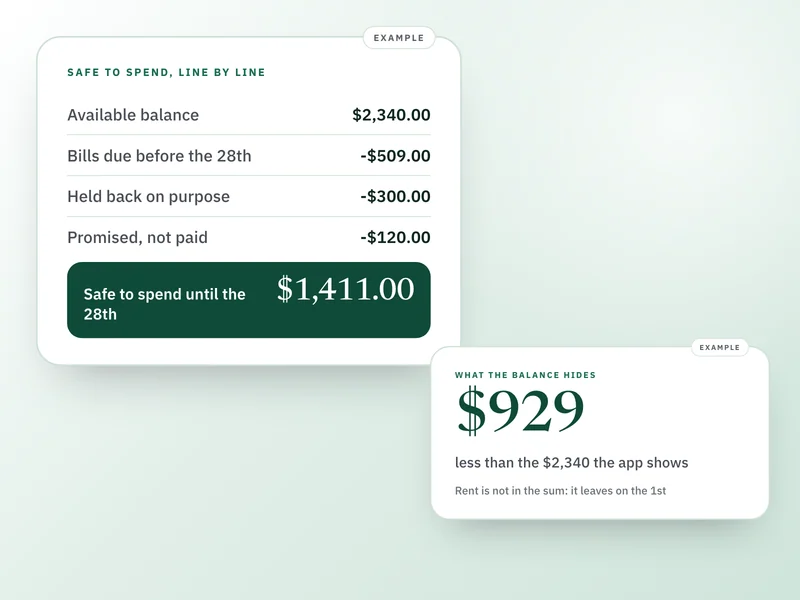
When you open your banking app and see $2,340, the money you can spend is that balance minus every bill and payment due before your next payday, minus anything you're holding back on purpose, minus anything you've promised but haven't paid yet. What's left is your safe-to-spend number, and it's usually much smaller than the balance.
This is for anyone paid on a steady rhythm who wants one number before a purchase. It only knows what you type in, so it's as current as your last look, and it can't predict groceries, fuel or a surprise repair. It isn't financial advice.
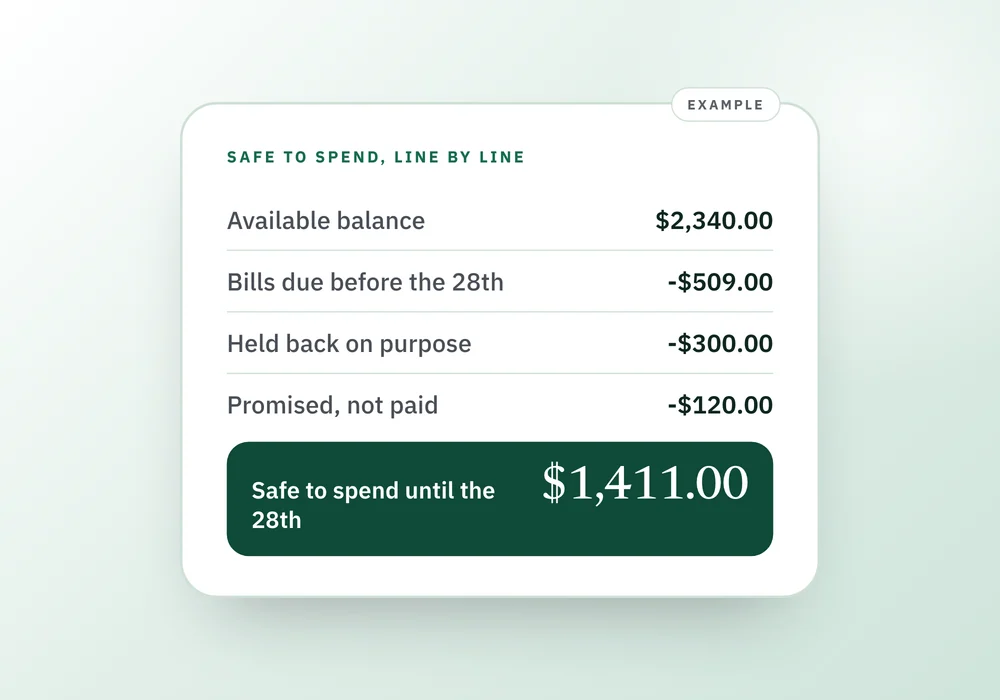
An example, line by line
Say it's the 12th, payday is the 28th, and your checking account shows $2,340.00 available. These figures are an illustration, not anyone's real month.
9 of 9 rows shown
Available balance
- Amount
- $2,340.00
- What it is
- Checking only, after pending items
Car insurance, the 15th
- Amount
- - $128.00
- What it is
- Due before payday
Phone, the 18th
- Amount
- - $62.00
- What it is
- Due before payday
Credit card payment, the 20th
- Amount
- - $210.00
- What it is
- You pay this card in full each month
Electric, the 22nd
- Amount
- - $94.00
- What it is
- Due before payday
Streaming, the 25th
- Amount
- - $15.00
- What it is
- Due before payday
Held back on purpose
- Amount
- - $300.00
- What it is
- Tax money you set aside, not for spending
Promised, not paid
- Amount
- - $120.00
- What it is
- A repair deposit you've agreed to
Safe to spend
- Amount
- $1,411.00
- What it is
- Until the 28th
| Line | Amount | What it is |
|---|---|---|
| Available balance | $2,340.00 | Checking only, after pending items |
| Car insurance, the 15th | - $128.00 | Due before payday |
| Phone, the 18th | - $62.00 | Due before payday |
| Credit card payment, the 20th | - $210.00 | You pay this card in full each month |
| Electric, the 22nd | - $94.00 | Due before payday |
| Streaming, the 25th | - $15.00 | Due before payday |
| Held back on purpose | - $300.00 | Tax money you set aside, not for spending |
| Promised, not paid | - $120.00 | A repair deposit you've agreed to |
| Safe to spend | $1,411.00 | Until the 28th |
What the $1,411 tells you
The balance said $2,340. The number you can act on is $1,411, which is $929 less. Rent isn't in the sum because it comes out on the 1st, after payday, and the 28th paycheck is what covers it.
If you want a weekly figure, divide by the weeks left. From the 12th to the 28th is a little over two weeks, so $1,411 works out to roughly $600 a week. Treat that as arithmetic, not a forecast. Then, when you're deciding on a specific purchase, test it against this number.
Work out your own number in five steps
- Open the account you pay bills from and write down the available balance, not the current one. If the two differ, this explains which to trust. Add other accounts only if you'd really spend from them. Leave savings out.
- Write down your next payday, then list every bill, subscription and card payment that leaves before it. Include the quarterly and annual ones. A bills list that includes them makes this a two minute job later.
- Subtract them. If you pay a credit card in full, that card's balance is a bill too. If you carry a balance, subtract the payment you'll actually make.
- Subtract what you're holding back: tax money, a deposit, the cushion you don't want to touch. Then subtract anything you've committed to but not paid, like a booking or a repair.
- Write the result at the top of a note and date it. If you want a weekly figure, divide by the weeks left. Next time you're about to spend, look at that number first, then look at the balance.
When the number is wrong or misleading
Six ways this sum goes off, and what to do about each.
- It comes out negative. Don't round it up to zero. It means the bills due before payday are bigger than the money you have, and you have days to move something: a payment date, a transfer, or a call to the biller.
- Money is coming but hasn't landed. Leave it out until it's in the account. A paycheck that's a day late shouldn't turn a plan into an overdraft.
- You forgot a bill. Annual and quarterly charges are the usual culprits. A charge from twelve months ago on your statement will show you which ones.
- The balance moved since you looked. A pending charge or a bill you paid after writing the number down makes it stale. Redo the sum after any big change.
- Different bills leave different accounts. Do the sum per account, or the money in one will hide a shortfall in the other.
- You stopped checking it. A number you wrote three weeks ago is a guess. Date it, and treat anything over a week old as suspect.
Questions people ask
Is safe to spend the same as disposable income?
Not quite. Disposable income usually means your pay after taxes, measured over a period. Safe to spend is a snapshot for today: the money in your account minus what's already spoken for before your next payday. Two people with the same disposable income can have very different safe-to-spend numbers on the 12th, depending on when their bills land.
Should I count my savings account?
Only if you'd truly spend it. If it's your emergency fund or money for a known cost, leave it out of the starting balance. Counting it makes the number bigger and less useful, because you'll end up spending money you'd already given a job.
Do I subtract my credit card balance?
If you pay the card in full, yes. Charges you've already made are money owed, so treat the payment as a bill due on its date. If you carry a balance, subtract the payment you'll make before payday. Either way, don't count the card's available credit as money you have.
How much cash should I keep as a buffer?
That's your call, and it's worth choosing a number rather than leaving it vague. Some people hold back the cost of a week of groceries, others a flat $100. Subtract it as its own line so it's visible, and adjust it when your month gets tighter or looser.
Why doesn't my banking app show this number?
Available balance in a banking app reflects pending items and holds that are already in the system. Bankrate notes it doesn't account for upcoming bills you haven't paid yet. Your bank can't know your insurance renews on the 15th, so the subtraction is yours to do.
Where the free Monthly Money Reset fits
Monthly Money Reset does this sum for you from numbers you type. You enter the money you have right now, your income once it arrives, your bills and any savings you're protecting, and it shows one safe-to-spend figure with a receipt of every line, plus a rough weekly amount. It works on the month rather than to payday, and it can go negative and says so. It's only as current as your last update, and it doesn't connect to your bank.
If you want your whole picture rather than one month, Personal Finance Companion keeps your accounts, bills, subscriptions and debt minimums together and shows an Available Money estimate with its working. It's a month-level estimate that subtracts a full month of bills, not a until-payday figure like the one above, so use the sum on this page for today's decision.
Sources and how we checked
- Consumer Financial Protection Circular 2022-06: Unanticipated overdraft fee assessment practices (CFPB): Defines available balance as ledger balance plus made-available deposits less pending debits, and shows how later-settling items can overdraw an account that looked positive.Checked 26 September 2026.
- Available balance vs. current balance (Bankrate): Available balance reflects pending items and holds but not upcoming bills you haven't paid yet.Checked 26 September 2026.
Where to go next
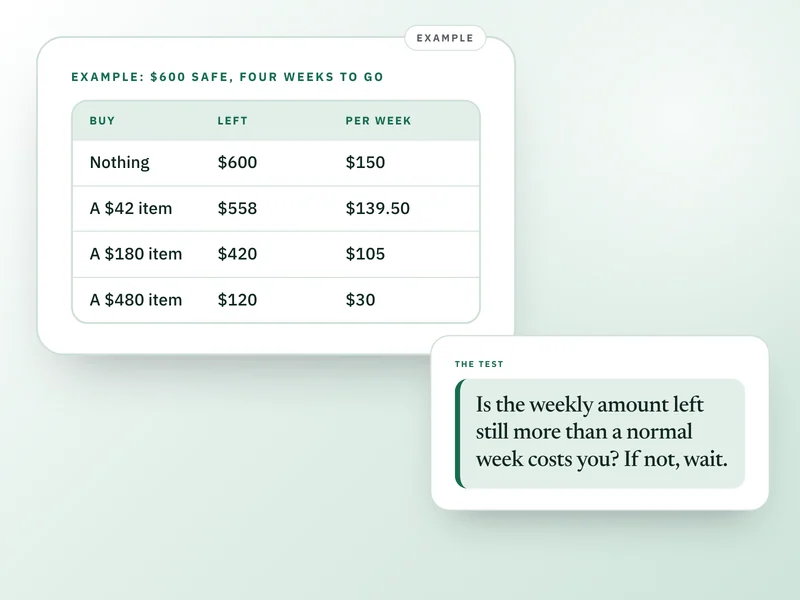 If this is where you areHow to know if you can afford something before you buy itOnce you have your safe number, use it to test one specific purchase before you commit to it.
- Available vs current balance: which one can you spend?
If your app shows two different balances, this explains posted, pending and held money and which figure to start from.
- Monthly bills list: include the bills that are not monthly
List every bill still due, including the quarterly and annual ones, so the number you subtract is complete.
- Before your bills come out: a two minute autopay check
Check which account each bill leaves from and when, so the money you set aside is in the right place.