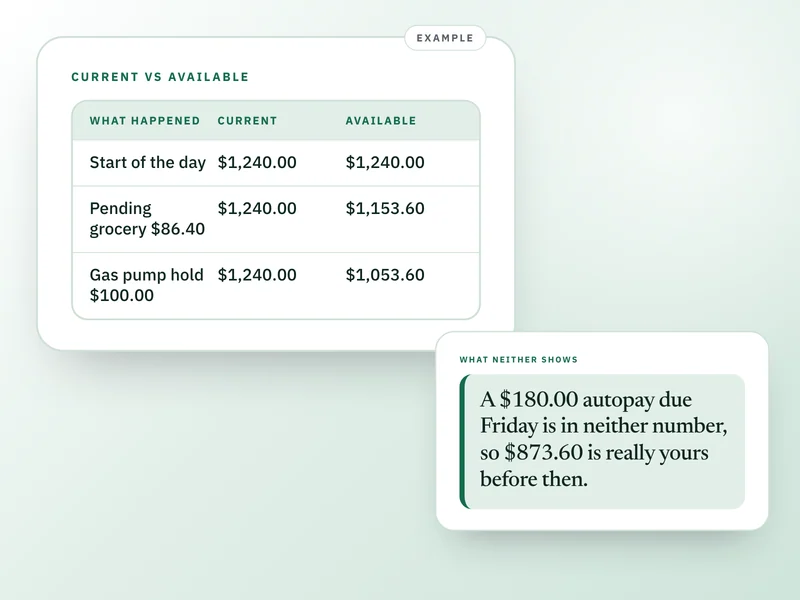
Current balance is the total of everything that has posted to your account. Available balance is what your bank will let you spend right now: the current balance minus pending card purchases and holds, plus any overdraft line some banks add. Use available to judge whether a payment will go through, and current to match a statement.
This is for anyone whose banking app shows two numbers and who wants to know which one to trust. It can't tell you what your bank does with your own account, because the rules on holds and overdraft lines are set in your account agreement.
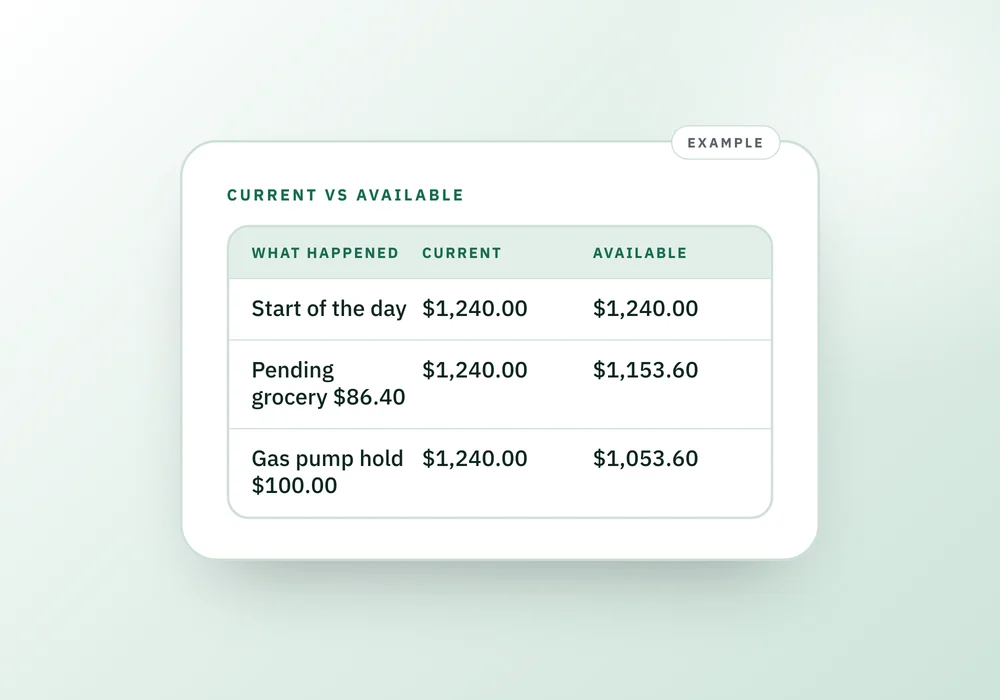
An example with a hold and pending charges
Say your checking account starts the day at $1,240.00 posted. Over two days you do three things, and your app updates like this.
Example figures only. Your bank may order or label these differently.
Start of the day, everything posted
- Current balance
- $1,240.00
- Available balance
- $1,240.00
Grocery purchase on your debit card, still pending: $86.40
- Current balance
- $1,240.00
- Available balance
- $1,153.60
Gas pump places a hold: $100.00
- Current balance
- $1,240.00
- Available balance
- $1,053.60
You deposit a $500.00 check and the bank holds it until Thursday
- Current balance
- $1,740.00 at some banks, $1,240.00 at others
- Available balance
- $1,053.60
A $180.00 autopay is due Friday but has not been taken yet
- Current balance
- unchanged
- Available balance
- $1,053.60
| What happened | Current balance | Available balance |
|---|---|---|
| Start of the day, everything posted | $1,240.00 | $1,240.00 |
| Grocery purchase on your debit card, still pending: $86.40 | $1,240.00 | $1,153.60 |
| Gas pump places a hold: $100.00 | $1,240.00 | $1,053.60 |
| You deposit a $500.00 check and the bank holds it until Thursday | $1,740.00 at some banks, $1,240.00 at others | $1,053.60 |
| A $180.00 autopay is due Friday but has not been taken yet | unchanged | $1,053.60 |
Notice what neither column does. The autopay isn't in either figure, so the money that is really yours before Friday is $873.60, not $1,053.60. And when the pump finishes at $42.15, the $100.00 hold drops off and your available balance rises by $57.85, without you doing anything.
That last part is why an available balance can go up on its own. Nothing arrived. A hold was replaced by the smaller real charge.
The terms your bank uses
Current balance
- What it means
- Everything that has posted, and nothing pending. Also called posted or ledger balance.
- Where you see it
- Statements, and the top line of many apps
Available balance
- What it means
- What you can spend now: current minus holds and pending debits, plus any overdraft line your bank includes.
- Where you see it
- ATM screens, and whatever your card is approved against
Pending
- What it means
- A purchase the merchant has authorized but not yet settled. It can change amount before it posts.
- Where you see it
- Your recent activity list
Authorization hold
- What it means
- Money set aside at gas pumps, hotels and rental cars until the final charge arrives. It can be larger than the final charge.
- Where you see it
- Your available balance only
Deposit hold
- What it means
- Part of a deposit your bank has not yet released for spending.
- Where you see it
- Your available balance, with a release date in the deposit notice
Overdraft line
- What it means
- Coverage some banks add to the available figure. You can spend it, but it isn't your money.
- Where you see it
- Sometimes folded into available with no label
| Term | What it means | Where you see it |
|---|---|---|
| Current balance | Everything that has posted, and nothing pending. Also called posted or ledger balance. | Statements, and the top line of many apps |
| Available balance | What you can spend now: current minus holds and pending debits, plus any overdraft line your bank includes. | ATM screens, and whatever your card is approved against |
| Pending | A purchase the merchant has authorized but not yet settled. It can change amount before it posts. | Your recent activity list |
| Authorization hold | Money set aside at gas pumps, hotels and rental cars until the final charge arrives. It can be larger than the final charge. | Your available balance only |
| Deposit hold | Part of a deposit your bank has not yet released for spending. | Your available balance, with a release date in the deposit notice |
| Overdraft line | Coverage some banks add to the available figure. You can spend it, but it isn't your money. | Sometimes folded into available with no label |
How to read your two numbers today
- Open the account and find both figures. If your app shows only one, look for a label such as "available" or "posted", or check the ATM receipt.
- Look at the pending list and add up anything marked as a hold or pre-authorization, especially fuel, hotels and rental cars.
- Check your recent deposits. If any is a check, find the date your bank says the money is released. The notice you got when you deposited it lists that date.
- Read your account agreement or ask the bank once whether the available figure includes an overdraft line. It changes how you read every balance afterward.
- Subtract what is due before payday from the available figure. The method is in how much of your money is actually safe to spend.
When the numbers mislead you
Deposit holds are set partly by federal rule. Banks must make cash and electronic deposits available quickly, but they can extend holds on checks, on large deposits, on accounts under 30 days old and on accounts with repeated overdrafts. Your deposit notice is where the bank has to tell you when it is holding money longer.
Debit card overdrafts are their own trap. Whether a purchase can overdraw your account depends on whether you opted in to that coverage, and a purchase can be approved against a balance that later shrinks. Before a bill leaves, look at what to check before each direct debit date. If a payment has already failed, you missed a payment covers the first 48 hours.
Common questions
Which balance is my real balance?
Neither one is the amount that is free to spend. Current shows what has posted, and available shows what the bank will approve today. Your real number is available minus what you owe before payday, such as autopays, rent and any set-aside money. That last step is up to you, because the bank can't see your bills.
Is available balance the same as what I can spend?
Only in the narrow sense that your card will probably be approved up to that amount. Some banks add an overdraft line to it, and it ignores bills that haven't been taken yet. Treat it as the ceiling for one purchase, not as spare money.
Why is my available balance higher than my current balance?
It usually means the bank is including something extra, most often an overdraft line or a credit that hasn't posted yet, such as a deposit it is letting you use early. Check your account agreement or ask the bank which one applies. Don't assume the difference is yours.
Why is my available balance lower than my current balance?
Something is holding money back. Common causes are pending card purchases, a gas pump or hotel authorization hold, and a deposit the bank hasn't released yet. Look for the item in your pending list. Most holds fall away by themselves once the merchant settles the final charge.
Which balance should I use to pay a bill?
Use available to see whether the payment will go through today, then subtract other bills due before payday so it doesn't cause a failed payment later. Use current when you are matching your records to a statement, because pending items can still change.
Where a Companion fits
Your bank shows you two balances and leaves out your bills. In Personal Finance Companion you type in each account's balance yourself, mark which accounts are available for spending and which are protected, and add your bills. It then shows what is left with the working written out line by line. It doesn't connect to your bank, so it only knows the balance you typed, and it works from a month of bills rather than counting down to payday. The free Monthly Money Reset is the shorter version: it takes the money you have now and subtracts the protected bills you haven't paid yet.
Sources and how we checked
- CFPB: How long can a bank or credit union hold funds I deposited?: Reasons a bank may extend a deposit hold: new accounts under 30 days, repeated overdrafts, large checks; deposit notice.Checked 26 September 2026.
- Federal Reserve: A Guide to Regulation CC Compliance: Exception hold categories and the duty to notify the customer of a longer hold. Dollar thresholds deliberately left out because they are inflation-adjusted.Checked 26 September 2026.
- CFPB: How can I avoid debit card overdrafts?: Deposits may not be immediately available, so check funds after recent deposits.Checked 26 September 2026.
Where to go next
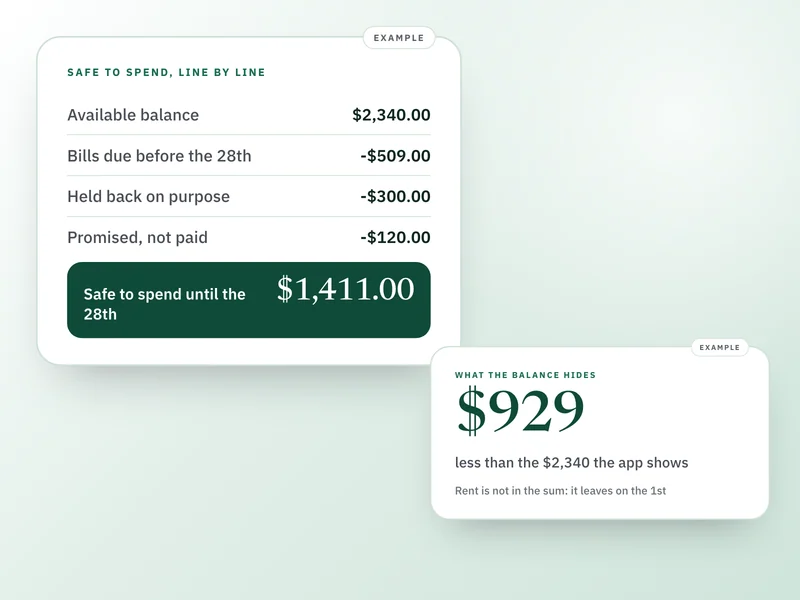 If this is where you areHow much money is safe to spend after your bills?Once you know which balance is real, subtract the bills still due to find what is safe to spend.
- How to know if you can afford something before you buy it
Turn the balance into a yes or no on a specific purchase, working out what is left until payday.
- Before your bills come out: a two minute autopay check
See why a payment can fail even when the balance looks fine, and what to check before each bill leaves.
- You missed a payment. What to do in the next 48 hours
A held or pending item can cause a missed payment, and this lays out the first 48 hours after one.