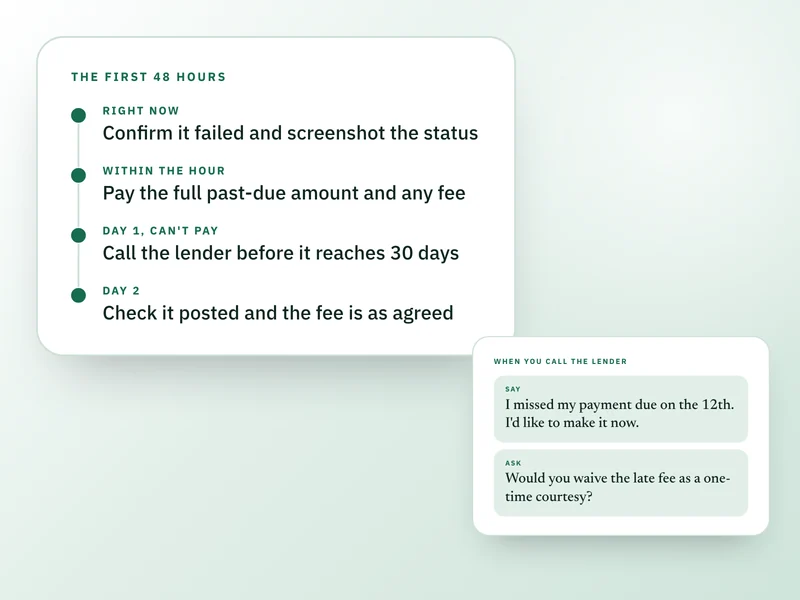
Check that the payment actually failed, then pay the full amount today if you can. Most lenders don't report a late payment to Equifax, Experian and TransUnion until it's 30 days past due, so paying inside that window usually costs a late fee, not a mark on your report. If you can't pay, call before day 30.
This is written for one missed bill, not a pile of them, and for US accounts. It can't tell you what your lender's late fee or grace period is, because that sits in your own agreement, and it isn't legal or financial advice. If you're missing payments regularly, skip to the section on when this isn't enough.
An example: a card minimum due on the 12th
Say your card minimum of $35 was due on the 12th and it's now the 14th. Here is how the next weeks could play out, as an illustration and not a forecast.
Day 1 to 29: a late fee can be added, and interest keeps running on the balance. Day 30: the lender can report the payment as 30 days late. Day 60 or more: some card agreements let the lender raise your rate on the existing balance. The CFPB's own materials note that a penalty rate can apply if you're more than 60 days late.
Pay the $35 plus any late fee on the 14th and you're in the first bucket. Wait until the 45th day and you're in the second. The money owed is the same. What changes is what gets written on your report, and a reported late payment can stay there for seven years, according to the CFPB.
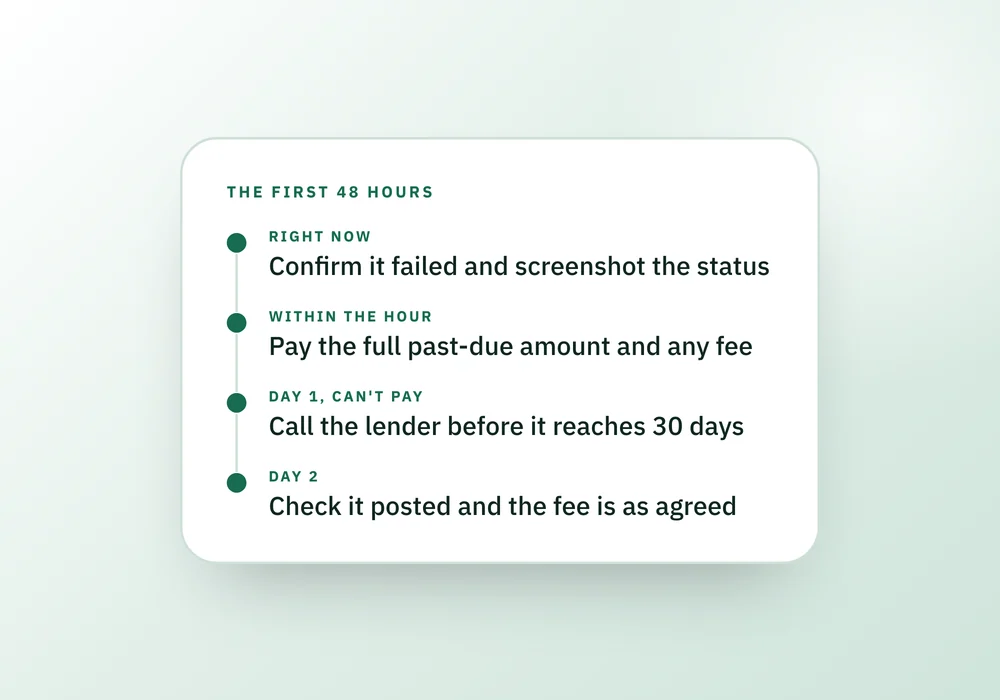
The first 48 hours, in order
Right now
Confirm it failed. Log in and look for a payment marked pending, a retry, or a payment that left a different account than you expected. Screenshot the status. Some banks show a balance that hasn't caught up with what already left, which is covered in available balance vs current balance.
Within the hour
If you have the money, pay the full past-due amount, plus the late fee if it has been added. A partial payment inside the 30 days can still be reported as late, according to Equifax.
Same sitting
Look at every bill due before your next payday, so fixing this one doesn't cause a second miss on Friday. A single list helps, see the monthly bills list.
Day 1, if you can't pay
Call the lender. Use the script below. Ask what they can do before the account reaches 30 days.
Right after the call
Write down the date, the name or ID of the person, and exactly what was agreed. Ask for it in writing or by email.
Day 2
Log in again. Check the payment posted, the fee is what they said, and autopay is on or the due date is in your calendar.
What to say when you call the lender
Use the number on your statement or the back of the card. Have your account number and the date of the missed payment in front of you.
Pick the one you are facing
“Hi, I missed my payment that was due on the 12th. I'd like to make it now and see what I can do about the late fee.”
“I can pay the full past-due amount today. Can you confirm the total, including any fee, and that this won't be reported as late?”
“This is the first time I've missed a payment. Would you waive the late fee as a one-time courtesy?”
“I can pay $X today and the rest on the [date]. Is there a hardship program, a payment plan, or a date change I can use so this doesn't reach 30 days late?”
“Is there a supervisor or a retention team who can review this? I'd like to note on the account that I asked.”
“Can you read back what we agreed, and can you send it to me in writing? Could I have your name or ID number?”
If the call is the part you're avoiding
Most of the fear is in the first sentence. Say it from the script above, word for word, and the rest follows the lender's questions. If you freeze, making a phone call you have been avoiding is a short plan for getting it done. A lender can only offer options while the account is still open and current enough to fix, which is why this call comes before day 30, not after.
What happens by bill type
This is the general pattern. Your agreement or the notice on the bill is the final word.
Credit card
- In the first days
- Late fee possible, interest keeps running
- At 30 days past due
- Lender can report it late to the bureaus
Mortgage
- In the first days
- Late fee after the grace period in your loan terms
- At 30 days past due
- Can be reported late. Call your servicer before it gets that far
Auto loan or personal loan
- In the first days
- Late fee and reminders
- At 30 days past due
- Can be reported late
Rent
- In the first days
- Late fee per your lease, notice from the landlord
- At 30 days past due
- Depends on the lease. Ask what the landlord does after the fee date
Utilities
- In the first days
- Late fee or a disconnection notice
- At 30 days past due
- Often handled with notices and a payment plan first. Ask the company
| Bill | In the first days | At 30 days past due |
|---|---|---|
| Credit card | Late fee possible, interest keeps running | Lender can report it late to the bureaus |
| Mortgage | Late fee after the grace period in your loan terms | Can be reported late. Call your servicer before it gets that far |
| Auto loan or personal loan | Late fee and reminders | Can be reported late |
| Rent | Late fee per your lease, notice from the landlord | Depends on the lease. Ask what the landlord does after the fee date |
| Utilities | Late fee or a disconnection notice | Often handled with notices and a payment plan first. Ask the company |
A grace period is not the same as forgiveness
On a credit card, the grace period is about interest: you skip interest on new purchases if you pay the whole balance by the due date, the CFPB explains. It doesn't give you extra days to pay without a fee. A late fee grace period, when there is one, is a separate number of days in your agreement, and mortgages and leases often include one. Look for it in the paperwork before you assume it exists.
When this isn't enough
- You're already past 30 days. Pay what you can, then ask the lender for a goodwill adjustment in writing, mentioning that this is your first miss and your record before it. Chase describes this as a goodwill letter, and there is no guarantee they'll agree.
- You can't pay this month or next. For a mortgage, the CFPB says to call your servicer first and to contact a HUD-approved housing counselor (the HOPE Hotline is 888-995-4673) for free help. You don't have to pay anyone to help you avoid foreclosure.
- It's happened three times this year. Then the fix isn't a call, it's a change in how bills get tracked, and why you keep missing bill due dates walks through that.
- You see an error on your report. You can dispute it for free with the bureau and the lender under the Fair Credit Reporting Act.
Questions people ask after a missed payment
How many days late before it hurts my credit?
For most accounts, a payment is reported to Equifax, Experian and TransUnion once it is 30 days past due. Before that, you can still get a late fee and interest, but Equifax says a late payment generally won't reach your reports for at least 30 days. After it's reported, later marks can follow at 60 and 90 days, so don't stop at the first one.
Will one missed payment ruin my credit?
It won't ruin it by itself, but it does count. If it's reported, the CFPB says a credit reporting company can generally keep negative information for seven years. The impact tends to fade as newer, on-time payments build up behind it. Paying before day 30 is what keeps it off the report in the first place.
Can I get a late fee waived?
You can ask, and the best time is when you call to make the payment. Lenders decide case by case. It helps if it's your first miss, and if you're paying it now. Ask once, politely, and note the answer. A fee they refuse today can sometimes be reviewed later if you keep paying on time.
What if I paid but it still shows as missed?
Check whether the payment is pending or was sent to the wrong account, then ask the lender to confirm it in writing. If a late mark is reported when you paid on time, you can dispute it for free with the credit bureau and the lender. Keep the confirmation email, bank statement line or screenshot.
Should I pay the whole bill or just some of it?
If you can, pay the full past-due amount, because Equifax notes partial payments inside the 30 days can still be reported as late. If you can't, pay what you can and call at the same time to arrange the rest. Getting the agreement in writing counts for more than the exact figure.
Where Draftpace fits
A lot of missed payments come from a due date that was never written down where it would be seen. Monthly Money Reset, which is free, lets you list the bills you still owe this month and holds that money back from your safe-to-spend number. Personal Finance Companion keeps each bill with its due date, lets you tick it paid, and shows what falls due in the next 14 days when you open it. It doesn't send payments or contact your lender for you.
Sources and how we checked
- CFPB: How long does information stay on my credit report?: Negative information can generally be reported for seven years.Checked 26 September 2026.
- Equifax: When late credit card payments post: Late payments generally aren't on reports for at least 30 days; late fees can come sooner; partial payments still reported.Checked 26 September 2026.
- CFPB: If I can't pay my mortgage loan, what are my options?: Call the servicer first, HUD-approved counselors, HOPE Hotline, no need to pay for foreclosure help.Checked 26 September 2026.
- Chase: Recovering from a late credit card payment: Contact the creditor, pay before 30 days, goodwill letter.Checked 26 September 2026.
- CFPB: What is a grace period for a credit card?: Grace period is about avoiding interest on new purchases.Checked 26 September 2026.
- CFPB: Credit Card Penalty Fees Final Rule: Checked for late fee rule status; guide does not state a fee cap.Checked 26 September 2026.
Where to go next
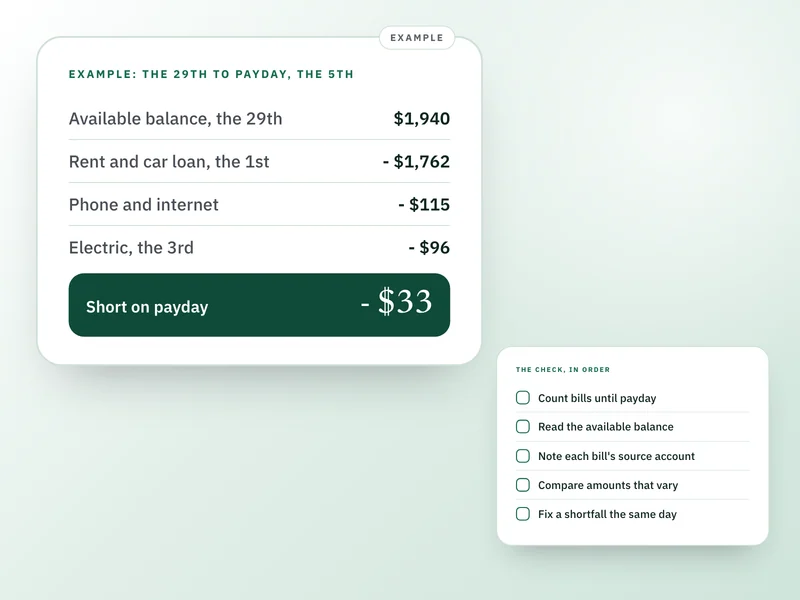 If this is where you areBefore your bills come out: a two minute autopay checkStop it happening again with a two minute check before the busiest payment date each month.
- Monthly bills list: include the bills that are not monthly
Put every bill, with its real due date, on one list so none is left to memory.
- How to build your first $1,000 emergency fund
A small cash cushion is what keeps a late bill from becoming a late fee, and this shows how to build one.
- How long paying only the minimum takes on credit card debt
If the missed payment was a credit card minimum, see how long minimums take to clear a balance and what extra changes.