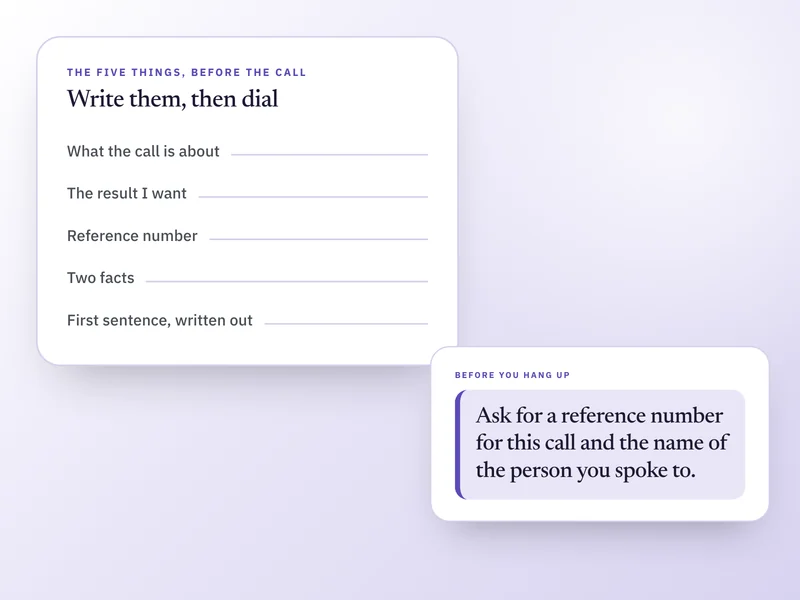
Write five things on paper before you dial: what the call is about, the result you want, your reference number, two facts, and your first sentence word for word. Then dial, read the first sentence, and follow the short list below. Before you hang up, ask for a reference number and a name.
This is for the call you've had on your list for days or weeks: a billing problem, a booking, a cancellation, a chase. It can't tell you why calls are hard for you in particular, and if dread of the phone is getting in the way of work or health, a clinician is the right person to ask. This is admin help, not medical advice.
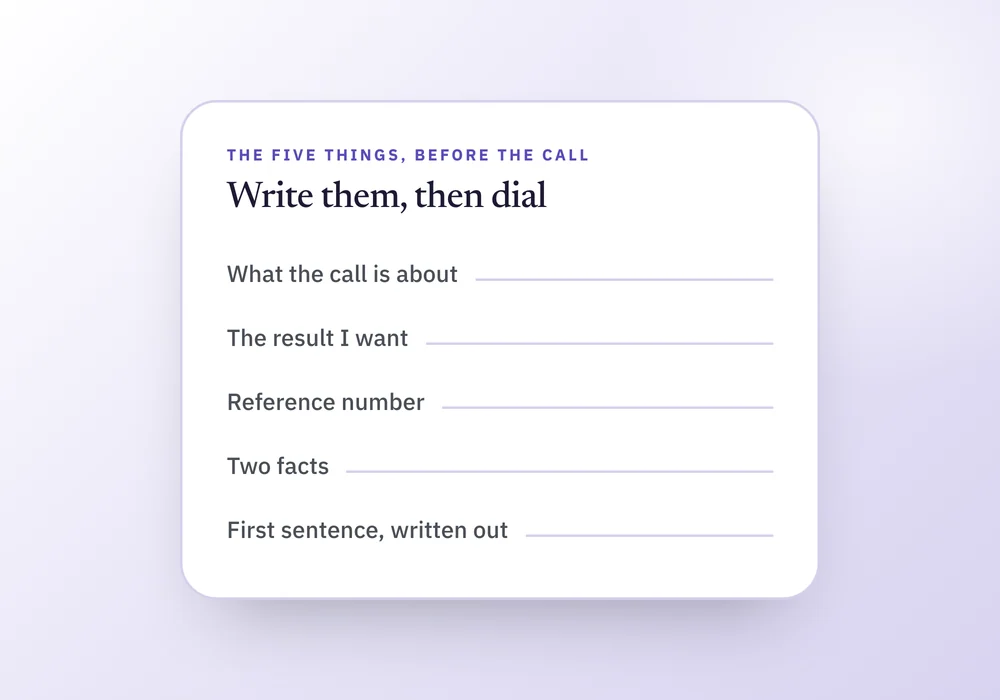
Why a call stalls when the task is small
You have the number. You've had it for three weeks. Nothing stops you from dialing except that a call asks you to do several things at the same moment: remember why you're calling, listen to someone you can't see, keep your main point in mind, answer their questions, write down the reference, and sound like a person who does this every day. There is no warm-up, and you can't pause it or read it back.
Many people describe this as too many things held at once, not a lack of caring, which may be why telling yourself to just get it over with hasn't worked. No one has proven a cure for the stall. What coaches and clinicians often suggest, and what is worth trying, is to take every one of those jobs out of your head except the talking. That is what the five things are for.
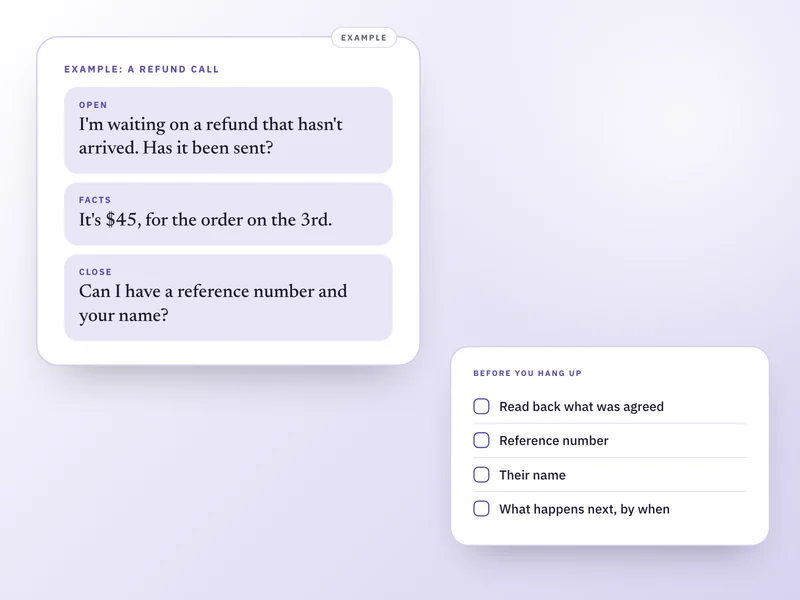
Example: the five things, filled in
An illustration, not a real account. Say a phone company charged you $45 twice on the same day and you want one of them back.
What it's about
- What's on the page
- The double charge on my phone bill.
The result I want
- What's on the page
- The second $45 charge refunded to my card.
Reference
- What's on the page
- Account ending 4471. Statement dated the 3rd.
Two facts
- What's on the page
- Both charges posted on the 3rd. I called once before, on the 9th, and spoke to someone named Dana.
First sentence
- What's on the page
- Hi, I've been charged twice for the same thing on my bill and I'd like to get it put right. Can I explain what happened?
| The thing | What's on the page |
|---|---|
| What it's about | The double charge on my phone bill. |
| The result I want | The second $45 charge refunded to my card. |
| Reference | Account ending 4471. Statement dated the 3rd. |
| Two facts | Both charges posted on the 3rd. I called once before, on the 9th, and spoke to someone named Dana. |
| First sentence | Hi, I've been charged twice for the same thing on my bill and I'd like to get it put right. Can I explain what happened? |
How to write each of the five
Paper is best, because you can't lose it behind another window. A note on your phone works if it's the only thing open.
- What it's about, in one line. Write it the way you'd say it to a friend: "the double charge on my phone bill." If it takes two lines, it's really two calls. Pick the one that comes first and put the other on a separate page.
- The result you want, in one line. Decide it now, because it's the thing that slips away halfway through explaining how you got here. A refund, a new date, a cancellation confirmed in writing. If the call wanders, this line is where you come back to.
- The reference. Account number, order number, booking code, or the name and address the account is under. Put it where you can read it, not where you could find it. Hunting through an app while a stranger waits is the moment many calls come apart.
- Two facts. A date and an amount, or a name and a date. Two, not ten. Anything more lives on the statement or email you've put next to the page.
- The first sentence, word for word. A full sentence, written out. Leaving it as "I'll work out how to begin" is how the number stays in your phone another week.
Set up the room
Two minutes, and only the ones that apply to you.
5 things to do
Ticks are for this visit only. Nothing here is saved anywhere.
Pick the time now
Later today isn't a time. Choose one exact time, add ten minutes of buffer before it, and treat the buffer as the moment you read your page once. If you'd rather call right now while everything is fresh, that's the other good answer. The one that doesn't work is leaving it open. Planning when you cannot feel time pass has more on naming a time so it stops sliding.
The first sentence, by kind of call
Take the closest one and change any of it. Yours can be shorter or clumsier. It only has to get you through the first fifteen seconds, and you can read it. Say it out loud once before you dial.
Pick the one you are facing
“Hi, I have a problem with my account and I'm hoping you can help me sort it out. Can I explain what happened?”
“Hi, I've been charged twice for the same thing and I'd like to get it put right. Can you look at the account for me?”
“Hi, I'd like to book an appointment. Are you the right person for that?”
“Hi, I'd like to cancel. Can you tell me what you need from me to do that?”
“Hi, I contacted you about this on the 9th and I'm calling to find out where it stands. Can you look it up for me?”
“Hi, I'd like to make a complaint. Can you tell me how that works here, and who I need to speak to?”
If the call is a harder one, like telling someone no or giving bad news, the opening lines are different. That's covered in how to say no or give bad news on the phone, and there are more openings for billing, chasing and canceling in scripts for the admin calls everyone dreads.
During the call
Short on purpose. Anything longer is unreadable while someone is talking to you.
- Read your first sentence. Then say the result you want, in your own words or straight off the page.
- Answer their questions from the page. If they ask for something you don't have, say so and ask what else would do.
- Write down what they tell you as they say it: names, dates, anything they promise.
- Ask what happens next, and by when.
- Before you hang up, ask for a reference number for this call and the name of the person you spoke to.
Lines to have ready mid-call
Put these at the bottom of the page. You're allowed to use every one of them.
Pick the one you are facing
“Can you give me a moment? I want to find that so I give you the right answer.”
“Sorry, let me check my notes. I'm calling about the double charge on my bill.”
“Could you say that again, more slowly? I'm writing it down.”
“Before you transfer me, can I have your name and a reference for this call, in case we get cut off?”
“So to confirm, you're going to refund the second charge and I should see it within five business days. Can I have a reference number for this call?”
If you get voicemail or a hold queue
A voicemail is a smaller version of the same call, and you can rehearse it on the page. Leave your name, one line about why you're calling, your number said slowly, then said again, and a time you'll be free. Then write down that you left it and when. That counts as making the call, and it gives them the next move.
On hold, keep the page in front of you and put the phone on speaker. Decide before you dial how long you'll wait. Twenty minutes is a fair limit if you have nothing else in the day. When it's up, hang up, write the time you called, and pick your next time. If they offer a callback, take it. Some menus route you to a person if you press 0 or say "representative". It's worth a try, and it doesn't always work.
Pick the one you are facing
“Hi, this is Sam Rivera, calling about a double charge on my phone bill. My number is 555 0142, again, 555 0142. I'm free between two and four today. Thank you.”
“Representative. (Or press 0.)”
If it goes badly
You might freeze, lose the thread, get someone unhelpful, or feel your voice go. None of that ruins the call. What you need out of it is still the same: a name, a reference, and what happens next. If you get those, you can stop, and the next call starts from where this one ended.
If you're being pushed to agree to something, you don't have to answer on the spot. You're allowed to ask for a minute. You're allowed to say you'll call back.
Pick the one you are facing
“Sorry, I lost my place. Can I have a second?”
“Give me a moment, I'm finding this stressful. I'll be right with you.”
“Is there someone who can? Can I have their name, or the name of the department?”
“I'd like to think about that. Can you send it to me in writing, and I'll call back?”
When you hang up, write four lines under your five things while it's fresh: the date and time, who you spoke to, the reference, and what they said would happen by when. That page is the first sentence of your next call, and it is the reason a call that didn't resolve wasn't wasted. Then decide whether you're done, waiting, or need to call again, and put an exact time on it.
If you can't get yourself to dial
Writing the five things is already the hardest step for many people, so if that's all you did today, keep the page. It will still be there tomorrow, and starting again from nothing is what makes the second attempt feel heavier than the first. If even the page won't start, what to do in the next ten minutes shrinks the first move until it needs no push, and the first physical step, with examples shows what that looks like for calls.
A ladder, if the real call is too big
Coaches often suggest working up from easier calls. It's worth trying, not proven, and you can skip any rung.
Rung 1: the page
Write the five things. Stop there if you need to.
Rung 2: no one to answer
Call after hours and leave the voicemail, or listen to the recorded greeting.
Rung 3: an easy call
Ask something with no stakes, like opening hours or whether they can help with your kind of problem.
Rung 4: the call
Dial with the page in front of you and read the first sentence.
When a phone call isn't the only route
Check whether the company takes the same request by email, online chat or a form. For a billing problem or a cancellation, writing also leaves you a record. If you'd rather write, the email you keep not sending works the same way, with your first line written out. Some things do need a voice, like proving who you are, or something urgent, and it's fine to do those with someone sitting in the room while you dial. They don't have to do anything.
When preparing turns into stalling
It happens. The page gets tidier and the phone stays where it is. Give yourself ten minutes to write the five things, and if you find yourself rewriting the first sentence a fourth time, dial. A slightly clumsy opening that you actually say beats a perfect one you never do. If the number has been on your mind for months and the guilt is the heavy part, how to deal with something you have put off starts from there.
Questions people ask
Why is it so hard to make a phone call?
A call has no warm-up. You have to remember why you're calling, listen live, answer questions and hold your main point in mind, all at once, and you can't pause or reread. Plenty of people find that heavier than the same task by email. Some link it to ADHD or anxiety, but only a clinician can say whether that applies to you.
How do I start a phone call when I'm nervous?
Write the first sentence out and read it. If they ask for your name, give it, and then say the sentence as written. It's fine to say you're a bit nervous or that you need a second. The first fifteen seconds are the part you can prepare completely, and the conversation usually carries itself after that.
What do I say if I get voicemail?
Say your name, one line about why you're calling, your phone number slowly, then the number again, and a time you'll be free. Keep it under twenty seconds. Then write down that you left the message and when. If you haven't heard back in a few days, that note tells you it's time to call again.
How long should I wait on hold?
There's no rule. Decide before you dial, based on your day. Twenty minutes is a fair limit if you have nothing else scheduled. When it's up, hang up, write down when you called, and pick your next exact time. If they offer a callback, take it and keep your phone free.
Can someone else make the call for me?
Sometimes. Many companies will only talk to the account holder, or will talk to someone else only after you've given permission. That usually means you're on the line briefly to say so. Ask the company what it requires. A friend sitting beside you while you make the call is always an option.
Where the Companion fits
The Make a phone call walkthrough in ADHD Life Companion asks these questions one at a time: what the call is about, who you're calling, what a good result looks like, what's worth having in front of you, and anything you must not forget to say. It then offers an opening line to use, or you can write your own, and asks whether to call now or name one exact time today. During the call it shows your own words back to you. If you close it halfway, it reopens at the question you left. It doesn't ask for account numbers or amounts, and it isn't a diagnosis or a treatment. It's the five things on a screen, in order.
Where to go next
 If this is where you areWhat to say on admin calls: opening lines and scriptsOnce you can dial, this has opening lines for billing problems, chasing, canceling and complaints, plus what to get before you hang up.
- How to say no, or give bad news, on the phone
If the hard part of the call is what you have to say, not dialing, this covers refusals and bad news.
- ADHD time blindness: how to plan when later never comes
Later today is not a time. Pick one exact time for the call and add a buffer, so it stops sliding.
- ADHD task paralysis: what to do in the next ten minutes
When even picking up the phone will not start, this ten minute way out shrinks the first step until it needs no motivation.