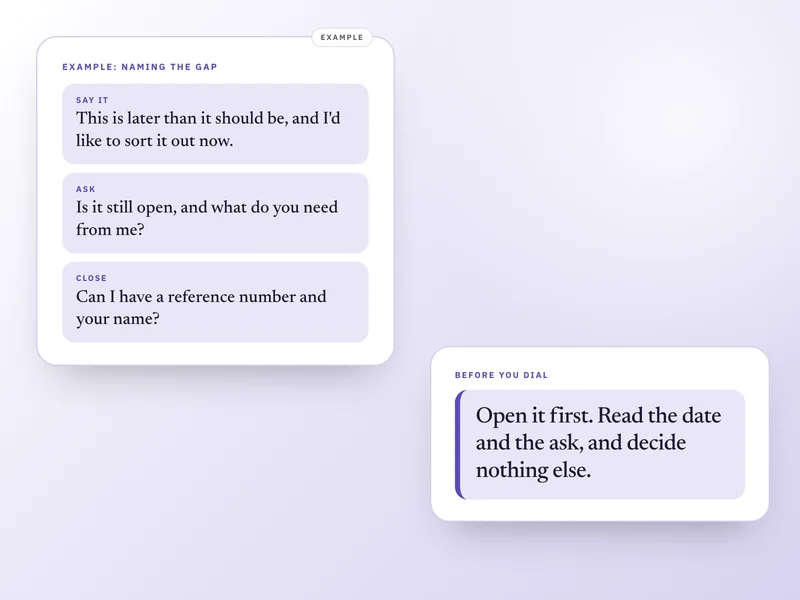
Open the thing first, find the one practical question it asks of you, and say one sentence about the gap before you ask it: "I know this has been outstanding a while, and I'd like to sort it out now." Skip the explanation unless it changes what they can do for you. Then write down what they say next.
This is for the letter, email, call or form that has waited so long the delay feels heavier than the task. It can't tell you what a late fee or a missed deadline will cost you, and it isn't legal or financial advice. It's admin help.
The moment a task turns into evidence
Say it's a Sunday night. There's an envelope from a clinic under the fruit bowl that arrived in May. You know roughly what it is. You don't know what it says, and the not knowing has been costing you more each week than anything inside it could.
At that point you may not be avoiding the work at all. You may be avoiding the conversation about why it didn't happen sooner, which is a different problem and a heavier one. There isn't one reason people let things sit, and this guide can't say which one is yours. What it can do is shrink the conversation to one sentence and put the task in an order you can follow.
Example: one stalled letter, filled in
An illustration, not a real account. Say a clinic sent a bill in May and it's now September.
Open it
- What's on the page
- Envelope from the clinic, dated May 12. Read it once. Decide nothing.
Find the facts
- What's on the page
- Amount: $180. Pay by: June 12. Reference: the number top right.
The practical question
- What's on the page
- Is it still open, and can I pay it in two parts?
The sentence about the gap
- What's on the page
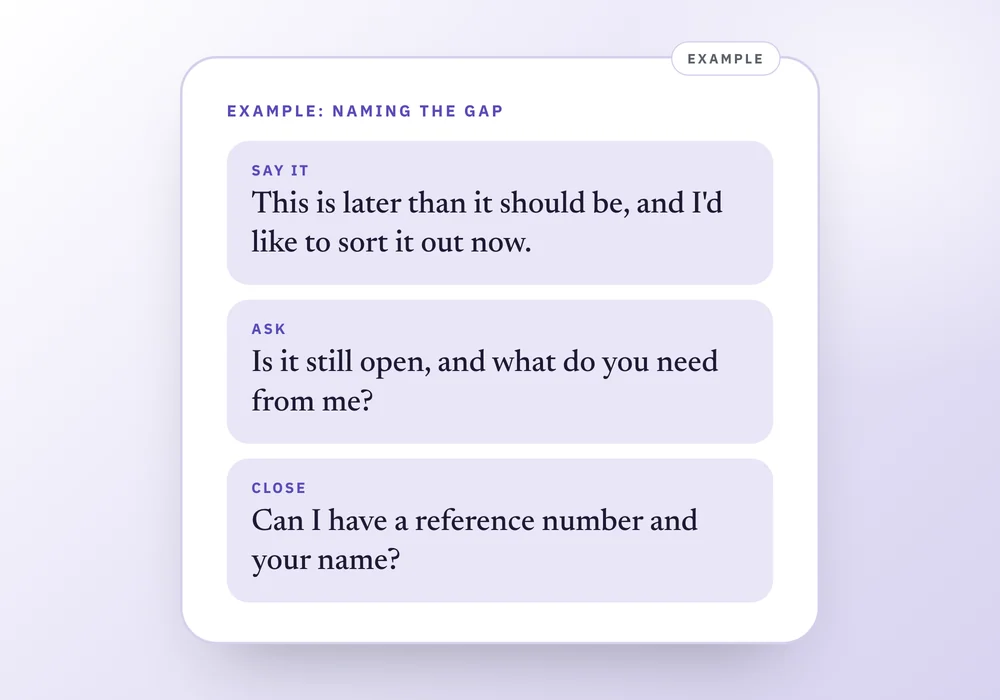
- This is later than it should be, and I'd like to sort it out now.
The route
- What's on the page
- The billing number on the letter. Tuesday at 10:00, before the line gets busy.
| Step | What's on the page |
|---|---|
| Open it | Envelope from the clinic, dated May 12. Read it once. Decide nothing. |
| Find the facts | Amount: $180. Pay by: June 12. Reference: the number top right. |
| The practical question | Is it still open, and can I pay it in two parts? |
| The sentence about the gap | This is later than it should be, and I'd like to sort it out now. |
| The route | The billing number on the letter. Tuesday at 10:00, before the line gets busy. |
The order that works
Each step is small on purpose. You can stop after any of them and pick up at the next.
- Open everything in the pile once, and do nothing else. No sorting, no deciding. A pile in the imagination grows faster than the contents justify. Often a few items are duplicates, a couple are marketing, and the real problem is one piece of paper.
- Read the date first, then the ask. Two questions: is there a date still ahead, and what do they want from you? If a letter mentions a court date, collections or legal action, that date is the one to act on today. Get advice from someone qualified for that one, because this guide can't tell you your options.
- Write the practical question on one line. "Is it still open, and what do you need from me?" is a good default. It's a question they can answer, which the question of why you waited is not.
- Write one sentence about the gap, from the lines below. Read it out loud once.
- Choose the route you can actually do this week: a call, an email or a form. If it's a call, the five things to write down first covers the preparation. If it's an email, the email you keep not sending covers the first line.
- Do the first physical step today, however small: put the letter next to the phone, copy the number onto a sticky note, open a blank reply. Not sure what counts? The first physical step, with examples has twenty.
What to say about the gap
One sentence, no story. Take the one closest to how you feel about it, and change any word.
Pick the one you are facing
“I know this has been outstanding a while, and I'd like to sort it out now.”
“This is later than it should be. What do you need from me?”
“I haven't dealt with this until now. Can you tell me where it stands?”
“I was ill in June and missed the date. Is there a way to correct that?”
“Hello, this is later than it should be on my side. Could you tell me what you need from me, and by when?”
Do not explain unless it changes what they can do
The instinct is to justify: an illness, a hard year, a bereavement. If the reason affects what they can offer, like a fee waived because you were in the hospital, say it in one line. Otherwise the explanation makes the exchange longer and more uncomfortable, mostly for you.
Organizations that send bills and letters hear from late people often, so a late reply is rarely news to them. The version you've rehearsed, where the person on the line is shocked, is often not the one that happens. Often they ask for a reference number and move on. Acknowledge the gap, then ask the practical question. It's the question they're set up to answer.
When waiting did cost something
Some things do get worse for having sat. A bill can pick up a late fee, interest can build, and a deadline can pass. That's real, and no sentence removes it. What you can do is ask what the position is now, and whether anything can be reduced or spread out. It's fine if the answer is no. The question then becomes what's left to do, and that has an answer too.
If you're dreading what the letters say, ask someone you trust to sit in the room while you open them. They don't need to read anything or say anything. Their being there is the whole job.
If opening it is where you stop
Opening the envelope is a complete first step, and it's enough for today. Put it on the desk and write the date on the outside. If more than one thing has gone this way, how to start when everything is overdue sorts them by who is waiting, and the paperwork pile shows how to open and sort mail without deciding anything. If even that feels impossible, what to do in the next ten minutes shrinks it further.
Questions people ask
How do I deal with something I've put off for months?
Open it and read the date and the ask, nothing more. Write one practical question, such as whether it's still open and what they need from you. Write one sentence about the gap. Then pick a route, call or email, and do the first physical step today. You don't have to finish it in one sitting.
What do I say when I'm late replying or paying?
Something short and plain: "I know this has been outstanding a while, and I'd like to sort it out now." Then ask what they need from you. You don't need an apology speech or a history. Give a reason only if it changes what they can do, and then in one line.
Should I explain why I waited?
Only if it's relevant to what they can offer you, such as a fee waiver for an illness. Otherwise it usually makes the conversation longer without changing the outcome. Acknowledge the delay in a sentence, ask your practical question, and write down the name and reference number you're given.
What if I'm afraid to open the letters?
Opening them is the first step, and you can do it without deciding anything. Ask someone to sit nearby while you do it, or open one a day. If a letter mentions court or legal action, read the date, and get advice from a qualified person about your options.
Why do I keep avoiding things I know I need to do?
There's no single reason. For some people it's dread of the conversation, for others it's too many steps at once, and it can be linked to ADHD, anxiety or low mood. Only a clinician can tell you which applies. Whatever the cause, a small physical first step tends to be easier to start than the whole task.
Where the Companion fits
The Pick something back up walkthrough in ADHD Life Companion starts with how long it has been: a week or two, a month or so, longer, or no idea. It says nothing counts it against you. It then asks where you left off, whether anything was missing last time, and what the smallest piece is that you could do next. If the piece is a call, the Make a phone call walkthrough takes over from there. If you stop partway, it reopens at the question you left. Choosing Did not get to it changes nothing on the item and adds nothing to its history. It's not a treatment or a diagnosis, and it doesn't read or store your paperwork.
Where to go next
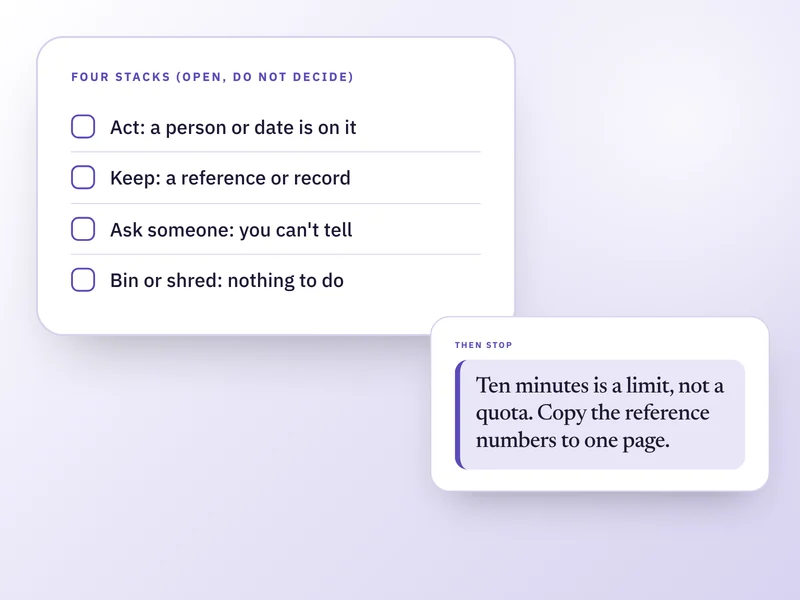 If this is where you arePaperwork pile you are avoiding: where to startIf part of what you have avoided is unopened mail, this shows a ten minute way to open and sort without deciding anything.
- Everything is overdue: how to pick the first thing
When several things have gone past their date, this shows how to sort by who is waiting and pick one first step.
- ADHD task paralysis: what to do in the next ten minutes
If naming the delay does not get you moving, this ten minute way out makes the first step small enough to start.
- What to say on admin calls: opening lines and scripts
When the thing you put off is a call, these opening lines cover billing, chasing, canceling and complaints.