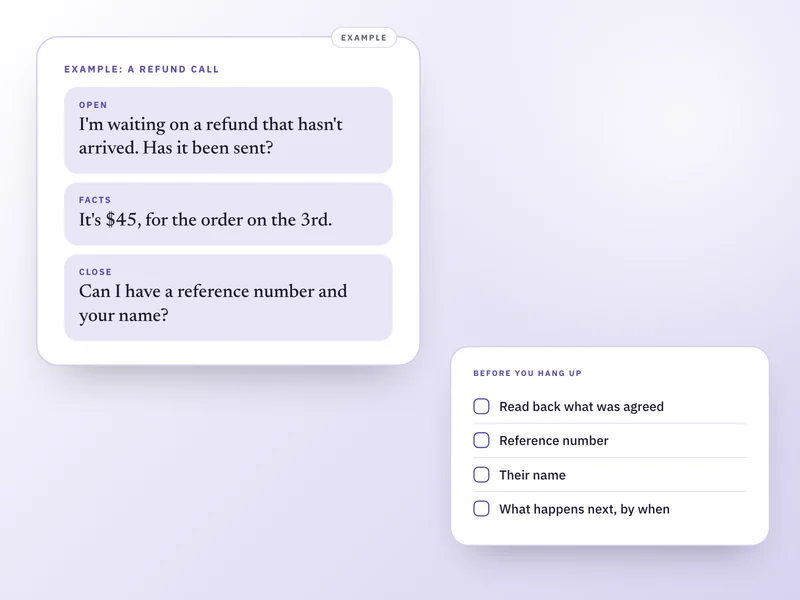
Open with the problem, say what happened once, in order, then say what you want done. End your first sentence with a question so the other person has the next move. Before you hang up, get a reference number, a name, what happens next, and by when.
This is for customer service, billing and account calls in the US. It can't tell you what a company owes you, and it isn't legal advice. If the call itself is what you keep avoiding, start with how to make a phone call you have been avoiding, which covers what to write down first.
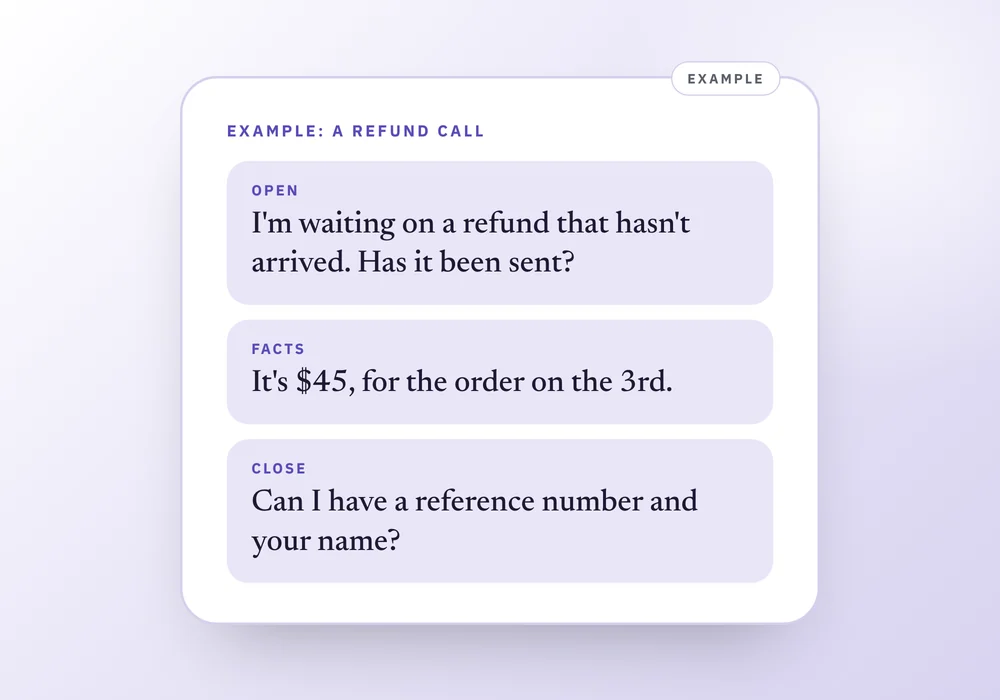
Example: a whole call in five lines
An illustration, not a real call. Say a refund promised two weeks ago hasn't arrived.
Open
- What you say
- Hi, I'm waiting on a refund that hasn't arrived. Can you tell me whether it's been sent, and when?
Facts, once
- What you say
- It's $45, for the order on the 3rd. Your colleague Dana said it would take five business days on the 9th.
The ask
- What you say
- I'd like the refund sent today, or a date I can rely on.
Read back
- What you say
- So the refund goes out by Friday. Can I have a reference number for this call?
Close
- What you say
- And your name, please? Thank you.
| Stage | What you say |
|---|---|
| Open | Hi, I'm waiting on a refund that hasn't arrived. Can you tell me whether it's been sent, and when? |
| Facts, once | It's $45, for the order on the 3rd. Your colleague Dana said it would take five business days on the 9th. |
| The ask | I'd like the refund sent today, or a date I can rely on. |
| Read back | So the refund goes out by Friday. Can I have a reference number for this call? |
| Close | And your name, please? Thank you. |
Opening lines for the common calls
Each opens with the problem, not an apology, and ends with a question. Change the wording until it sounds like you.
Pick the one you are facing
“Hi, the amount I've been charged isn't what I was expecting. Can you tell me what it's for?”
“Hi, I've been charged twice for the same thing and I'd like to get it put right. Can you look at the account for me?”
“Hi, I canceled this and I've been charged since. Can you check when the cancellation was recorded?”
“Hi, there's a charge on my account I don't recognize. Can you tell me what it is?”
“Hi, I'm waiting on a refund that hasn't arrived. Can you tell me whether it's been sent, and when?”
“Hi, I got in touch about this before and I'm calling to find out where it stands. Can you look it up for me?”
“Hi, I'd like to cancel. Can you tell me what you need from me to do that?”
“Hi, I'd like to make a complaint. Can you tell me how that works here, and who I need to speak to?”
Say what happened, once, in order
Whoever answers can only help with the actual sequence of events. Give it once, cleanly, then say what you'd like to happen. Two or three sentences is usually enough: what happened, when, and what you want now. Leading with the ask before the facts tends to make the call longer, because they have to stop you and ask for the facts anyway.
When the answer is no, or you're passed along
Polite and specific works better than firm. Keep these at the bottom of the page.
Pick the one you are facing
“I understand that's the policy. What options do I have from here?”
“Is there someone with more authority to change this that I can speak to? I'll hold.”
“Before you transfer me, can I have your name and a reference for this call, in case we're cut off?”
“Can you note on the account that I called today and what I asked for? Then I'll say so when I call again.”
“Can you give me a moment? I want to find that so I give you the right answer.”
“Can you tell me in writing what you've told me today? Which email or address should I expect it from?”
Four things to get before you hang up
This is the part that saves the second call.
- Ask them to read back what has been agreed. If you've written it down, read it to them and ask if that's right.
- Get a reference number for the call itself. Without it the next call starts from nothing.
- Get the name of who you spoke to.
- Ask what happens next, and by when. Ask for a date, not "soon".
A note to write straight after the call
Two minutes. It's the note you'll want if you have to call again.
- Date and time of the call, and the number you dialed.
- Name of the person, and the reference number.
- What was agreed, in their words if you can.
- What they said happens next, and the date you'll check if it hasn't.
- Anything you need to send or do, with a day.
Voicemail, and when a call isn't enough
A voicemail is a small version of the same call. Say your name, one line on why you're calling, your number slowly, then your number again, and when you're free. Then write down that you left it and when. For a longer chase, an email after the call, with the reference number and what was agreed, gives you something written. The email you keep not sending covers that.
One US-specific limit. For a wrong charge on a credit card, the Consumer Financial Protection Bureau says a phone call alone doesn't protect your rights: you send a written billing error notice to the card company within 60 calendar days after the charge appeared on your statement. Call first if you like, and then put it in writing. If it's an overdue bill you're calling about, see you missed a payment: what to do next.
Being polite is enough
A lot of advice about hard calls is really about being assertive, which assumes you're too soft. You may not be. On a billing call the person answering usually has a fixed set of options and is choosing which to offer, so being clear about what you want and having the facts ready tends to help more than a harder tone. For calls where you need to refuse or give bad news, see how to say no or give bad news on the phone.
Questions people ask
What do I say when I call customer service?
Open with the problem in one sentence, end with a question, and give the facts once in order: what happened, when, and what you want. For example: "Hi, I've been charged twice for the same thing and I'd like to get it put right. Can you look at the account?"
How do I ask for a supervisor politely?
Ask after they've said they can't help, and frame it as needing someone who can change the outcome: "Is there someone with more authority to change this that I can speak to?" Stay polite, get the agent's name and a call reference first, and be ready to wait.
What should I get before I hang up?
Four things: a read-back of what was agreed, a reference number for the call, the name of the person, and what happens next with a date. Write them on the page as you hear them. It saves you from starting over next time.
What do I say when I want to cancel something?
"Hi, I'd like to cancel. Can you tell me what you need from me to do that?" Then ask for a confirmation number and whether a written confirmation will come. If they offer a discount to stay and you don't want it, say no once, plainly, and repeat that you want to cancel.
Should I follow up a call in writing?
For anything with money or a promise in it, yes. A short email with the date, the name, the reference number and what was agreed gives you a record. For a disputed credit card charge in the US, the written notice is what protects your rights.
Where a Companion can hold this for you
Alongside, the ADHD Life Companion, has walkthroughs for Make a phone call, Sort out a billing problem and Follow something up. Each asks a few short questions, such as what would sort it and what you have in front of you, then shows a suggested opening for your situation. You use it or write your own. During the call it shows a short list, including the reference number, the name, and what happens next. It holds no account numbers or amounts by design, only who the charge is from and how it went, in your words.
Sources and how we checked
- Consumer Financial Protection Bureau: How do I dispute a charge on my credit card bill?: Written billing error notice within 60 calendar days; a call alone does not preserve those rights.Checked 26 September 2026.
Where to go next
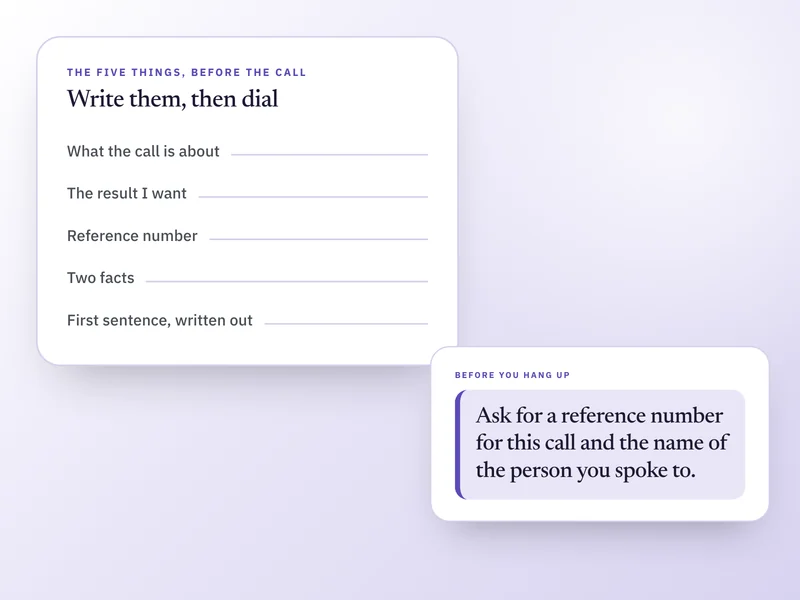 If this is where you areHow to make a phone call you keep avoidingIf the call itself is what you keep avoiding, start with the full walkthrough: five things on paper and a first sentence.
- How to say no, or give bad news, on the phone
For calls where you must refuse or deliver bad news, this has the opening and what to decide before you dial.
- The email you keep not sending: first lines and follow-ups
When a call is too much, a written first line and a follow-up plan for silence can do the same job.
- First physical step: 20 examples for stuck admin tasks
Twenty examples of a first step, including the call, for admin you are stuck on.