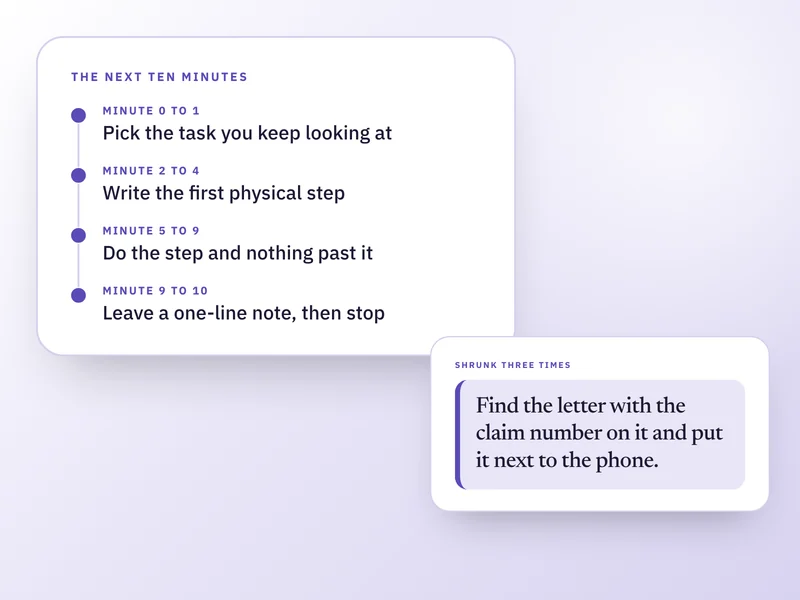
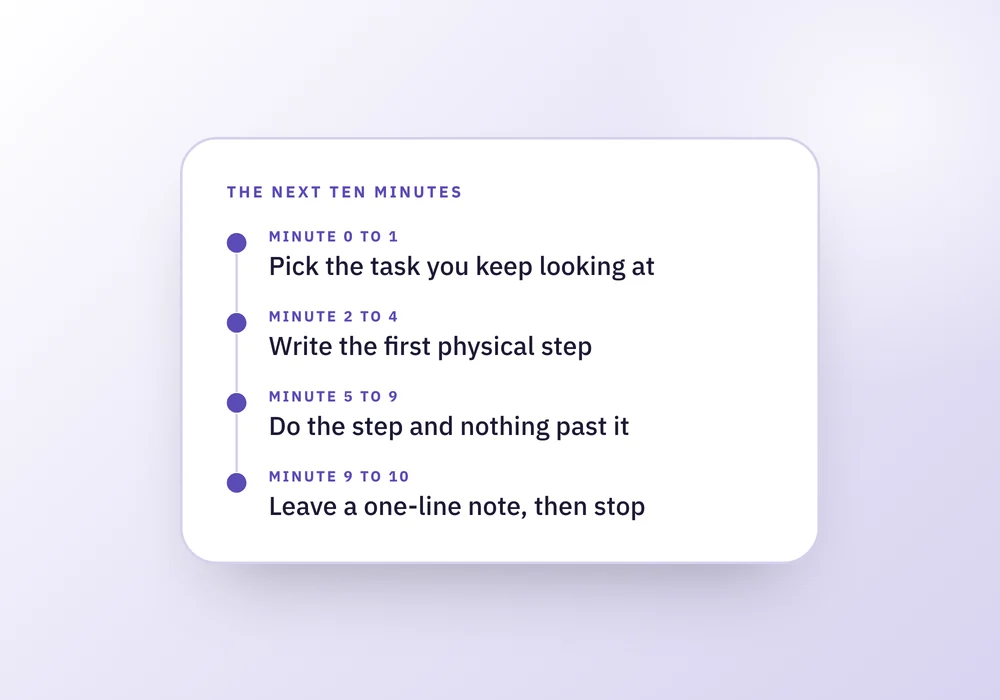
Pick one task and shrink it until the first step is something a person watching could see you do, like opening a folder or finding a phone number. Do only that, for up to ten minutes, then write one line about where you stopped. Below is the sequence minute by minute, with worked examples.
This is for the moment when you know what needs doing, you have the time, and you still can't begin. It's practical admin help, not medical advice, and it can't tell you why you're stuck. If it's affecting your work or health, a clinician is the right person to ask.
What it looks like from the inside
You've opened the same tab four times. The letter is on the desk, face down, and you've moved it twice to wipe the table. You could have made the call in the time you've spent deciding whether to make it, and you know that, which makes it worse.
Child Mind Institute describes this stall, usually called ADHD paralysis, as a frozen feeling when you face a task or decision and can't act however much you want to. It also says it isn't an official ADHD symptom, though it's common in people who have ADHD. We're not going to tell you what yours is. The sequence below doesn't depend on a label, and it's built around one idea: the start is the problem, so shrink the start.
Example: the same task, shrunk three times
This is an illustration, not a case. Say the task is "sort out the insurance claim". Here is what happens as you cut it down.
Version one: "Sort out the insurance claim." There's no visible first move in that. You'd have to decide where to look, who to call and what to say, all before doing anything. That's the wall.
Version two: "Call the insurer." Better, but a call needs a number, a claim reference, the dates and ten free minutes. Still several decisions in a trench coat.
Version three: "Find the letter with the claim number on it and put it next to the phone." That's it. You can see it happen. It takes two minutes. It needs no motivation, because nothing in it can go wrong, and no one on the other end can say no.
The next ten minutes, minute by minute
Set a timer for ten minutes. It's a ceiling, not a target. You're allowed to stop early.
Minute 0 to 1: choose
Pick one task. Not the most important, just the one you keep looking at. If two are close, take the one whose paper or screen is nearer. Choosing well isn't the point. Choosing is.
Minute 1 to 2: say where it ends
Finish this sentence in a few words: "It's done when...". For the claim, that might be "the insurer has my claim number and knows I called". A task with no end feels endless, and that's part of the weight.
Minute 2 to 4: find the first step
Write the first physical step on paper or a note. Physical means someone watching could see it. Find the letter. Open the form. Write the first line. If you wrote "think about", "plan" or "decide", cross it out and try again.
Minute 4 to 5: check the size
Ask whether you could do it right now, in under three minutes, without deciding anything. If yes, go. If not, shrink it again. The section below covers what to do when it still feels too big.
Minute 5 to 9: do only that
Do the step and nothing past it. If you find the letter, you may stop there. If momentum shows up, keep going. If it doesn't, you've still moved a task that was stuck.
Minute 9 to 10: leave a note
Write one line where you'll see it: what you did and what the next step is. "Found the letter, it's by the phone. Next: call, number is on page 2." Then stop, even if you feel you should keep going.
Why the smaller step works, and what we'd skip
A big task asks you to choose a route, hold the goal in mind, and act, all at once. Shrinking the first step takes the choosing and the holding out of it. What's left is one action with no decision in it.
We'd skip the pep talk and the consequences. Telling yourself what happens if you don't do it adds dread to a task that already had plenty. It tends to raise the wall rather than lower it. A smaller step doesn't need you to feel ready, which is the only thing you can't order up on demand.
More first steps, from vague to visible
Examples of the same move on different tasks. For twenty more, see the first physical step: examples for admin you are stuck on.
The spare room
- What it feels like
- Too much, no starting point
- The first physical step
- Take one photo of the room from the doorway
A form for work
- What it feels like
- Dreading the first box
- The first physical step
- Open it and type your name and the date
The email you owe someone
- What it feels like
- Every opening line sounds wrong
- The first physical step
- Write "Hi [name]," and one true sentence, even a bad one
A bill you don't understand
- What it feels like
- Afraid of what it says
- The first physical step
- Put it on the desk and read only the total
Booking an appointment
- What it feels like
- Too many choices of day
- The first physical step
- Find the phone number and write down two days you could go
A project you dropped
- What it feels like
- Guilt about the gap
- The first physical step
- Find the file or box and put it where you'll see it
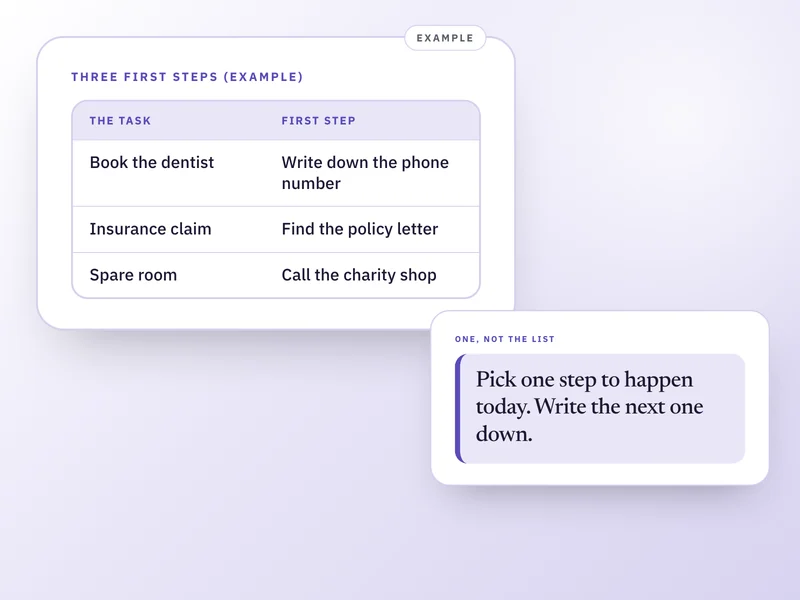
| The stuck task | What it feels like | The first physical step |
|---|---|---|
| The spare room | Too much, no starting point | Take one photo of the room from the doorway |
| A form for work | Dreading the first box | Open it and type your name and the date |
| The email you owe someone | Every opening line sounds wrong | Write "Hi [name]," and one true sentence, even a bad one |
| A bill you don't understand | Afraid of what it says | Put it on the desk and read only the total |
| Booking an appointment | Too many choices of day | Find the phone number and write down two days you could go |
| A project you dropped | Guilt about the gap | Find the file or box and put it where you'll see it |
If the first step still feels too big
It happens, and it doesn't mean you're doing it wrong. Usually one of three things is going on. Try them in this order.
Three ways to go smaller
- Shrink the step again. "Find the letter" too big? Try "walk to the room where the letter is". "Open the form" too big? Try "put the laptop on the desk". This sounds silly. That's the point: a step so small there's nothing to refuse.
- Change one thing about the setting before you touch the task. Stand up, move to another room, get a glass of water, eat something if you haven't. Child Mind Institute suggests checking basic needs like hunger, tiredness or the need for a change of scene. Then try the step you already picked.
- Ask someone to be nearby. Working next to another person, even in silence, helps some people begin. Child Mind Institute lists it as a strategy, called body doubling. It's worth trying, not proven for everyone. A text to a friend saying "I'm going to open the form now, can you stay on with me" is enough.
What can go wrong
You might do the step and feel nothing. Fine. The step counted, and the task isn't where it was. You might pick a new task every ten minutes and finish none. If that's happening, stay with one task for the whole ten minutes, and write it in your note so you meet it first tomorrow.
If you keep circling the same task in your head without starting, that's a slightly different problem, covered in why you keep thinking about a task and not doing it. If it's not one task but a whole pile, all late, use how to pick the first thing when everything is late instead of this page.
Ten minutes won't fix a pattern. If starting things is a constant, painful struggle, or it's getting in the way of your job, your health or your relationships, that's worth taking to a doctor or other clinician, who can look at the whole picture. The CDC says the first step is to talk with a healthcare provider, since there's no single test for ADHD. For what comes after, see diagnosed with ADHD as an adult: what happens next.
If nothing moves today
Then nothing moved today. The tasks are where they were, and the only thing you can protect is tomorrow's start. Leave a note that says what the first step would have been and where the paper is. Tomorrow you begin from that line, not from zero. For more on returning to something you dropped, see how to restart a project you gave up on.
Tonight, do one physical thing: put the paper or the laptop where you'll see it first thing.
Questions people ask
What is task paralysis?
It's a stuck feeling where you want to do something, know roughly what it is, and can't begin. Child Mind Institute describes ADHD paralysis as a powerful feeling of being frozen. It isn't an official symptom or a diagnosis by itself. It's a description of an experience, and different things can cause it, so this page sticks to what you can do about it.
How do you snap out of task paralysis?
Don't try to snap out of it. Shrink the task until the first step needs no decision. Pick one task, write the first physical step, and do only that for a few minutes. Opening the folder counts. If that's still too big, go smaller, change rooms, or ask someone to stay nearby while you start.
Is task paralysis the same as procrastination?
Not quite, though they overlap. Procrastination usually means choosing something more pleasant. Task paralysis tends to feel like being frozen with no pleasant alternative, and the delay is miserable. The fix differs too: pressure and deadlines can make the freeze worse, while a smaller first step often helps. See executive dysfunction is not procrastination.
Why can't I start even simple tasks?
A simple-looking task can hide several decisions: where to look, what to say, when to do it. A stall often sits in those hidden decisions, not in the effort. Writing the actual first move, such as finding the number, removes most of them. If it happens a lot and hurts your daily life, a clinician can help work out why.
How long should I work on a task when I'm stuck?
Up to ten minutes is a good ceiling, and you can stop earlier. The timer is there to make the start feel finite, not to make you finish. If you get going, keep going. If you don't, write one line about where you stopped and leave it for another day.
Is a to-do list good for task paralysis?
Usually not on its own. A long list makes you choose between rows every time you look, and a row like "sort insurance" gives no first move. One task with a written first step works better. More on that in why to-do lists make it worse.
Where a Companion can hold this for you
Alongside, the ADHD Life Companion, has a walkthrough for this exact situation, called Break something down. It asks what the thing is, what would be true when it's finished, and what the first physical step is, then optionally the next two, and which of them could happen today. One of them, not the list. The steps you aren't doing today go into Life, so you don't have to carry them in your head. It shows one thing at a time, and if you stop partway it changes nothing on the item.
Sources and how we checked
- Child Mind Institute: What Is ADHD Paralysis?: Description of the frozen feeling, that it is not an official ADHD symptom, and the basic needs, body doubling and chunking strategies.Checked 26 September 2026.
- CDC: About ADHD: First step is to talk with a healthcare provider; no single test for ADHD.Checked 26 September 2026.
Where to go next
 If this is where you areFirst physical step: 20 examples for stuck admin tasksStuck on what the first step even looks like? Twenty worked examples show how to shrink a task to something you could see happen.
- Executive dysfunction vs procrastination: the difference
If you wonder why willpower and deadlines do not help, this separates executive dysfunction from procrastination.
- Why you keep thinking about a task and not doing it
When you keep circling the same task in your head, this covers the gap between knowing and starting.
- Everything is overdue: how to pick the first thing
If it is not one task but many, all past their dates, this shows how to pick the first thing and stop for tonight.