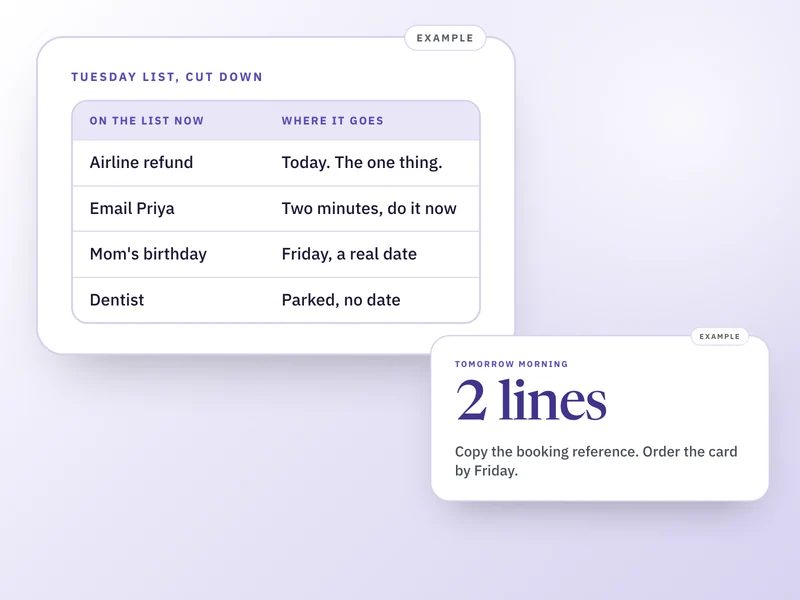
A to-do list stops working when it gets long enough that every look means choosing between rows, and when its rows name an outcome instead of a first move. Cut it to one physical first step for today, a date only where a real one exists, and park the rest out of sight.
This is for anyone whose list has become something to avoid, with ADHD or without. It can't tell you why your attention works the way it does, and it isn't medical advice.
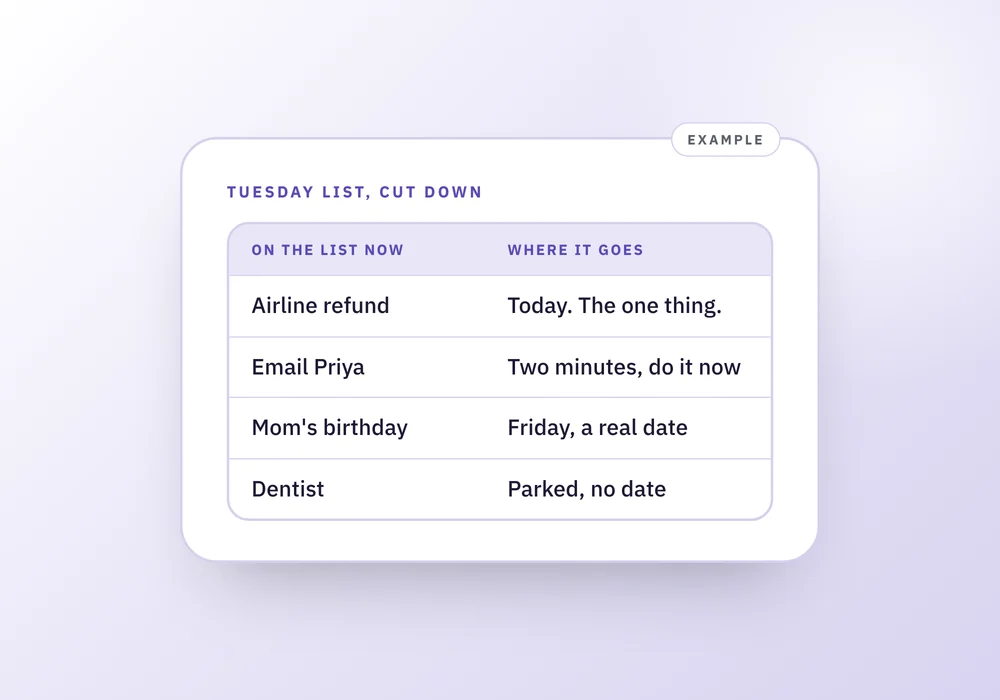
Example: one Tuesday list, before and after
Say you open your list at 9 a.m. and it says: Taxes. Dentist. Car. Mom's birthday. Spare room. Airline refund. Email Priya. Insurance. Laundry. Nine rows, no order, and you have known about most of them for weeks.
Here is the same list rewritten. The middle column is the only thing that changed about the words. The right column is what changed about where each one lives.
9 of 9 rows shown
Airline refund
- Rewritten as a first step
- Open the airline's email and copy the booking reference onto one line
- Where it goes
- Today. This is the one thing.
Email Priya
- Rewritten as a first step
- Send: "Can you confirm the 12th still works?"
- Where it goes
- Two minutes. Do it now, then it's gone.
Mom's birthday
- Rewritten as a first step
- Order a card by Friday
- Where it goes
- Friday is a real date, so it gets one.
Dentist
- Rewritten as a first step
- Call the office and ask for the first opening after the 15th
- Where it goes
- Parked. Pick a day to come back to it.
Car
- Rewritten as a first step
- Find the renewal notice and put it on the desk
- Where it goes
- Parked, no date.
Spare room
- Rewritten as a first step
- Carry the boxes by the door out to the hall
- Where it goes
- Parked, no date. It's ongoing, not one task.
Insurance
- Rewritten as a first step
- Write the claim number on one line where you can find it
- Where it goes
- Reference. It's a detail to keep, not a task.
Taxes
- Rewritten as a first step
- Open the folder and find last year's return
- Where it goes
- Parked, no date.
Laundry
- Rewritten as a first step
- Nothing. It's a habit, not a list item.
- Where it goes
- Off the list.
| On the list now | Rewritten as a first step | Where it goes |
|---|---|---|
| Airline refund | Open the airline's email and copy the booking reference onto one line | Today. This is the one thing. |
| Email Priya | Send: "Can you confirm the 12th still works?" | Two minutes. Do it now, then it's gone. |
| Mom's birthday | Order a card by Friday | Friday is a real date, so it gets one. |
| Dentist | Call the office and ask for the first opening after the 15th | Parked. Pick a day to come back to it. |
| Car | Find the renewal notice and put it on the desk | Parked, no date. |
| Spare room | Carry the boxes by the door out to the hall | Parked, no date. It's ongoing, not one task. |
| Insurance | Write the claim number on one line where you can find it | Reference. It's a detail to keep, not a task. |
| Taxes | Open the folder and find last year's return | Parked, no date. |
| Laundry | Nothing. It's a habit, not a list item. | Off the list. |
After ten minutes, what you look at tomorrow morning is two lines: copy the booking reference, and order the card by Friday. The other seven still exist. They just aren't asking you to choose among them every time you look.
Why a long list stops working
A list shows a two-minute email and a four-hour form as the same kind of row, so picking between them costs effort every time. The hard rows also stay while the easy ones pass through, which means an old list slowly becomes a record of what you keep avoiding.
And a row like "Airline refund" says what you want to be true, not what to do first. The first physical move is the part that was hard all along, and the list leaves it blank.
How to cut a long list down in ten minutes
Do this on one page or one screen, with a timer set for ten minutes.
- Copy everything onto one page, in whatever order it comes. Don't sort yet.
- Cross out what isn't a task: habits you do anyway, things you've decided against, things already done.
- Do anything that takes two minutes or less right now, and cross it out. ADDitude's list advice makes the same call: those never need to sit on a list.
- Rewrite each remaining row as a first step someone watching could see you do. Call, open, find, carry, send. This is the "next action" idea from Getting Things Done, and it's the whole trick. There are 20 examples in the first physical step.
- Pick one for today. Put its first step where you will see it, not at the bottom of the page.
- Give a date to the rows that have a real one: a deadline, an appointment, something you told someone. Leave the rest with no date at all.
- Move everything else to a second page. Tomorrow you'll only open it after today's one thing is done.
When this doesn't work
The parked page can turn into a second pile. If you open it every day to check, you've rebuilt the long list. Look at it once a week instead, as in a weekly reset that survives a bad week.
Another common snag is that rewriting the list becomes today's task. If it takes more than ten minutes, stop, and just do the first step of the item you most dread. And if you pick your one thing and still can't start it, the step is too big. Task paralysis: what to do in the next ten minutes shrinks it further.
If everything on the page is late and every row feels urgent, start with how to start when everything is overdue. If the whole system fell apart weeks ago, that is a different problem, and why you stop using planners covers how to come back to one.
One limit, said once: a short list is not a cure. If you already have a list that works, keep it. This is for the one you've stopped opening.
Questions people ask
Why don't to-do lists work for ADHD?
There isn't one reason, and this guide can't speak to a diagnosis. What people commonly describe is that a long list makes every row look equally urgent, hard items sit there for weeks, and rows say what should happen but not what to do first. The fix is the same either way: fewer rows in view, a physical first step, and dates only where they're real.
Why does my to-do list make me anxious?
A long list is a visible tally of everything undone, and the rows you've avoided longest are still on it every time you look. Cutting what you see to one thing for today, with the rest parked on another page, removes the daily tally without losing anything. If the anxiety is broader than your list, that is worth raising with a professional.
How many things should be on a to-do list for one day?
There is no proven number. We'd start with one thing, plus anything with a real date that day, as in the example above. If you finish the one, you can pick another. Starting with five usually rebuilds the same list you were trying to escape.
Is a paper list or an app better?
Neither wins by itself. What helps is how much you see at once and whether each row starts with something physical. A paper page with one line on it can beat an app showing forty rows, and an app that shows one item can beat a crowded notebook. Use whichever you'll actually open tomorrow.
What do I do with a to-do list that already has 50 items?
Don't rewrite all 50. Cross out what isn't a task, then pick the five you'd least like to be asked about and rewrite only those as first steps. Choose one for today and move the other 45 to a second page you open weekly. You can bring rows back as you get to them.
Where the Companion fits
The steps above work on paper. ADHD Life Companion does two of them for you. Now shows one thing at a time, chosen from what you already told it: a date you set, something you're waiting on, or something ongoing you left 14 or more days ago. When none of those applies, it says "Nothing needs you right now" and stops.
Life holds everything else in four separate groups: Something to do, Waiting on someone, Something ongoing, and Worth having to hand. Nothing is marked late and nothing is counted. Its "Break something down" walkthrough asks what the thing is, what would be true when it's finished, and the first physical step, then asks which could happen today, with the note "One of them. Not the list." It is a web app, not a list manager, so it doesn't hold everything, and it isn't treatment or medical advice.
Sources and how we checked
- Getting Things Done: What is GTD: The clarify step: decide the next action for each actionable item instead of leaving it vague.Checked 26 September 2026.
- ADDitude: ADD To-Do Lists: Two-minute tasks done immediately and kept off the list; specific task wording; large projects kept off the daily list.Checked 26 September 2026.
Where to go next
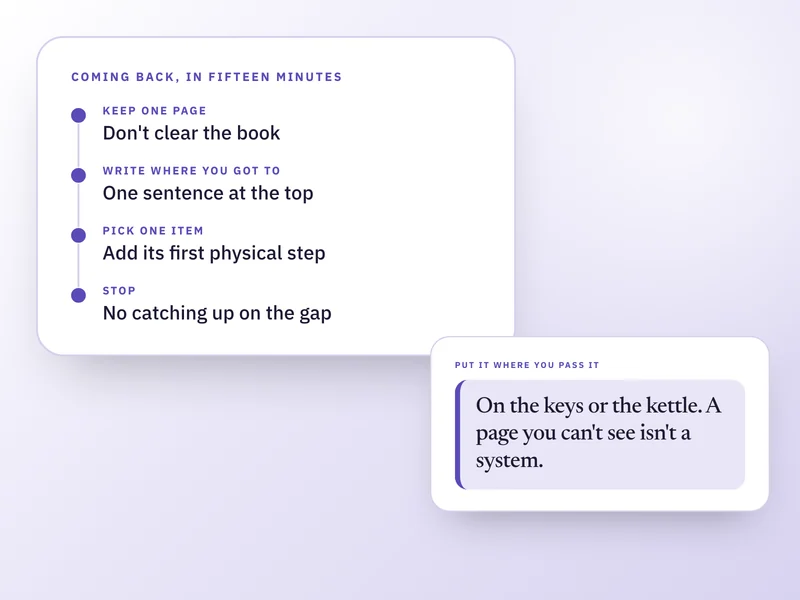 If this is where you areWhy you stop using planners, and how to come backLists are one kind of system that breaks. This explains why planners fail the same way and how to come back without starting over.
- ADHD task paralysis: what to do in the next ten minutes
When the list is not the problem and starting is, this ten minute way out shrinks the first step until it needs no decision.
- A weekly reset that survives a bad week
Instead of a longer list, a ten minute weekly reset picks one thing and lets a skipped week go.
- Why you keep thinking about a task and not doing it
If you keep rewriting the task without doing it, this explains the gap between knowing and starting and offers two questions.