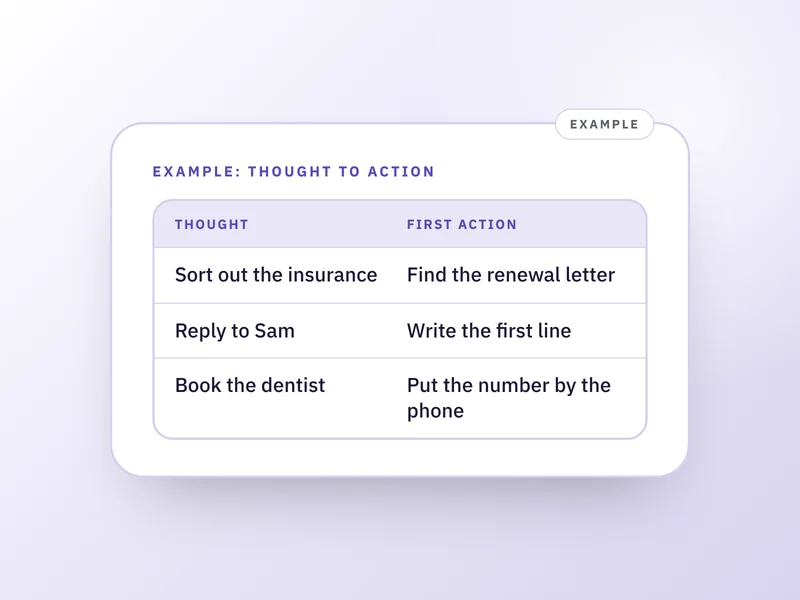
Attach one physical action to the thought, and one thing you need in front of you to do it. Two questions do that: what is the next physical action, and what would have to be on the table for me to do it? Then do the action, or give it a day and a time.
This is for one task that keeps coming back at eleven at night. It can't tell you why it loops for you, and if the worrying is constant and about everything, a clinician is the right person to ask.
Thinking about it is not starting it
Picture it. You've thought about the insurance renewal in the shower, in the car, and again in bed. Each time it arrives as the whole task: sort out the insurance. That phrase has no first move in it, so the thought has nowhere to go and comes round again. You haven't forgotten it, which is why a fresh list entry changes nothing. It was never off the list.
Starting also asks you to hold several things at once: what this is about, what you want to happen, two facts you'll need, and enough spare attention to think while someone talks to you. That's a lot to assemble at a bad hour. Many people find that gathering those conditions is the hard part, more than the task itself.
How to tell circling from moving
- You rehearse how they'll react
- You reword the task on your list
- The task is named by its outcome: sort out, deal with
- Nothing you could photograph has happened
- You can name a verb: find, open, write, call
- You know what paper or fact you need
- It has a day, or you're doing it now
- Someone watching could see it happen
Circling
- You rehearse how they'll react
- You reword the task on your list
- The task is named by its outcome: sort out, deal with
- Nothing you could photograph has happened
Moving
- You can name a verb: find, open, write, call
- You know what paper or fact you need
- It has a day, or you're doing it now
- Someone watching could see it happen
Example: three looping thoughts, worked through
Illustrations, not real cases.
Sort out the insurance
- Next physical action
- Find the renewal letter and read the date on it
- What needs to be in front of me
- The letter and this year's quote
I need to reply to Sam
- Next physical action
- Open the email and write: Sorry for the slow reply.
- What needs to be in front of me
- A decision: yes or no to Saturday
Book the dentist
- Next physical action
- Look up the number and stick it by the phone
- What needs to be in front of me
- Two days that work for me
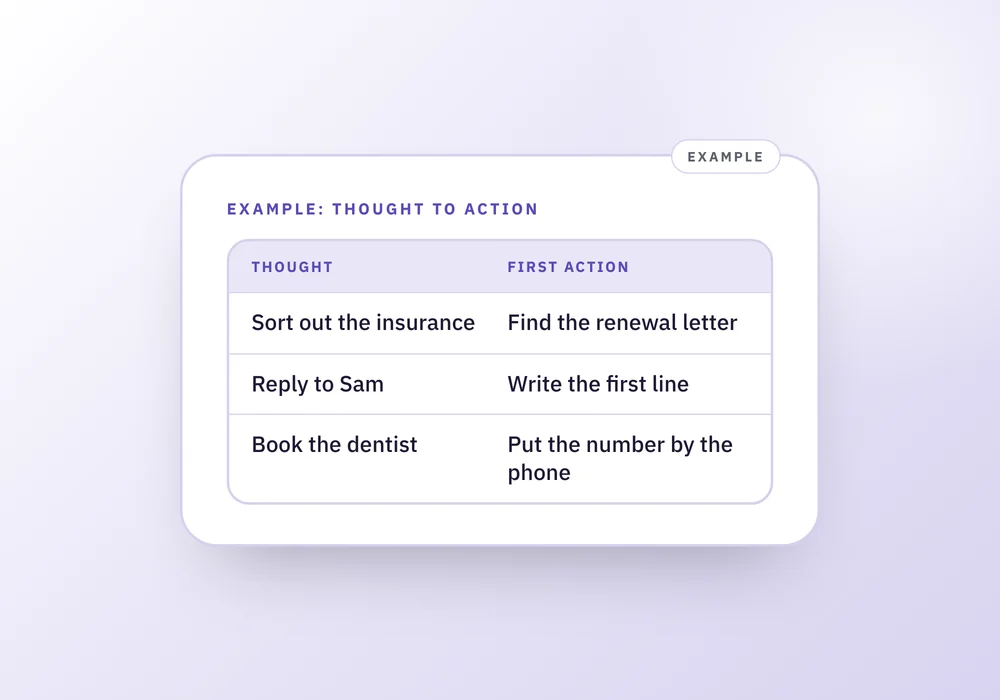
| The thought | Next physical action | What needs to be in front of me |
|---|---|---|
| Sort out the insurance | Find the renewal letter and read the date on it | The letter and this year's quote |
| I need to reply to Sam | Open the email and write: Sorry for the slow reply. | A decision: yes or no to Saturday |
| Book the dentist | Look up the number and stick it by the phone | Two days that work for me |
The two questions, step by step
- Say the thought as a task, out loud or on paper, in your own words. "The insurance thing" is fine.
- Ask: what is the next physical action? A phone call, opening a form, finding a document. Not deciding and not planning. If you can't name one, that is why it hasn't moved. First physical step: 20 examples has models to borrow.
- Ask: what would have to be in front of me to do that? Usually a reference number, a date, and a decision about what you want. Put them in one place, next to the action.
- Choose: now, or a specific day and time. If it's a day, write it where you'll see it that morning. "Sometime this week" leaves the thought looping.
- Then stop thinking about the rest. Finding the letter counts. You don't need to finish the renewal to have moved it.
What can go wrong
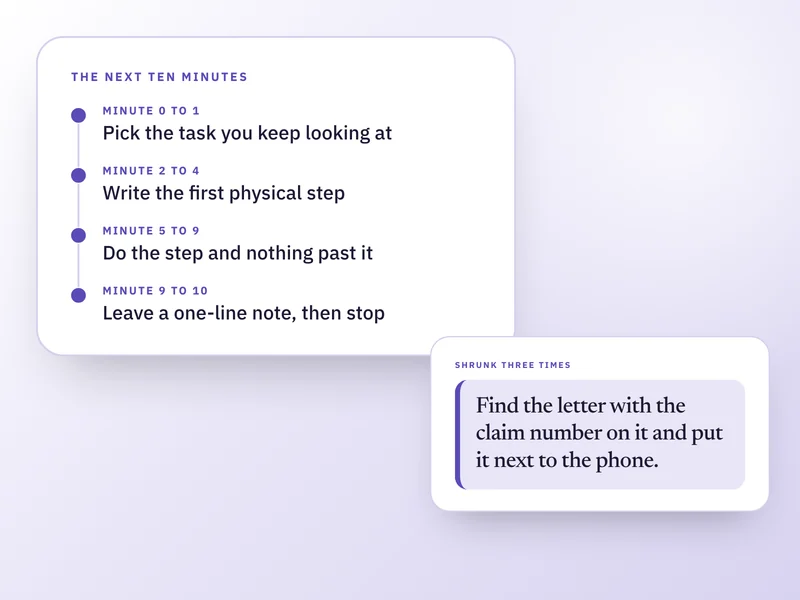
Sometimes the action is still too heavy to begin. That's a different problem from circling, and task paralysis: what to do in the next ten minutes is the guide for it. If the action is a call, how to make a phone call you have been avoiding covers the five things to write out first.
Sometimes the thought has picked up weight from how long it has waited, and starting feels like admitting the delay. How to deal with something you have put off has one-sentence lines for that. And if the thing lives on a list you keep rewriting, see why to-do lists make it worse.
One more limit. If the same thoughts keep you awake most nights, or spread to everything, tell a doctor or therapist. This guide covers admin that keeps coming to mind, and nothing beyond that.
Tell one person
If the step needs a decision, saying it aloud to a friend can speed it up: "I need to choose between the two plans by Friday." You're not asking them to fix it. Tonight, write the action on a sticky note and put it on the thing you'll touch first tomorrow.
Questions people ask
Why do I keep thinking about a task but not do it?
One common reason is that the thought has no first move attached. "Sort out the insurance" gives your mind nothing to act on, so it circles. Naming one physical action and what you need to hand often ends the loop. Persistent, wide-ranging worry is a question for a clinician.
Why can't I start a task I know I need to do?
Starting can mean holding the purpose, the outcome, some facts and spare attention all at once. That's a lot at the moment you try. Get the facts into one place and pick a first action small enough that starting isn't a decision, like opening the file.
Is this the same as task paralysis?
They overlap but feel different. Here you keep thinking about one task. In paralysis you may not be able to begin anything at all. The fixes overlap too: shrink the first step. The task paralysis guide covers the second case.
Does writing the task down help?
Only if the entry has a physical action in it. "Insurance" on a list is the same thought in a new place. "Find the renewal letter" is something you can do. Write the verb, not the topic, and note where the paper is.
When is it worth talking to a professional?
If the thoughts are constant, affect your sleep or work, or spread across everything, mention it to a doctor or therapist. A guide can help with the single stuck task. It can't work out why your mind behaves the way it does.
Where a Companion can hold this for you
Alongside, the ADHD Life Companion, has a walkthrough called Break something down. It asks what the thing is, what would be true when it's finished, and what the first physical step is, plus optionally the next two. Then it asks which of them could happen today: one of them, not the list. The steps you aren't doing today go into Life, so you're not carrying them in your head. If you give an item a date, it appears on the day you chose with the line "You said you would come back to this."
Where to go next
 If this is where you areADHD task paralysis: what to do in the next ten minutesWhen thinking about it has turned into being stuck, this is the main guide to getting unstuck in ten minutes.
- First physical step: 20 examples for stuck admin tasks
Twenty examples of a first step you could see happen, to replace the vague thought with something you can do.
- Executive dysfunction vs procrastination: the difference
If this looks like laziness from outside, this explains the difference between not starting and not caring.
- Why to-do lists do not work when starting is the problem
If the task lives on a list you keep rewriting, this explains three ways lists get in the way of starting.