Procrastination is putting something off even though you expect the delay to cost you, usually because something else feels better right now. Executive dysfunction is a plain-language label for trouble with skills like starting, planning and holding several steps in mind. The two overlap, and you can do both in one afternoon.
This is for anyone who keeps not starting things they do want done. It can't tell you why it happens or whether you have a condition, and it isn't medical advice.
An example: the same form, two different Tuesdays
Say a parking permit renewal is due Friday. It's a one-page form and you know where it is. On the first Tuesday you think about it, decide the game on your phone sounds better, play for an hour, and feel a small hit of relief followed by a small hit of guilt. That's what most people mean by procrastination: a choice, made with your eyes open, to trade later for now.
On the second Tuesday the form is on the desk. You sit down with it and nothing happens. You aren't enjoying anything else. You look at the first field, look at your phone, look at the form again, and forty minutes later you feel worse than when you sat down. Outside, the two Tuesdays look the same: the form wasn't touched. Inside, the second one is the kind of stuck that people often describe as executive dysfunction. This is an illustration, not a case.
How the two often differ
These are tendencies, not tests. Plenty of people land in the middle, and one person can be in either column on different days.
What you do instead
- Procrastination
- Something more appealing, on purpose
- Executive dysfunction
- Often nothing, or something you aren't enjoying
How it feels
- Procrastination
- Avoidance, with some relief
- Executive dysfunction
- Stuck, with little or no relief
Do the stakes help
- Procrastination
- Often, when the deadline gets close
- Executive dysfunction
- Often not, and for many people more pressure adds distress
Does breaking it down help
- Procrastination
- A little
- Executive dysfunction
- Often a lot, if the first piece is small enough to see
Where the trouble sits
- Procrastination
- Wanting to do it now
- Executive dysfunction
- Getting started, holding the steps, or sequencing them
| Procrastination | Executive dysfunction | |
|---|---|---|
| What you do instead | Something more appealing, on purpose | Often nothing, or something you aren't enjoying |
| How it feels | Avoidance, with some relief | Stuck, with little or no relief |
| Do the stakes help | Often, when the deadline gets close | Often not, and for many people more pressure adds distress |
| Does breaking it down help | A little | Often a lot, if the first piece is small enough to see |
| Where the trouble sits | Wanting to do it now | Getting started, holding the steps, or sequencing them |
Why the difference is not always clean
Executive function is the set of mental skills that let you plan, focus, hold information in mind, filter distractions and switch tasks. The Center on the Developing Child at Harvard compares it to an air traffic control system. Trouble with those skills is called executive dysfunction, but it is a description of a pattern, not a diagnosis of its own. ADDA says so directly, and lists ADHD, autism, depression, brain injury and several other conditions as common companions.
Procrastination research points in a similar direction from the other side. Piers Steel's 2007 review of 691 correlations found that the strongest predictors were how unpleasant the task is, how long the payoff is delayed, how confident you feel about doing it, impulsiveness, and organization and self-control. In other words, a task that is boring, unclear and far from any reward is easy to put off, and so is a task you don't feel able to organize. The same afternoon can contain both.
Five questions to ask yourself about today
You're not trying to name a condition. You're picking which kind of help to try first.
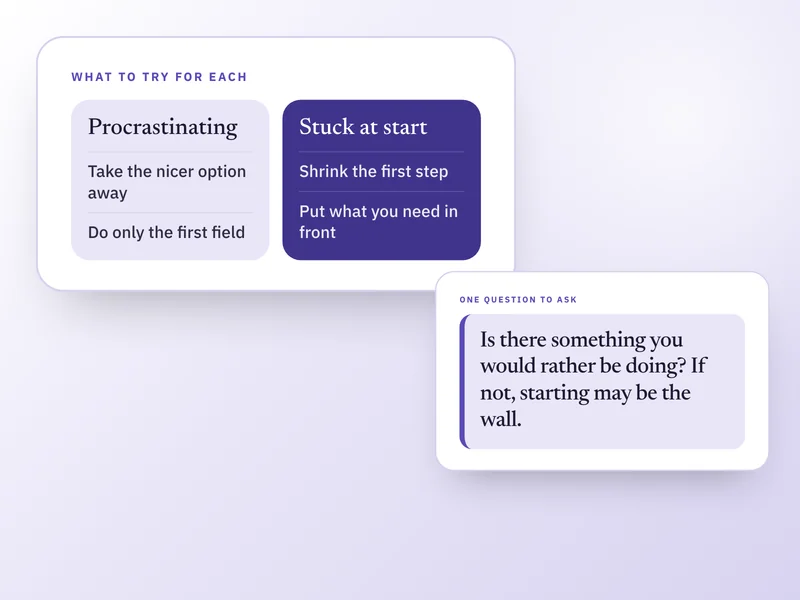
- Is there something you'd rather be doing? If yes, you're probably choosing. If you're doing nothing, or something you don't enjoy, starting itself may be the wall.
- Could you say the first physical action out loud, such as open the form or find the account number? If you can't, the task hasn't been broken down yet. Try twenty examples of a first step.
- Would a deadline in an hour get you moving? If it would, delay is more likely. If you'd sit there looking at it anyway, more pressure probably isn't the missing piece.
- Is it one task, or a pile? A pile is usually a sorting problem before it's a starting problem. How to start when everything is overdue covers that.
- Are you also short on sleep, ill, grieving or flat? Those change how much capacity you have on any given day, and a smaller first step is a fair response to all of them.
What to try for each
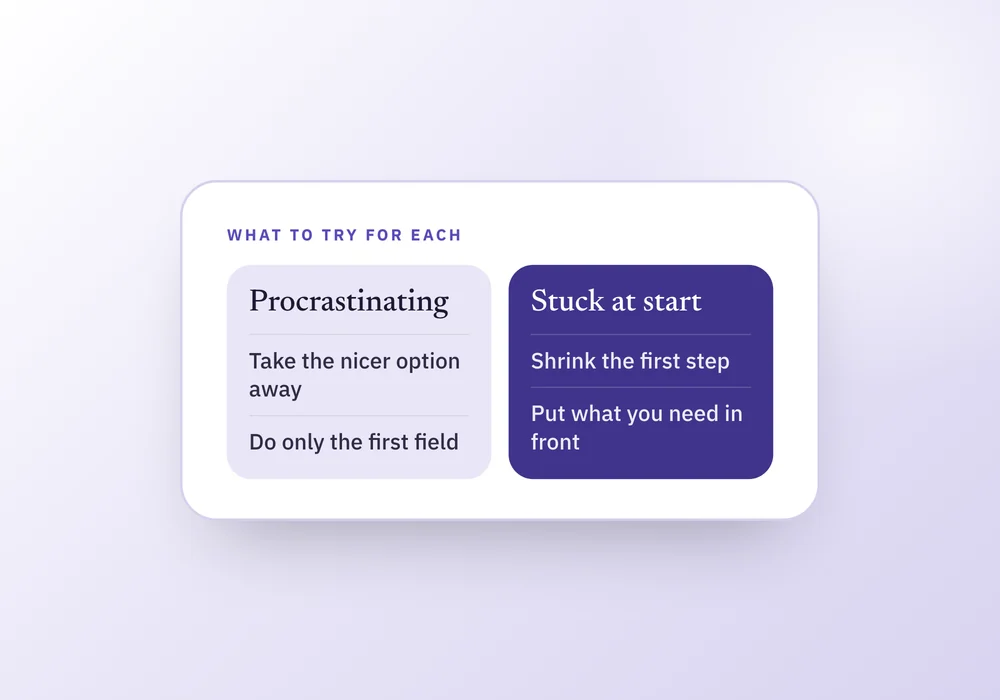
- Take away the nicer option for twenty minutes: phone in another room, tab closed.
- Make the unpleasant part shorter. Decide you'll do only the first field.
- Attach a small, real reward you'll actually give yourself afterward.
- Say the deadline to someone who will ask how it went.
- Shrink the first step until it's something a person watching could see: pick up the form, put it on top of the keys.
- Put what you need in front of you first: the reference number, the date, the letter.
- Remove decisions. Choose today's one thing and leave the rest out of sight.
- Stop when the small step is done. Doing more is allowed, not required.
If you're choosing something nicer
- Take away the nicer option for twenty minutes: phone in another room, tab closed.
- Make the unpleasant part shorter. Decide you'll do only the first field.
- Attach a small, real reward you'll actually give yourself afterward.
- Say the deadline to someone who will ask how it went.
If starting itself is the wall
- Shrink the first step until it's something a person watching could see: pick up the form, put it on top of the keys.
- Put what you need in front of you first: the reference number, the date, the letter.
- Remove decisions. Choose today's one thing and leave the rest out of sight.
- Stop when the small step is done. Doing more is allowed, not required.
When this doesn't work, and what to do about it
A smaller first step won't fix everything. If a task is stuck because you're afraid of what it will say, or because you're exhausted, you may need to deal with the fear or the exhaustion first, and the step may need to be a text to someone rather than the task itself. Shame also builds. The longer a thing sits, the more it feels like it says something about you, and that weight is real even when the task is small. Naming it once, then doing one tiny thing, usually costs less than waiting for the feeling to pass. Task paralysis: what to do in the next ten minutes walks through it.
If starting things has been this hard for months, is affecting your work, money or health, and isn't explained by a bad stretch, it's worth raising with a doctor or a mental health professional. They can look at what's behind it, which a guide can't. If you already have a diagnosis or suspect one, diagnosed with ADHD as an adult covers the paperwork side.
Questions people ask
Is executive dysfunction just an excuse for procrastinating?
No, but they can look the same and can happen together. Procrastination is a choice to delay something you expect to regret delaying. Executive dysfunction describes trouble with skills like starting and organizing. Either way, the useful question is what would lower the cost of starting today, not who is to blame.
Is executive dysfunction a real diagnosis?
Not on its own. Organizations such as ADDA describe it as a set of symptoms, not a medical diagnosis, and it shows up with ADHD, autism, depression, brain injury and other conditions. If you're worried about what's behind it, a doctor or mental health professional can assess that. This guide can't.
How do I know if I'm procrastinating or can't start?
Ask whether you'd rather be doing something else. If you're choosing something more pleasant, that leans toward procrastination. If you're doing nothing, or something you don't enjoy, and a deadline wouldn't move you, starting itself may be the barrier. It can be both, and it can change by day.
Why can't I start a task even when I know it's important?
Knowing it's important isn't the same as being able to begin. Starting takes holding the purpose, the first step and the materials in mind at once, and that is hard when you're tired, stressed or short on capacity. Many people find a tiny, visible first step easier than more urgency.
What helps when I can't get started?
Shrink the first step until it's something you could see happen, like finding the letter or opening the form. Put what you need in front of you, pick one thing rather than a list, and let yourself stop after it. If it's constant and hurting your life, talk to a professional.
Where the Companion fits
If the second Tuesday sounds familiar, ADHD Life Companion does the shrinking with you. You keep the thing once, and Now shows one card instead of a list. Choose Do this with me, and its Break something down walkthrough asks what the first physical step is, then asks which one could happen today, with the note that it's one of them, not the list. It doesn't diagnose anything, ask about symptoms or medication, or time you, and stopping partway leaves the item as it was.
Sources and how we checked
- Center on the Developing Child, Harvard University: InBrief, Executive Function: Plain description of executive function skills (focus, holding information, filtering distractions, switching); air traffic control comparison.Checked 26 September 2026.
- ADDA: Executive Function Disorder and ADHD: Executive dysfunction is not a medical diagnosis; list of associated conditions; task paralysis description.Checked 26 September 2026.
- Steel, P. (2007). The nature of procrastination. Psychological Bulletin 133(1), 65-94 (University of Calgary record): 691 correlations; strongest predictors task aversiveness, delay, self-efficacy, impulsiveness, self-control and organization.Checked 26 September 2026.
- NIMH: Attention-Deficit/Hyperactivity Disorder: ADHD inattention described as trouble staying on task or organized, often continuing into adulthood; symptoms can interfere with daily life.Checked 26 September 2026.
Where to go next
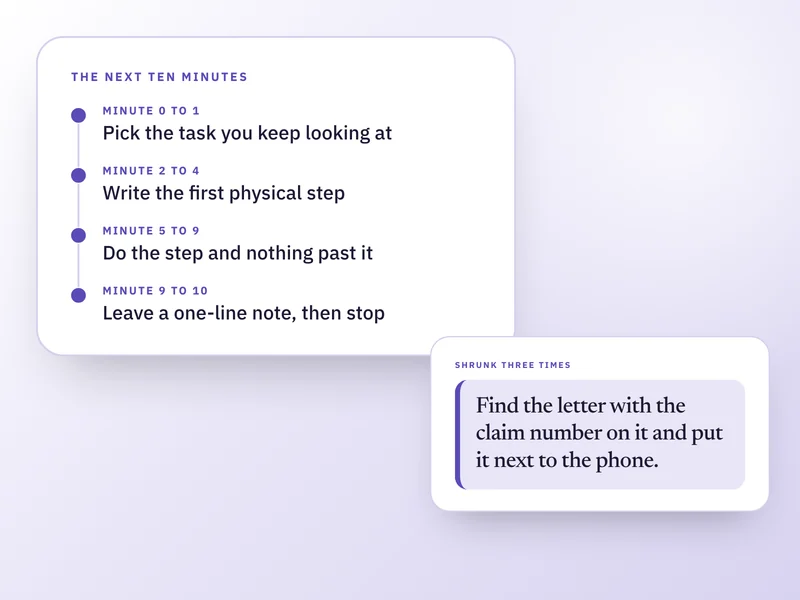 If this is where you areADHD task paralysis: what to do in the next ten minutesTo act on this rather than just understand it, this is the ten minute way out when you cannot begin.
- Why you keep thinking about a task and not doing it
If you keep thinking about the task without starting, this looks at that gap and two questions that help.
- First physical step: 20 examples for stuck admin tasks
Examples of first steps that lower the cost of starting, for calls, forms and documents.
- Diagnosed with ADHD as an adult: the admin that follows
If this sounds familiar and you have just been diagnosed, this covers the admin that follows.