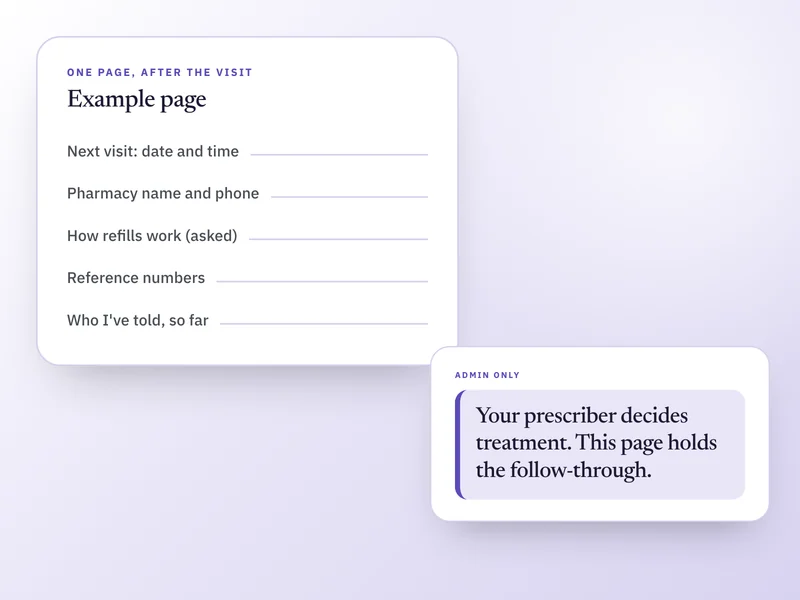
In the first month after an adult ADHD diagnosis, three things need a home: the follow-up dates, the pharmacy and prescription details, and the reference numbers for every office involved. Put them on one page, treat any repeat-prescription cycle as an appointment with a date, and write your own history down once so you don't rebuild it in every waiting room.
This is admin help for adults in the United States. Pharmacy, insurance and workplace rules differ by state and by country. It can't tell you what to take, whether to tell your employer, or what your rights are, and it isn't medical advice. Your prescriber decides treatment and the schedule that goes with it.
What a diagnosis changes, and what it doesn't
The CDC says ADHD symptoms start in childhood and often last into adulthood, that there's no single test for it, and that the first step is talking to a healthcare provider. The NIMH lists medication and psychosocial treatments such as cognitive behavioral therapy among the standard ones. What you're prescribed, if anything, is between you and your prescriber, and this guide has no view on it.
What it does have a view on is the part no one hands you at the end of the appointment: a diagnosis creates work. Follow-up visits, a pharmacy relationship, forms, and the same history told to several offices that can't see each other's records. None of that is treated for you by the diagnosis, and the backlog you already had doesn't clear itself. Many people notice the irony that the process asks for administration on a schedule, with real consequences for missing a step. Struggling with it isn't evidence that you're handling the diagnosis badly.
The first month, in order
Nothing here is a deadline set by anyone. It's an order that keeps the costly steps early.
Before you leave the visit
Ask how follow-ups and refills work, and when the next visit is. Write the answers down there and then.
The same day
Put the next appointment in your calendar with the time you have to leave, not just the time it starts.
Within a week
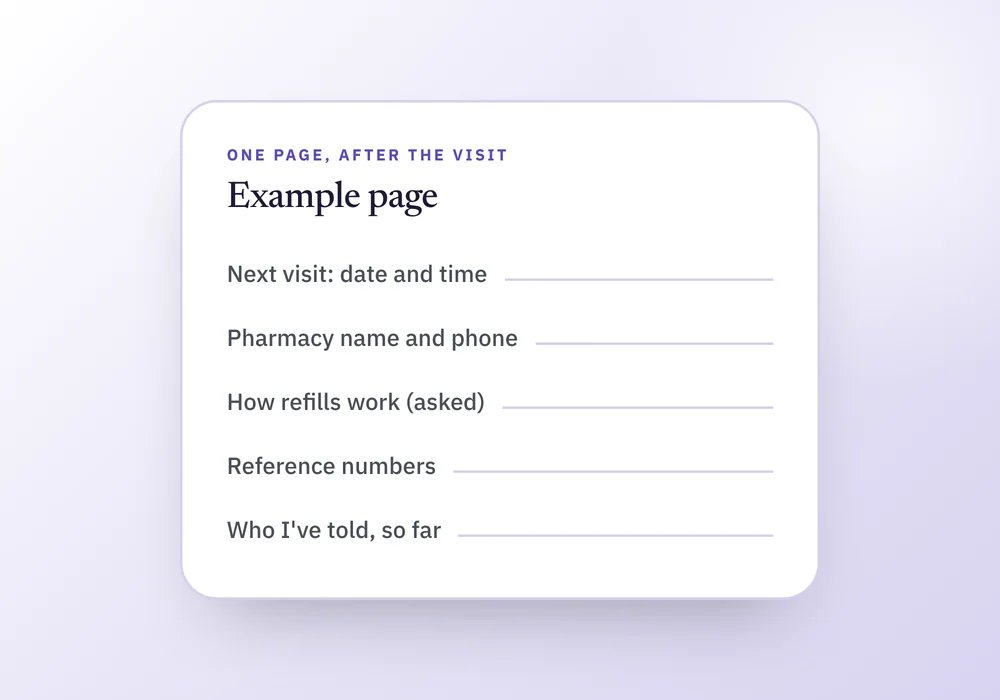
Fill in the one page below. Call the pharmacy, if you're using one, and ask how it handles your prescription.
Within two weeks
Ask your insurer how visits and prescriptions are covered. Write down the name and reference you're given.
Within a month
Decide who you want to tell, and how. There's no deadline on this.
Example: the one page, filled in
An illustration, not a real account. Every line here is something you'd otherwise be asked for over the phone by someone who can't see the last office's notes.
Next appointment
- Example
- October 14, 9:30. Leave by 8:45. Bring the current list of questions.
Prescriber's office
- Example
- Phone number and hours. Patient number, from the portal or the card.
Pharmacy
- Example
- Name, phone and hours, and the one person you asked about refills.
How refills work (as I was told)
- Example
- Written from the answer you got, with the date you asked.
Reference numbers
- Example
- One line per office: clinic, pharmacy, insurer.
Who I've told so far
- Example
- Names only. Add to it if you decide to tell more people.
| On the page | Example |
|---|---|
| Next appointment | October 14, 9:30. Leave by 8:45. Bring the current list of questions. |
| Prescriber's office | Phone number and hours. Patient number, from the portal or the card. |
| Pharmacy | Name, phone and hours, and the one person you asked about refills. |
| How refills work (as I was told) | Written from the answer you got, with the date you asked. |
| Reference numbers | One line per office: clinic, pharmacy, insurer. |
| Who I've told so far | Names only. Add to it if you decide to tell more people. |
Questions to ask before you leave
Logistics only. Your prescriber can answer these, and the answers are worth writing on the page in your own words.
6 things to do
Ticks are for this visit only. Nothing here is saved anywhere.
Treat the repeat cycle as an appointment
Depending on what you're prescribed and where you live, refills may need a new prescription or a visit each time. Ask your prescriber and pharmacy how yours works. Whatever the answer, give the cycle a date on the calendar, not a vague intention to remember. It has a date and a consequence, and vague remembering doesn't hold up against either.
Work backwards. If the pharmacy needs a few days, and the office needs a few more, put the first date where you'll see it a week earlier. If you do run short, call the prescriber's office and the pharmacy the same day and ask what the options are. Don't change anything yourself. For putting the leave time into a calendar, planning when you cannot feel time pass has more.
Write your history once
You'll be asked to repeat your history to several professionals. Written down once, it stops being something you reconstruct while sitting in front of someone. Keep it to facts: the year, the clinician or clinic, what was assessed, and what happened. Skip interpretation. You can always say more in the room, and the page gets you started when your mind goes blank.
The choices that have no deadline
Whether to tell an employer is yours to decide. If you're thinking about it, ask HR how workplace adjustments are handled before you decide, because the process differs by employer. Insurance may ask questions on applications or renewals. Read what's asked before you answer, and ask the insurer if you're unsure what a question means. Some places have driving or licensing rules that could apply to you, so check your local rules. And if records from a private assessment have to reach a public system, or the other way round, don't assume it happens automatically. Ask who sends what.
The backlog doesn't clear
A diagnosis can explain the pile without removing it, and there's often a stretch of disappointment when that becomes clear. What tends to change is the approach: less trying harder, more building around the difficulty. The things that have sat longest are covered in how to deal with something you have put off. A pile of unopened mail has its own order in the paperwork pile. If a missed due date is the recurring cost, why you keep missing bill due dates sets up a check that doesn't rely on remembering. If starting is the barrier, executive dysfunction is not procrastination is the place to begin, and if illness or grief is also in the picture, life admin with brain fog builds for the bad day.
Questions people ask
What do I do after being diagnosed with ADHD as an adult?
Follow your clinician's advice on treatment. On the admin side, get the next visit date, learn how refills work, and put your prescriber's, pharmacy's and insurer's details on one page. Add the follow-up dates to your calendar. Take the rest slowly. Some of it, like telling an employer, is your decision and has no deadline.
What admin comes with an adult ADHD diagnosis?
Follow-up appointments, a pharmacy relationship if you're prescribed medication, insurance questions, possible workplace conversations and, in some places, driving or licensing rules. You may also need records to move between private and public systems. Ask your prescriber and insurer about their processes. Local rules decide the details.
How do I keep track of repeat prescriptions?
Ask your prescriber and pharmacy how yours works, then put the refill cycle in your calendar as an appointment, with a date a week or so before you need it. Write down who you asked and what they said. If you run short, call both offices the same day and ask what the options are.
Should I tell my employer about my ADHD diagnosis?
That's your decision, and it isn't one this guide can make for you. If you're considering it, ask HR how workplace adjustments work before you decide, since processes and legal protections differ by employer and by country. You don't need to decide during the first month.
Can ADHD really be diagnosed in adulthood?
Yes. The CDC says ADHD symptoms start in childhood and often last into adulthood, and that there's no single test. A healthcare provider can assess whether your symptoms fit, since other conditions can look similar. Only a clinician can say whether ADHD applies to you.
Where the Companion fits
ADHD Life Companion holds the follow-through, not the medical side. Book an appointment and be ready for it asks who it's with, whether it's booked, and what you want to come away with, then lists what to bring on the day. Life keeps what you're carrying in four groups, including Worth having to hand for a reference number you'll need again. A date you choose can trigger a reminder if you switch reminders on. They're off by default, arrive by web push, and only cover dates you set. It has no field for a diagnosis, medication or symptoms, so keep prescription details on your own page. It isn't a diagnosis, a treatment or medical advice.
Sources and how we checked
- CDC: About ADHD: Symptoms start in childhood and often last into adulthood; no single test; the first step is to talk with a healthcare provider.Checked 26 September 2026.
- NIMH: Attention-Deficit/Hyperactivity Disorder: Standard ADHD treatments include medication and psychosocial interventions such as cognitive behavioral therapy.Checked 26 September 2026.
Where to go next
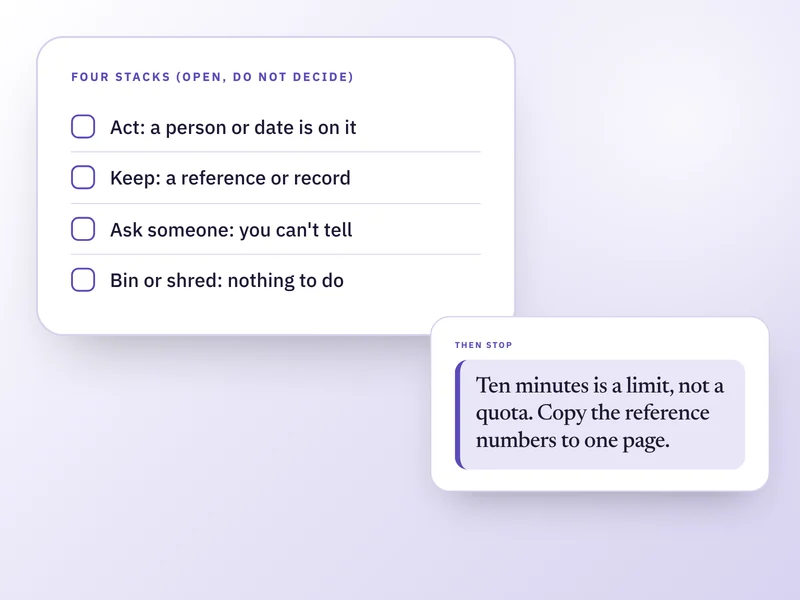 If this is where you arePaperwork pile you are avoiding: where to startAfter a diagnosis comes paperwork; this shows how to open and sort a pile without deciding anything in a hurry.
- Executive dysfunction vs procrastination: the difference
To understand why starting is hard, this explains executive dysfunction and how it differs from procrastination.
- Why you keep missing bill due dates (and a better system)
Missed due dates are a common cost of stalled admin; this sets up a system that does not rely on remembering.
- Life admin with brain fog: long covid, illness, grief
If illness or grief is also in the picture, this builds life admin around the bad day, not the good one.