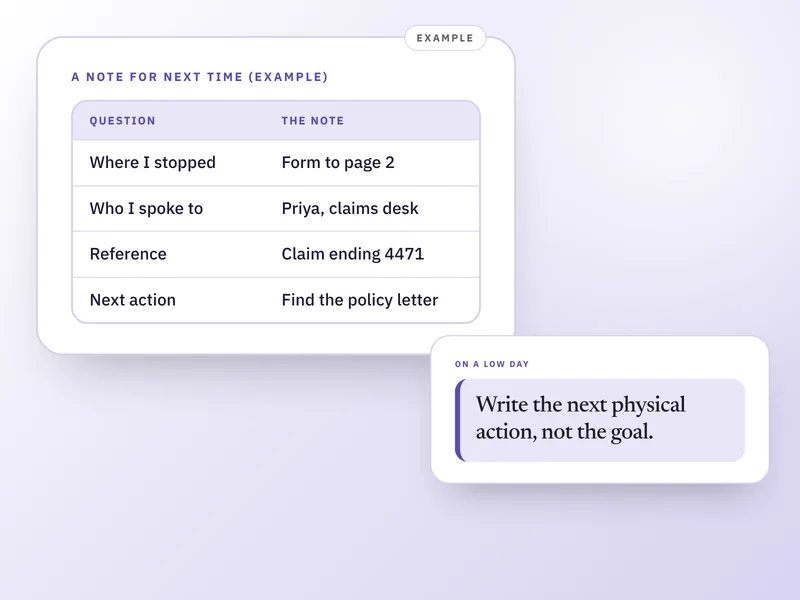
Build your admin for the bad day, not the good one. Write the next physical action instead of the goal, leave a note each time you stop, keep reference numbers on paper, and save the tasks that need a clear head for the days you have one. None of it depends on knowing why your thinking has become unreliable.
This is for stretches when a plan you used to hold in your head no longer stays put: long covid, a concussion, chronic illness, grief, new parenthood, menopause, depression. It can't tell you what's causing yours, and it isn't medical advice. If it's new, lasting or worrying, a clinician is the right person to ask.
Why intermittent is harder than absent
If your capacity were simply lower, you'd adjust once and get on with it. The difficulty is that it varies, sometimes without warning. Long covid is one example: the CDC notes its symptoms can emerge, persist, resolve and reemerge over weeks, months and even years. A plan made on a good Tuesday assumes a version of you that may not turn up on Thursday.
So treat a good day as a bonus, not the baseline. Plan against the bad day, and if the good one arrives, spend it on the one thing that needs a clear head.
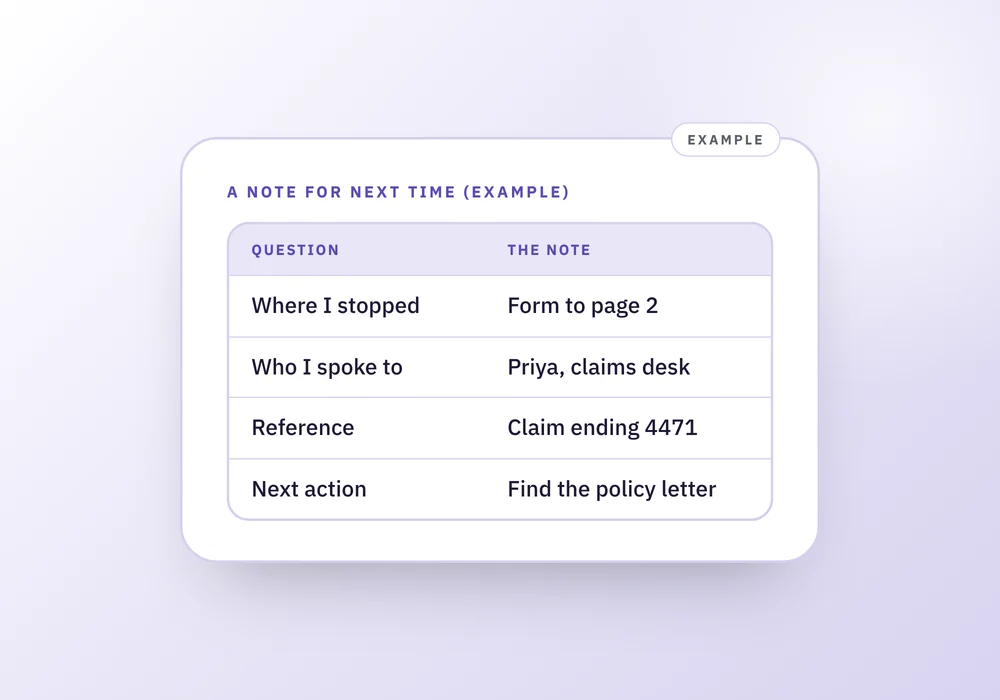
Example: a note for next time
An illustration, not a real account. Say you're partway through an insurance claim and your head goes flat at 2 p.m. Write this before you stop, and you won't have to rebuild anything tomorrow.
Where I stopped
- The note
- Form filled to page 2. Page 3 needs the policy number.
Who I spoke to
- The note
- Priya, claims desk, Monday at 11.
Reference
- The note
- Claim number ending 4471.
What I already tried
- The note
- Website login failed twice. Phone line was faster.
Next physical action
- The note
- Find the policy letter in the blue folder.
| Question | The note |
|---|---|
| Where I stopped | Form filled to page 2. Page 3 needs the policy number. |
| Who I spoke to | Priya, claims desk, Monday at 11. |
| Reference | Claim number ending 4471. |
| What I already tried | Website login failed twice. Phone line was faster. |
| Next physical action | Find the policy letter in the blue folder. |
Six adjustments
You don't need all six. Start with the first two.
- Put the details outside your head. Not a task list, but the things you'd otherwise hold: reference numbers, what you've already tried, who you spoke to and when. Paper by the phone works. So does one page per matter.
- Write the next physical action, not the goal. "Call the number on the letter" is doable on a low day. "Sort out the insurance" is not. The first physical step, with examples has twenty to copy.
- Record where you stopped, every time. Rebuilding where you were is the most expensive part of any restart, and the easiest to skip. Use the five lines in the example above, or fewer.
- Sort tasks by how much they ask of you, not by importance. See the two columns below.
- Expect to repeat yourself. Institutions will ask the same questions across four different people, so keep your notes where you can read them off.
- Don't add a second job. Anything that needs daily upkeep to stay accurate will fail during the stretch you need it most, and then hand you a repair task. Test a system by asking what happens after three weeks of ignoring it. Some stay roughly right. Others turn misleading and want an hour before they help again.
Two sizes of task
Some jobs need a clear head, and some don't. Keep both kinds ready so a poor day still has something in it.
- A call with a stranger
- A form with numbers on it
- A decision with money in it
- Anything you'll have to explain
- Open one envelope
- Copy a number onto the page
- Put the letter by the phone
- Write today's stopping note
Needs a clear head
- A call with a stranger
- A form with numbers on it
- A decision with money in it
- Anything you'll have to explain
Fine on a foggy day
- Open one envelope
- Copy a number onto the page
- Put the letter by the phone
- Write today's stopping note
Phone calls are the hardest single job
A call asks you to process, remember and speak all at once, and many people find it harder when thinking is affected. A call that would once have been trivial can become the hardest thing in a week. Preparation helps here more than anywhere, because it turns a live task into reading. Write the five things first, as described in making a phone call you have been avoiding, and keep the page in front of you.
Lines for when the call gets away from you
Put these at the bottom of your page. You can use every one of them.
Pick the one you are facing
“Sorry, I lost my place. Can you repeat the last part?”
“Could you slow down? I'm writing this down.”
“Can you send that to me in writing, so I can go through it after we hang up?”
“I gave those details to your colleague. Can you see the notes on the account?”
“I need to stop here. Can I call back, and who should I ask for?”
When it doesn't work
Some days nothing here will be within reach, and that's not a failure of the method. On those days the whole job is the stopping note: where you are, and the next physical action, in one line. If the fog is lasting, getting worse or new, take it to a clinician. The CDC advises talking to a healthcare provider about long covid symptoms that last for months after an infection, and nothing in an admin guide replaces that.
If starting is the barrier however you feel, executive dysfunction is not procrastination covers how to lower the cost of starting. For a week that has already fallen apart, a weekly reset that survives a bad week keeps the minimum small. If an ADHD diagnosis is part of your picture, diagnosed with ADHD as an adult covers the admin that follows.
Ask one person to know where the page is
If you live with someone, or have one person you trust, tell them where the notes are kept. They don't need to manage anything. If a bad week turns into a bad month, knowing where to look is the whole help, and it saves you explaining from scratch while you're depleted.
Questions people ask
How do I manage life admin with brain fog?
Move the details out of your head and onto paper. Write the next physical action instead of the goal, leave a stopping note each time, and save calls and forms with numbers for your clearer days. Choose tools that still work after three weeks of being ignored. None of this needs a diagnosis.
How can I remember appointments and deadlines with brain fog?
Don't rely on remembering. Write each date where you'll see it without looking, such as beside the phone or on a fridge page, and put the reference number next to it. Add a note of what to bring. If you use reminders, set them for the day you need to act, not the day the thing happens.
Why are phone calls so hard with brain fog?
A call needs you to listen, remember, speak and write at the same moment, with no way to pause. That's a lot to hold when your thinking is affected. Preparing a page first turns the live task into reading, and asking someone to slow down or repeat is always fair.
Is brain fog a symptom of long covid?
Some people describe trouble thinking after long covid, a concussion or during illness or grief. What's behind yours is a question for a clinician. The CDC advises talking to a healthcare provider if symptoms last for months after an infection, and says long covid symptoms can come and go.
Do I need a diagnosis to use these methods?
No. The difficulty of holding a plan in your head is the same to deal with whatever causes it, and none of these adjustments depend on the cause. A diagnosis, if you're seeking one, is a separate conversation with a clinician.
Where the Companion fits
In ADHD Life Companion, the stopping note is built into the walkthroughs. If you leave one halfway, it reopens at the question you left, with your earlier answers still there. A Made progress outcome asks what's worth remembering and shows it back to you when you return, in a Where you left off panel. Life keeps what you're holding in four groups, including Worth having to hand for a reference number you'll need again. It asks nothing about a diagnosis, medication or symptoms, and it has no daily upkeep, so ignoring it for three weeks leaves it as it was. Nothing in it is marked late, and Did not get to it changes nothing on the item. It isn't a treatment or medical advice.
Sources and how we checked
- CDC: About Long COVID: Long COVID symptoms can emerge, persist, resolve and reemerge over weeks, months and years; talk to a healthcare provider if symptoms last for months after an infection.Checked 26 September 2026.
Where to go next
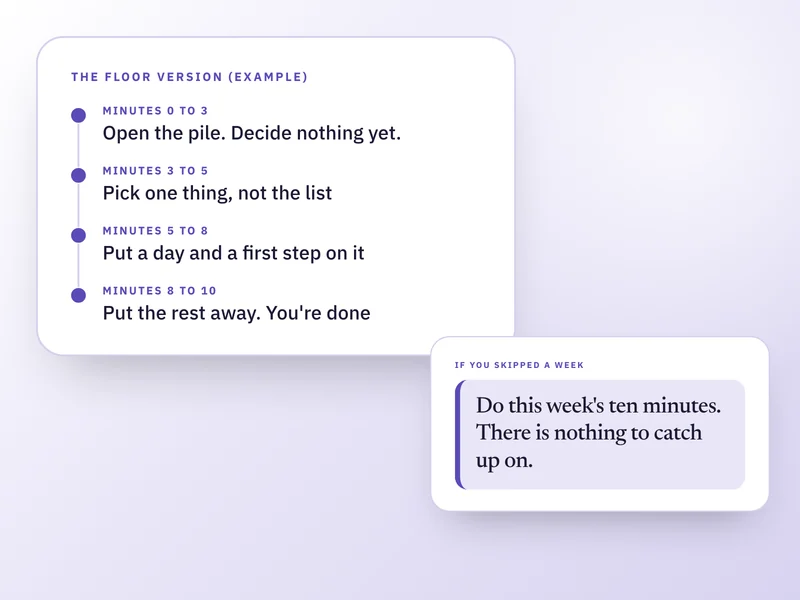 If this is where you areA weekly reset that survives a bad weekFor days when planning falls apart, a ten minute weekly reset that needs no catching up fits a bad week.
- Executive dysfunction vs procrastination: the difference
If starting is the barrier whatever the cause, this explains executive dysfunction and how to lower the cost of starting.
- First physical step: 20 examples for stuck admin tasks
Concrete first steps you can copy on a day when holding a plan in your head is unreliable.
- Diagnosed with ADHD as an adult: the admin that follows
If an ADHD diagnosis is part of your picture, this covers the appointments, records and backlog that follow it.