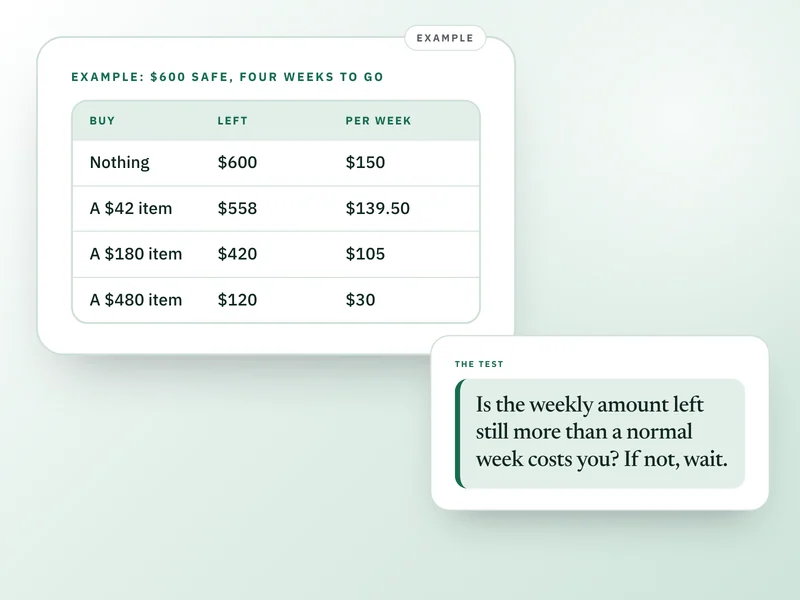
You can afford it if, after you subtract the price from your safe-to-spend money, the amount left per week until payday is still more than a normal week costs you. Start with your balance minus the bills due before payday, subtract the price, divide by the weeks left, and compare. It takes about thirty seconds.
This is for everyday purchases, in US dollars, from a pair of shoes to a repair. A car or a house needs a lender's calculator and a longer look. It can't see spending you haven't entered, and it isn't financial advice.
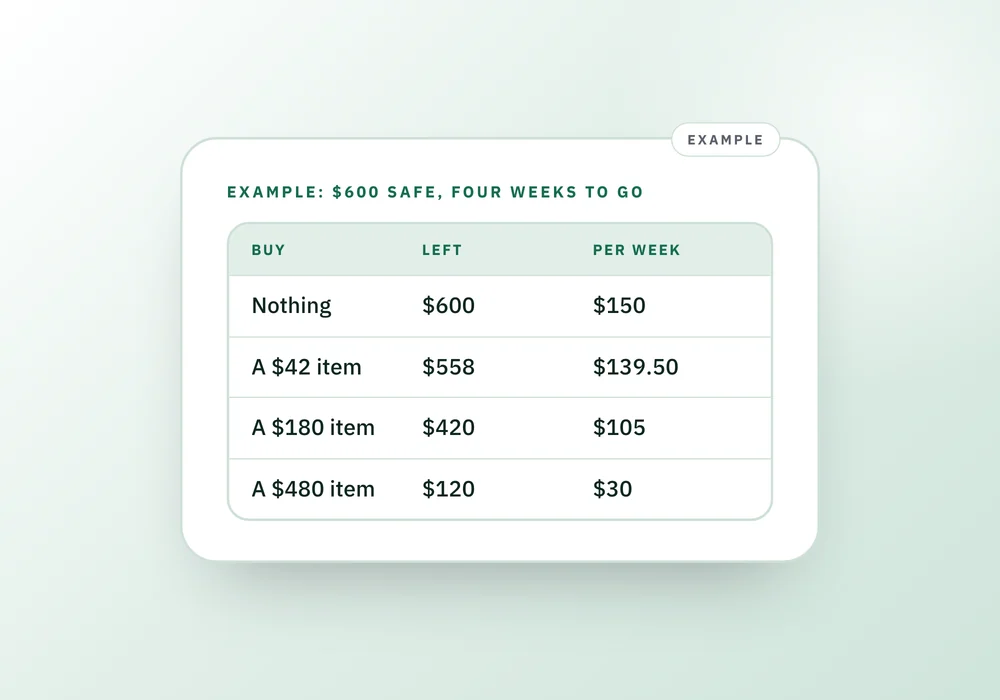
An example: $600 safe to spend, four weeks to payday
Say you have $1,850 available. Bills due before payday come to $900 and you're holding back $350 you don't want to touch, so your safe-to-spend figure is $600. Payday is four weeks away. A normal week of groceries, fuel and small things costs you about $110. These figures are an illustration, so swap in your own.
Nothing
- Left to spend
- $600
- Per week, over 4 weeks
- $150
- Against a $110 week
- Room to spare
A $42 item
- Left to spend
- $558
- Per week, over 4 weeks
- $139.50
- Against a $110 week
- Fine
A $180 item
- Left to spend
- $420
- Per week, over 4 weeks
- $105
- Against a $110 week
- A little short
A $480 item
- Left to spend
- $120
- Per week, over 4 weeks
- $30
- Against a $110 week
- No, not before payday
| If you buy | Left to spend | Per week, over 4 weeks | Against a $110 week |
|---|---|---|---|
| Nothing | $600 | $150 | Room to spare |
| A $42 item | $558 | $139.50 | Fine |
| A $180 item | $420 | $105 | A little short |
| A $480 item | $120 | $30 | No, not before payday |
The $42 purchase barely moves anything. The $180 one leaves $105 a week, which is under your normal $110, so you'd feel it by week three. The $480 one leaves $30 a week, and that's a no for today. It might be a yes after payday, or with a plan to save for it.
The check, in five steps
- Work out your safe-to-spend money: the available balance, minus every bill and payment due before your next payday, minus anything you're holding back. The full method is here, and if your banking app's balance looks higher than what you really have, this explains why.
- Subtract the full price, including tax and shipping.
- Divide what's left by the weeks until payday. Count the days and divide by seven, rounding to the nearest half week.
- Compare that weekly figure with a normal week for you. Add up groceries, fuel and small purchases from the last two or three statements. If the leftover is lower, you can't afford it today.
- Look for an annual or quarterly bill that lands before payday and isn't in your sum yet, such as insurance or a renewal. Sinking funds are how you stop those from breaking the check.
If it's close, wait for payday
We'd wait when the answer is close and the purchase isn't urgent. Waiting until after payday costs nothing, and the number gets bigger without you doing anything. If it can't wait, like a repair, then the question changes to what you can move. How to find $200 this month lists specific ways to free up cash.
Splitting the payment doesn't shrink the price
A buy now, pay later plan splits the cost. The CFPB describes one common version as four interest-free payments two weeks apart, with the first sometimes due at checkout. Say a $180 item comes as $45 today and $45 at two, four and six weeks. Today's number falls by $45, and each of the next three paydays is $45 lower.
Test the full price against the whole schedule, not the first payment. Then add each installment to your bills list on its date. The CFPB notes that most of these plans charge late fees for a missed payment, and that a bank may charge an overdraft fee if an automatic payment fails.
When the number misleads
- Your safe-to-spend figure is old. A number from three weeks ago is a guess. Redo the sum before a big purchase.
- You forgot a bill. Annual charges are the usual culprit, and a bills list that includes them fixes it.
- Your pay isn't steady. Use your lowest recent month, not the last good one. Budgeting with irregular income shows how.
- The item has a cost after you buy it, such as a subscription, accessories or upkeep. Add those before you divide.
- You're paying with a credit card. The card doesn't change the answer. It moves the cost to a payment you'll owe later, so count that payment as a bill on its date.
Questions people ask
How do I know if I can afford something?
Subtract everything due before your next payday and any money you're holding back from your available balance. Take off the price. Divide what's left by the weeks until payday, and compare it with what a normal week costs you. If the leftover is lower than a normal week, it's too much for now.
How do I figure out how much I can spend each week?
Take your safe-to-spend money and divide by the weeks left until payday. It's plain arithmetic, not a forecast, so it's only as good as the bills you counted. Check it against last month's real grocery and fuel spending, because your instinct for a normal week is usually close.
Is buy now, pay later a good way to afford something?
It changes when you pay, not how much. Test the full price against every payment date, and add each installment to your bills. The CFPB notes that most plans charge late fees, and a failed automatic payment can trigger a bank overdraft fee. Only use one if every payment fits.
Should I use my savings to buy something I want?
That's your call, and it depends on the job the money already has. Emergency savings and money set aside for a known cost already have a purpose, so spending them creates a new gap. Money you saved specifically for this item is what it's for. Choose which pot before you buy, not after.
Can I use this for a car or a house?
No. Those come with loans, insurance, taxes and upkeep that stretch across years, and this check only looks to your next payday. Use a lender's calculator for the loan, then test the monthly cost against your bills list. This guide is for the everyday purchase.
Where the Companions fit
Monthly Money Reset is free and shows this arithmetic. You type in the money you have now, your income and your bills, and it shows one safe-to-spend figure with every line of the sum. Its Quick add screen previews what a spend would change before you record it, such as from $600.00 to $558.00 after a $42.00 spend. It also shows an About $X a week figure, which is safe to spend divided by the weeks left in the month, not to your payday, so treat that as arithmetic. It only knows what you type in, and it doesn't connect to your bank.
Personal Finance Companion has no weekly figure. Its Available Money is a month-level estimate across accounts, bills, subscriptions and debts, with the working shown, so use the steps above for a purchase decision today.
Sources and how we checked
- What is a Buy Now, Pay Later (BNPL) loan? (Ask CFPB): One common plan is four interest-free biweekly payments, the first possibly at checkout; most plans charge late fees for a missed payment.Checked 26 September 2026.
- Should you buy now and pay later? (CFPB blog): Make sure installments fit your budget, and a bank may assess overdraft charges if an automatic payment fails.Checked 26 September 2026.
Where to go next
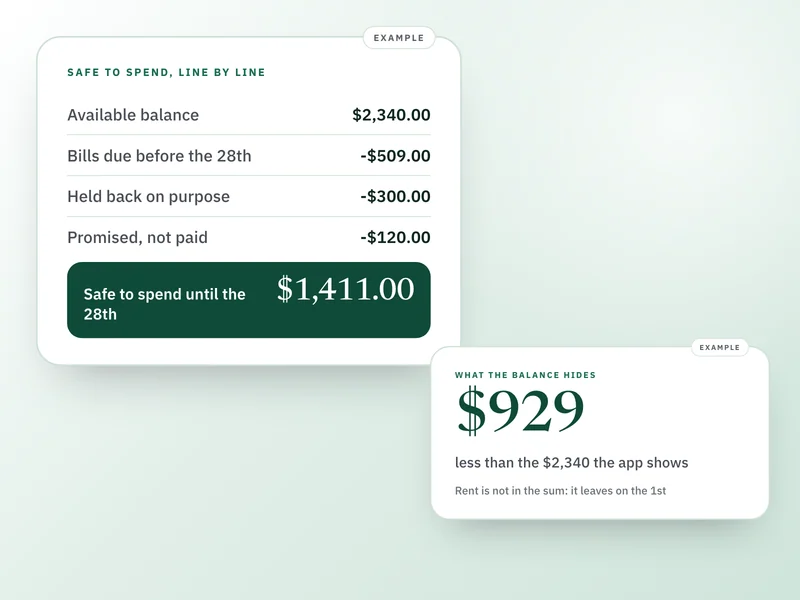 If this is where you areHow much money is safe to spend after your bills?See the full five step method behind this quick check, with a worked example and the negative number case.
- Available vs current balance: which one can you spend?
If the balance in your app looks higher than the money you have, learn the difference between posted and available.
- Sinking funds explained: save for costs you can see coming
Annual and quarterly bills skew a purchase check, and a sinking fund is how you save for them in advance.
- How to find $200 this month without a big life change
Decided you cannot afford it yet? These small moves free up cash within a single month.